Pot-au-Feu: The Boiled Beef of the French Table
Three cuts, a charred onion, and a broth clear enough to read through
Contents
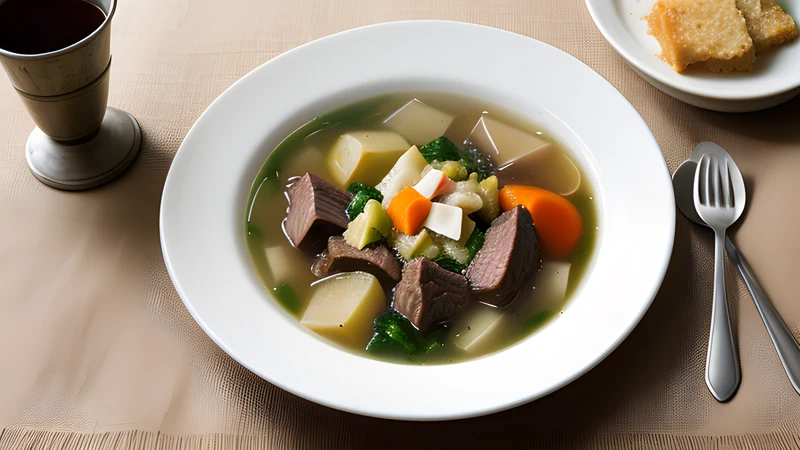
↓ Jump to recipePot-au-feu is the dish French people name when you ask what French food actually is. They mean the thing that was on the table at home, which has very little to do with the restaurant repertoire. A pot of water, some cheap beef, whatever roots were in the cellar, and a fire that was already lit for other reasons. The name is literal: pot on the fire.
Pot-au-Feu: The Boiled Beef of the French Table
Ingredients
- 800g beef shin, in one piece
- 800g beef short rib or flanchet, on the bone
- 600g ox cheek or chuck, in one piece
- 3 marrow bones, about 6cm each
- 2 large onions, unpeeled, halved through the equator
- 4 cloves
- 4 large carrots, peeled and halved lengthways
- 3 leeks, trimmed to the pale green, halved
- 2 turnips, peeled and quartered
- 4 celery sticks, halved
- 500g small waxy potatoes, peeled
- 1 head of garlic, halved through the equator
- 1 bouquet garni: 4 parsley stalks, 3 thyme sprigs, 2 bay leaves, tied
- 1 tbsp black peppercorns
- 20g fine salt, plus more to finish
- To serve: coarse sea salt, Dijon mustard, cornichons, grated horseradish, toasted baguette
Method
- Soak the marrow bones in cold salted water in the fridge for 12 hours, changing the water twice, to draw out the blood. Drain.
- Tie the shin and the cheek into neat cylinders with butcher's string so they hold their shape and slice cleanly later. Leave the short rib whole.
- Char the onions. Put a dry heavy frying pan over a high heat and sit the onion halves cut-side down, unpeeled, for 6 to 8 minutes without moving them, until the cut faces are properly black. Stud two halves with the cloves.
- Put the shin, short rib and cheek in a large stockpot and cover with 5 litres of cold water. Bring very slowly to a bare simmer over medium-low heat, which should take about 40 minutes. Do not let it boil.
- Skim. As the water heats, grey foam will rise; lift it off with a ladle every few minutes until it stops appearing and the surface runs clear, about 20 minutes of attention. This is the single step that decides whether your broth is clear.
- Add the charred onions, garlic, bouquet garni, peppercorns and the 20g of salt. Keep the pot at a bare simmer, with a bubble breaking every second or two, uncovered, for 3 hours. Top up with boiling water if the meat is ever exposed.
- Add the marrow bones, standing them upright, and simmer 20 minutes until the marrow is soft and translucent. Lift them out and keep warm.
- Add the carrots, turnips and celery and simmer 25 minutes. Add the leeks and potatoes and simmer a further 20 minutes, until everything is tender to a knife tip.
- Test the meat: a skewer should slide in and out of all three cuts with almost no resistance. If not, lift the vegetables out and keep going. Then lift the meat out, remove the string, and rest it on a warm platter under foil.
- Strain the broth through a muslin-lined sieve into a clean pan. Let it settle for 5 minutes, then skim the fat from the surface with a ladle or blot it with kitchen paper. Taste and add salt until it tastes of beef rather than of water; it will need more than you expect.
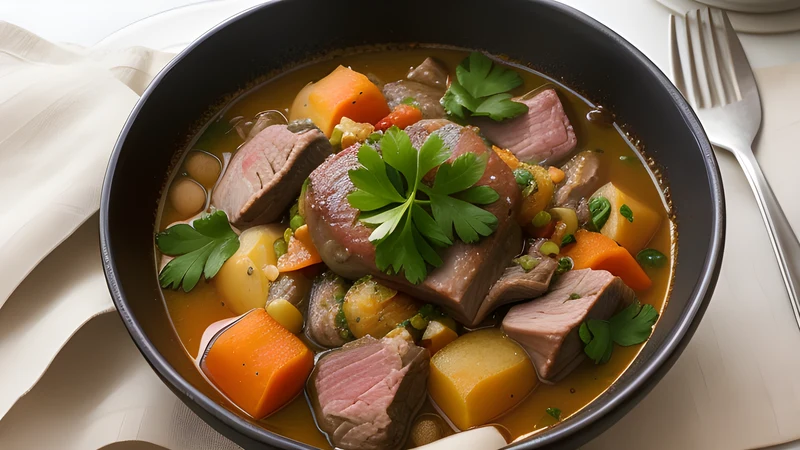
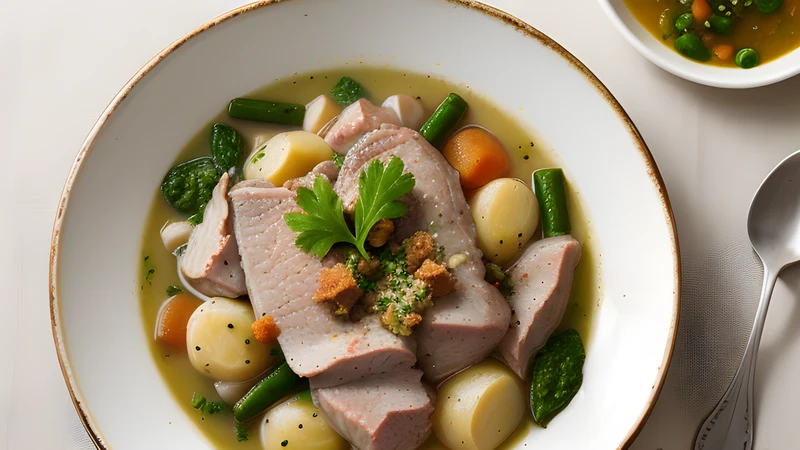
- Serve in two courses. First the broth alone in warm bowls, with the marrow scooped onto toasted baguette, sprinkled with coarse salt. Then the meat, sliced thickly across the grain, with the vegetables, mustard, cornichons and horseradish.
The pot that never went out
The historical claim you will read is that French farmhouses kept a pot permanently over the hearth, adding meat and water as they went, so that the same broth ran for months or years. That is mostly romance, but the kernel is real: the hearth fire burned continuously because relighting it was work, and a pot hanging in it cost nothing to run. Pot-au-feu is what you make when heat is free and meat is expensive.
That economy shaped everything about the dish. The cuts are the ones nobody wanted — shin, cheek, short rib, the collagen-heavy muscles that a roast would ruin. The vegetables are storage vegetables. And crucially, the dish yields two courses from one pot, which is why it fed a family: the broth is the first course, the meat and vegetables the second. In some regions the broth was served over stale bread, which is where a great many European soups come from.
Grimod de La Reynière, writing in the early 1800s, called it the foundation of French domestic cooking, and by the middle of that century it had been formalised enough that Escoffier felt the need to complain about how variable it was. It has been the national dish more or less by consensus ever since. Every region tweaks it: oxtail in the south-west, a stuffed chicken in Béarn, sausages in Alsace.
The point of it has never changed, though. Pot-au-feu is a technique for turning tough meat and water into something clear, deep and restorative, and the technique is almost entirely about temperature.
The charred onion
My addition is a proper char on the onions. Halved through the equator, skins left on, pressed cut-side down onto a dry, ripping-hot pan until the faces are genuinely black, well past golden, before they go into the pot.
This is borrowed from pho, and it does two things. The blackened sugars and the papery skins leach colour, so the broth comes out amber instead of the pale grey-beige that honest pot-au-feu otherwise is. And the char contributes bitter, roasted pyrazines that give the broth a bottom note it cannot otherwise have, because nothing else in the pot ever goes above 100C. Boiled food tastes boiled. One charred onion is the cheapest way to put a roasted flavour into a dish that has no browning step in it at all.
Leave the skins on. They are where most of the colour is, and they strain out at the end.
The three cuts, and why three
One cut makes a decent stew. Three make a pot-au-feu, and the reason is that each one is doing a different job.
Shin is the gelatine engine. It is a hard-working muscle wrapped in connective tissue, and four hours converts that collagen into gelatine, which is what gives the broth body — the faint stickiness on the lips that separates broth from flavoured water. A pot-au-feu without shin or a similar cut tastes thin no matter how long you run it.
Short rib on the bone is the flavour. Bone marrow and the fat around the ribs carry most of the beefiness, and the bone itself contributes more gelatine. Buy it in a piece with the bone in; boneless short rib is a lesser thing here.
Cheek or chuck is the eating. Ox cheek in particular cooks to a texture nothing else matches — dense, silky, slightly resistant — and it is the piece people will go back for on the platter. It is also, still, one of the cheapest things at the counter.
Tie the shin and the cheek. Butcher’s string around a loose piece of long-cooked meat is the difference between slices and debris, and it costs a minute. Leave the rib alone; the bone holds it together.
Why it must never boil
This is the whole recipe, and everything else is shopping.
Water at a bare simmer — 85 to 95C, a bubble breaking every second or two — cooks the meat gently and lets fat rise to the surface where you can remove it. Water at a rolling boil does something different: the turbulence smashes the fat droplets and the coagulated proteins into the liquid and emulsifies them. That is what makes broth cloudy, and once it has happened there is no reversing it. You can strain a boiled broth through muslin all day and it will stay murky.
Boiling also wrecks the meat. Collagen converts to gelatine happily at 80C given time; the muscle fibres around it squeeze out their water and go stringy above about 95C. A bare simmer for four hours gives you meat that is silky. A boil for two gives you rags in a cloudy soup.
So: start in cold water, bring it up over a good forty minutes, and once it is there, keep it there. If your smallest gas ring is still too fierce, sit the pot half off the flame — the convection will still circulate — or slide it into a 140C oven, which holds the temperature for you and is what I do when I want the afternoon back.
Skimming
The grey scum that surfaces in the first twenty minutes is denatured albumin, and it tastes of nothing. Left in, it breaks up and clouds the broth. Lift it off with a shallow ladle every few minutes until the surface stops producing it.
Two habits help. Start from cold water, because a slow rise gives the proteins time to coagulate into rafts you can lift, rather than dispersing them instantly as hot water does. And do not stir. Stirring in the first hour undoes the skimming.
Salting early, at the start of the long simmer, is deliberate. It seasons the meat all the way through over four hours, which no amount of salt added at the end will do.
Two courses, one pot
Serve the broth first, on its own, hot, in warm bowls, with the marrow on toast. It looks austere and it is the best part. Then the platter: the meat sliced thick across the grain, the vegetables arranged around it, and the condiments — Dijon, cornichons, coarse salt, horseradish — which are the acid and heat that a boiled dinner needs to come alive. Skipping the condiments is how people conclude they do not like pot-au-feu.
Slice across the grain and slice thickly. Thin slices of long-cooked shin fall apart on the board.
The broth is the point
Strain it through muslin and let it settle. What you are after is a liquid you can see the bottom of the bowl through, amber from the charred onion, with enough gelatine that it sets to a soft jelly in the fridge. That jelly is the proof: if the cold broth wobbles, you got the temperature right and the shin did its work.
Degrease properly. A ladle skims most of it; a sheet of kitchen paper laid on the surface and lifted off takes the film. A greasy first course is unpleasant in a way that no amount of seasoning covers, and the fat you lift off is dripping — keep it, and roast potatoes in it.
Marrow, and the soak
Soaking the bones for twelve hours in cold salted water draws out residual blood, which otherwise cooks grey and tastes metallic. Change the water twice. The marrow then poaches to a soft, translucent, custardy state in twenty minutes, and is scooped straight onto toast with coarse salt. Add the bones near the end; an hour in the pot and the marrow simply melts into the broth.
The vegetables go in late
The instinct is to put everything in at once and walk away, and it produces four hours of grey mush. Vegetables need 20 to 45 minutes; the meat needs four hours. Staging them is the difference between a platter and a landslide.
Order matters within the vegetables too. Carrots, turnips and celery are dense and go in first. Leeks and potatoes are soft and go in last — leeks in particular collapse into threads after half an hour, and potatoes past their point shed starch into the broth and cloud the very thing you spent the afternoon keeping clear. If you are worried about the potatoes, cook them separately in a ladleful of the broth and you keep both.
Cut everything large. Halved carrots, quartered turnips, whole small potatoes. Small pieces disintegrate, and the platter wants vegetables that look like vegetables.
The aromatics — bouquet garni, peppercorns, garlic, cloves — go in after the skimming is finished, at the start of the long simmer. Putting them in from cold means fishing herb stalks out of the scum for twenty minutes.
Timing, leftovers and the day after
Made a day ahead, pot-au-feu improves. Cool the meat in some of the broth so it does not dry out, refrigerate everything separately, and the fat sets into a disc on the broth that lifts off in one piece — a far cleaner job than skimming hot. Reheat the meat gently in the broth.
The leftovers have their own name. Cold boiled beef, diced, fried in butter with onion and topped with a fried egg, is bœuf miroton territory; shredded into the broth with fresh vegetables it becomes lunch. Any leftover broth is the best base you will ever have for French onion soup, and it freezes for three months.
Bring the flavour up at the end with salt in stages, tasting between each. Under-salted broth is the most common complaint about this dish and the easiest thing in the world to fix.
For the neighbouring dishes: tafelspitz is Vienna’s answer to exactly the same problem and uses the same gentle-simmer logic, while beef bourguignon takes the same cuts in the opposite direction, browning them hard and drowning them in wine. Garbure is the south-western cousin that never bothered separating the courses at all.
Related Content