Pork Vindaloo: Goan Vinegar and Garlic Curry
The Portuguese wine-and-garlic marinade, rebuilt in Goa with palm vinegar and dried red chillies
Contents
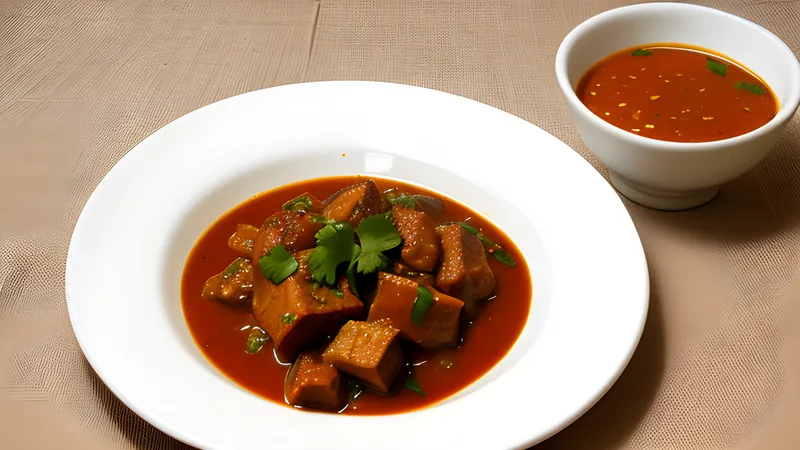
↓ Jump to recipePork vindaloo has a branding problem in Britain, where it has spent decades as curry-house shorthand for the hottest thing on the menu, ordered on a dare and eaten as a test of nerve rather than a dish anyone actually claims to enjoy for its flavour. The real Goan dish it was named for is something else entirely: sharp with vinegar, thick with garlic, warmly spiced with cinnamon and clove, and only as hot as the cook chooses to make it — heat is one ingredient among several rather than the entire point.
The name itself gives the game away. Vindaloo is an Indian rendering of the Portuguese carne de vinha d’alhos — meat in wine and garlic — a preserved-meat dish Portuguese sailors and settlers brought to Goa from the sixteenth century onward, using wine and garlic as a preservative marinade for pork on long sea voyages. In Goa, where wine was neither local nor easily kept, Konkani cooks substituted palm vinegar or toddy vinegar, made from fermented coconut palm sap, and added the region’s own dried red chillies, giving the dish its now-signature colour and heat while keeping the Portuguese backbone of vinegar and garlic intact.
Pork Vindaloo: Goan Vinegar and Garlic Curry
Ingredients
- 900 g pork shoulder, cut into 4 cm pieces, with some fat
- 12 dried Kashmiri chillies, deseeded and soaked in warm water for 20 minutes
- 8 garlic cloves
- 3 cm piece fresh ginger, chopped
- 1 tsp cumin seeds
- 1 tsp black peppercorns
- 1 tsp black mustard seeds
- 6 cloves
- 5 cm cinnamon stick
- 1 tsp ground turmeric
- 120 ml palm vinegar or malt vinegar
- 2 tbsp jaggery or dark brown sugar
- 2 tsp fine salt, plus more to taste
- 3 tbsp vegetable oil
- 2 large onions, finely sliced
- 300 ml water, plus more as needed
Method
- Drain the soaked chillies and blend with the garlic, ginger, cumin, peppercorns, mustard seeds, cloves, cinnamon, turmeric and vinegar to a smooth, thick paste, adding a splash of water if needed.
- Toss the pork with the paste, jaggery and salt in a non-reactive bowl. Cover and marinate in the fridge for at least 4 hours, or overnight.
- Heat the oil in a heavy pot and fry the onions over a medium heat for 12-15 minutes until deeply golden.
- Add the marinated pork with all its paste and cook over a high heat for 5-6 minutes, stirring, until the meat is sealed on all sides.
- Add 300 ml water, bring to a simmer, then cover and cook over a low heat for 55-60 minutes, stirring occasionally, until the pork is tender and the sauce has thickened and darkened.
- Uncover for the final 10 minutes if the sauce needs reducing further. Taste and adjust salt and vinegar before serving.
Marination is the technique, not a formality
Vindaloo’s marinade is doing genuine preservative and flavour work, not just seasoning the surface of the meat before cooking, and this is the detail most quick versions skip past. A full four hours, and ideally overnight, gives the vinegar time to actually penetrate the pork rather than sit on top of it, tenderising the meat’s connective tissue slightly while the garlic, ginger and chilli paste works its way into the fibres. A pork vindaloo marinated for twenty minutes and cooked the same evening will taste like a red curry with a splash of vinegar stirred in; the same dish marinated overnight tastes fundamentally different, the sourness woven all the way through the meat rather than sitting as a separate top note.
Use a non-reactive bowl — glass or ceramic, not bare aluminium — since the vinegar will react with reactive metals over a long marination and pick up a faint metallic taste. Cover it properly and keep it in the fridge rather than at room temperature; the acidity slows bacterial growth considerably but this is still raw pork sitting in liquid for the better part of a day, and refrigeration is not optional.
The paste, and why cinnamon and clove belong in a “hot” curry
The spice paste is built from two distinct groups that most curry-house versions collapse into indistinguishable heat: the chilli-and-vinegar group that gives colour and sourness, and the warm baking-spice group — cinnamon, clove, cumin, black pepper — that gives the dish its depth and stops it reading as one-dimensional fire. This warm-spice backbone is the clearest surviving trace of the dish’s Portuguese ancestry, since cinnamon and clove both arrived in Goan cooking through the Portuguese spice trade rather than through inland Indian tradition, and they mark vindaloo out from purely indigenous Goan curries built more around coconut, kokum and curry leaf.
Kashmiri chillies are worth insisting on over a hotter, more generic dried chilli, because they give the characteristic deep red colour without overwhelming heat, letting you control the dish’s actual spiciness with a separate, hotter chilli added to taste rather than relying on the base paste to do double duty as both colourant and heat source. If you want a genuinely fiery version, add a couple of hotter dried chillies or fresh bird’s-eye chillies at the frying stage rather than loading the base paste with them, which keeps the balance of the other spices intact.
Cooking down to the right consistency
Vindaloo should reduce to a thick, clinging sauce rather than a thin, soupy one, and this happens through patient reduction rather than a thickener of any kind. Browning the onions properly before the pork goes in builds the base the sauce needs; searing the marinated pork hard for several minutes before adding any water develops a genuine crust on the meat that the subsequent slow simmer then works loose into the sauce, deepening its colour and body considerably beyond what the raw paste alone provides.
The dish is traditionally, and noticeably, better the day after cooking, once the sauce has had time to further concentrate and the vinegar has mellowed slightly against the meat’s fat — many Goan households make vindaloo specifically a day ahead for this reason, treating it more like a stew that rewards a rest than a curry meant to be eaten within the hour it is cooked.
How the curry house version drifted so far
The vindaloo most British diners know developed inside the UK’s own curry-house tradition rather than in Goa, where waves of Bangladeshi and Punjabi-run restaurants from the 1960s onward inherited the name but built a house style meant to fit a fixed heat-scale menu, positioned above a korma and madras and below only a phall. Over decades of that arrangement, the dish drifted toward pure chilli-forward heat, often built from a shared base gravy rather than a separate marinated preparation, with extra chilli powder or fresh chillies stirred in to push it up the scale rather than the vinegar-and-spice complexity that defines the Goan original.
None of this makes the curry-house version wrong exactly — it is its own dish, with its own decades of history and its own place in British food culture, and there is no reason to be sniffy about a plate ordered as a test of nerve on a Friday night. But it is a genuinely different dish from the one Goan households cook, in the same way a curry-house chicken tikka masala and a home-cooked Punjabi butter chicken share a name-adjacent lineage without being interchangeable. Cooking the version here, with its overnight marinade and its cinnamon-and-clove backbone, is worth doing at least once specifically to taste what the name originally described, heat included but not centred.
Potatoes, a later addition
Some vindaloo recipes, particularly outside Goa, include potatoes cooked directly in the sauce, and the combination is common enough that a few cookbooks list it as traditional. Historically, though, the potato is a later addition rather than part of the original Portuguese-Goan dish, likely folded in as the recipe spread further across India and needed to stretch further and feed more people from the same amount of meat. If you want to add them, peel and quarter two medium potatoes and add them along with the water at the simmering stage, giving them the same 55 to 60 minutes the pork needs; this leaves the core method here untouched and stands as a genuine, if secondary, variant rather than an essential component.
What can go wrong
An overly sharp, one-note sour result usually means the vinegar was added in too high a proportion for the amount of time the dish actually cooked, or the sauce was not reduced long enough to let that sharpness mellow into the meat’s fat. Simmer it a little longer, uncovered, if this happens, and taste before adding any more vinegar at the end — many recipes call for a final splash to freshen the dish, but it should be balancing already-mellowed sourness, not correcting for an underdone simmer.
A greasy, oil-heavy sauce comes from pork shoulder with too high a fat content rendering out faster than the sauce can absorb it; skim visible pooled fat from the surface toward the end of cooking rather than trying to stir it back in, since a spoon or two removed makes a noticeable difference to the final texture without sacrificing the richness the fat contributes elsewhere in the dish.
Serving, substitutions and storage
A quick note on the vinegar itself
Palm vinegar, made from fermented toddy (the sap of coconut or palmyra palms), has a rounder, slightly funkier sourness than the sharper, more one-dimensional acidity of malt or distilled white vinegar, and it is worth seeking out from a Goan or wider South Asian grocer if you plan to make this dish more than once. It ferments locally in Goa in small batches and varies noticeably in strength between producers, which is one reason most Goan home cooks taste and adjust the vinegar quantity in a marinade rather than following a fixed measurement — treat the amount given here as a starting point for your particular bottle rather than a fixed target.
Serve vindaloo with plain steamed rice, which does the necessary work of soaking up the sharp, thick sauce without competing with it; a simple cucumber salad or sliced onion in vinegar on the side echoes the dish’s own sourness rather than fighting it. On a Goan table it often sits alongside goan fish curry with kokum and coconut, the two dishes showing the range of the region’s cooking from vinegar-and-Portuguese-spiced to coconut-and-kokum-soured, and a slice of bebinca, Goan layered coconut cake closes the meal the way it traditionally would at a Goan Christmas table.
If palm vinegar is unavailable, malt vinegar or a mix of white wine vinegar and a splash of dark soy for colour is a reasonable substitute, though the flavour will be sharper and less rounded than the real thing. A word on the cut of pork, too: shoulder, sometimes sold as blade or in the UK as “pork shoulder steaks” cut into pieces yourself, is the right choice over leaner loin or tenderloin, since the marinade’s acidity and the long simmer both need the connective tissue and fat that a fattier cut provides to break down properly; a leaner cut will cook faster but turn dry and stringy well before the sauce has had time to develop.
Vindaloo keeps for up to four days in the fridge, improving over the first two, and freezes well for up to three months; thaw fully before reheating gently on the stove, since the sauce can split slightly if brought back from frozen over too high a heat. Thaw it overnight in the fridge rather than at room temperature, then reheat slowly with the lid on for the first few minutes to bring the sauce back gently before finishing uncovered to adjust the consistency.
Related Content