Popiah: The Fresh Spring Roll With Stewed Turnip
A thin wheat wrapper, hours of stewed jicama, and a table full of things to pile on top
Contents
↓ Jump to recipePopiah: The Fresh Spring Roll With Stewed Turnip
Ingredients
- 8 fresh popiah wrappers (or large spring roll skins), room temperature
- 600g jicama (bang kuang) or turnip, peeled and julienned
- 150g carrot, julienned
- 200g pork belly, finely diced (optional)
- 150g raw prawns, peeled and diced
- 2 tbsp vegetable oil
- 4 cloves garlic, minced
- 500ml chicken or pork stock
- 2 tbsp light soy sauce
- 1 tsp sugar
- 1/2 tsp white pepper
- 3 eggs, beaten and made into a thin omelette, then sliced
- 150g firm tofu, fried and diced
- 100g cooked prawns, whole, for topping
- 2 lettuce leaves per roll, or shredded lettuce
- sweet dark soy sauce (tim cheong), for spreading
- chilli sauce or sambal, for spreading
- 3 cloves garlic, fried until golden and crushed, for topping
- 2 tbsp fried shallots, for topping
- 2 spring onions, finely sliced, for topping
Method
- Heat the oil in a wok and fry the minced garlic until fragrant. Add the pork belly, if using, and cook until it renders some fat.
- Add the diced prawns and cook for 2 minutes, then add the jicama and carrot. Stir-fry for 3 minutes.
- Pour in the stock, soy sauce and sugar. Bring to a simmer, cover, and cook on low heat for 1 to 1.5 hours, stirring occasionally, until the turnip is very soft and most of the liquid has been absorbed or reduced to a thick, sticky coating.
- Season with white pepper and adjust salt to taste. The filling should hold together loosely on a spoon, not swim in liquid. Cool to room temperature before wrapping.
- Lay a wrapper flat. Spread a thin layer of sweet dark soy sauce down the centre, then a thin smear of chilli sauce, to taste.
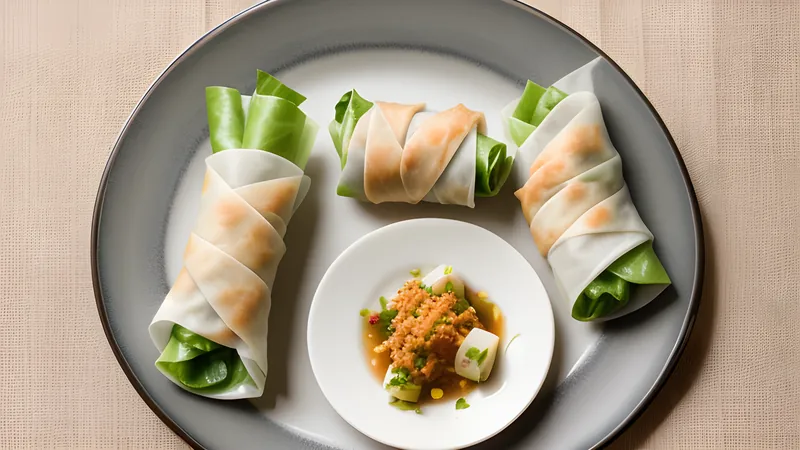
- Add a lettuce leaf, then a spoonful of the stewed turnip filling, a few strips of omelette, some diced tofu, a whole cooked prawn or two, and a scattering of fried garlic, fried shallots and spring onion.
- Fold the bottom edge over the filling, fold in both sides, then roll up tightly into a cylinder. Trim the excess wrapper if it overhangs. Serve immediately, halved on the diagonal.
Not a fried thing at all
Popiah gets grouped with spring rolls in most people’s minds, which sets up the wrong expectation the moment it lands on the table — because a proper popiah is never fried. It’s a thin, slightly elastic wheat-flour wrapper, closer to a crêpe than a pastry, rolled fresh around a filling that’s already fully cooked. The result eats cool and soft, closer in texture to a fresh summer roll than to a crackling lumpia, and it’s meant to be assembled at the last possible moment, at the table, by the person eating it.
The name comes from Hokkien — poh (thin) and piah (wrapper) — and the dish traces back to Fujian province in southern China, where it’s still eaten during Qingming, the tomb-sweeping festival, and at other family gatherings. Hokkien migrants carried it to Southeast Asia in the nineteenth century, and it took root distinctly in Penang, Singapore and Indonesia’s Medan, each developing its own filling logic while keeping the same unfried wrapper and the same idea: a communal spread of components that everyone assembles themselves.
The turnip is the whole point
Ask any popiah cook what makes their version good and the answer is almost always the same word: the bang kuang, jicama, sometimes swapped for a regular turnip in places where jicama isn’t sold fresh. It’s stewed — not stir-fried quickly, properly stewed, for an hour or more — until it collapses from crunchy to silky, releasing its own liquid into the pot along with the stock, until what’s left is a thick, faintly sweet, deeply savoury mass that clings together on a spoon. Rush this step and you get watery, half-crunchy turnip that soaks straight through the wrapper within minutes; the long stew is what turns a vegetable side dish into a filling substantial enough to build a meal around.
The braise picks up flavour from pork belly and prawns cooked in first, then the vegetables go in, then stock, and then it’s just time and a low flame doing the work. The finished filling should look almost jam-like, glossy and cohesive, no separate puddle of liquid pooling at the bottom of the pot. If yours is still soupy after ninety minutes, keep the lid off and let it reduce further rather than adding cornflour or another thickener — reducing naturally concentrates the flavour instead of diluting it with starch.
Assembling at the table
A popiah spread in most Singaporean and Penang homes is laid out like a build-your-own station: the stack of wrappers under a damp cloth to keep them pliable, the bowl of stewed turnip, sliced omelette, diced fried tofu, whole prawns, lettuce, and the array of condiments and toppings — sweet dark soy, chilli sauce, crushed fried garlic, fried shallots, chopped spring onion — set out in small dishes so each diner builds their own roll to their own taste. This isn’t a shortcut; it’s the actual tradition, going back to the shared family gatherings the dish grew out of, where the assembly itself is part of the occasion rather than kitchen prep done in advance.
The order of layering matters more than it looks like it should. Sweet soy and chilli go directly onto the wrapper first, thin enough not to soak through, so every bite that follows carries a little of both. Lettuce goes down next as a moisture barrier between the sauces and the warm-ish filling, keeping the wrapper from turning soggy in the minute or two before it’s eaten. The turnip filling sits on top of that, followed by the garnishes, and the whole thing gets rolled tight enough to hold its shape but not so tight that the wrapper splits.
Fresh wrappers versus store-bought
Fresh popiah wrappers, sold in stacks at wet markets across Singapore and Malaysia, are made by dabbing a ball of very wet, elastic dough onto a hot dry griddle and lifting it almost instantly, leaving behind a wrapper so thin it’s translucent. Very few home cooks outside the region attempt this — it takes real practice to get the dough hydration right — so large spring roll skins from an Asian grocer, the fresh (not frozen, not the crisp fried type) kind sold for making unfried rolls, are the sensible substitute. Look for ones labelled specifically for popiah or lumpia wrapping rather than the frozen pastry-style skins meant for deep-frying, which are a different product entirely and won’t roll the same way.
Keep the wrappers covered with a slightly damp tea towel while you work, since they dry out and crack within minutes of sitting exposed to air. If a wrapper does dry out and tear, a light brush of water on the surface will make it pliable enough to use again, though it won’t roll quite as smoothly as a fresh one.
Variations across the region
Penang popiah tends to be sweeter, with a more generous hand on the tim cheong and sometimes a bit of grated fresh pineapple folded through for brightness against the savoury turnip. Singaporean versions lean more savoury and often add a spoonful of sambal belacan rather than a plain chilli sauce, giving the whole roll a sharper, funkier back note. Indonesian versions from Medan and elsewhere sometimes include bean sprouts for extra crunch and can skip the pork entirely in favour of a fully seafood-and-vegetable filling, which also makes for an easy way to adapt the dish for anyone not eating pork.
Vegetarian popiah is straightforward: drop the pork and prawns from the braise, use vegetable stock, and lean a little harder on garlic and white pepper to keep the filling from tasting thin. The turnip and carrot carry enough natural sweetness on their own that the dish doesn’t suffer for losing the meat, though it will taste noticeably different from the version made with rendered pork fat.
Make-ahead and storage
The stewed turnip filling keeps for up to four days refrigerated and, if anything, tastes better on day two once the flavours have had time to settle. It also freezes well for up to a month — thaw it fully and reheat gently in a pan before using, since the texture turns slightly grainy if microwaved from frozen. Do not fill and roll the wrappers ahead of time, though; assembled popiah goes soggy and the wrapper turns gummy within an hour, which is exactly why the dish is traditionally built to order rather than prepped in batches.
Leftover garnishes — fried garlic, fried shallots, sliced omelette — all keep well in separate containers for several days, so it’s worth making a full batch of each even if you’re not planning to eat the whole thing in one sitting.
If you’re building a wider spread of Hokkien and Teochew coffee-shop dishes, popiah pairs naturally with chai tow kway for a shared table of turnip-based dishes cooked two very different ways, and with a bowl of bak kut teh if you want something warm alongside the cool, fresh roll. For a fried alternative from the same broad family of wrapped fillings, lumpia shanghai makes a useful contrast on the same table.
Where the dish sits in family life
Popiah shows up most reliably around Qingming in Chinese families that still observe it, and around Chinese New Year and other gatherings in Peranakan and Hokkien households across Singapore and Malaysia more broadly, precisely because it scales so easily and turns cooking into a shared activity rather than one person’s job. Someone stews the turnip the day before, someone else fries the shallots and garlic, someone slices the omelette, and by the time everyone sits down the actual work of eating is just as communal as the work of cooking was. It’s one of the few dishes in the region where the labour of preparation and the ritual of eating are genuinely the same activity, stretched across a table rather than confined to a kitchen.
That communal structure also explains why recipes for the filling vary so much from household to household while the format stays fixed. Ask five Singaporean home cooks how they make their turnip filling and you’ll get five slightly different answers — more or less pork, a handful of dried shrimp added for depth, French beans instead of carrot, a spoonful of bean paste stirred through near the end — but every single one will insist on the same long, patient stew, and every one will still lay the wrappers out on the table for guests to fill themselves.
Getting the wrapping technique right
The most common mistake home cooks make on their first attempt is overfilling, cramming in as much turnip and garnish as the wrapper will physically hold. A popiah wrapper is thin and forgiving up to a point, but pack it too full and it splits the moment you try to fold the sides in, spilling filling across the plate before you’ve even finished rolling. A modest, tightly packed line of filling down the centre — no wider than three fingers — rolls far more reliably than a generous mound, and the roll ends up easier to eat in two or three bites rather than falling apart on the first.
Rolling direction also matters more than it seems. Fold the bottom edge up and over the filling first, tucking it snugly rather than loosely, before folding in the two sides. Only then roll forward into the final cylinder. Rolling the sides in before the bottom, or trying to roll the whole thing diagonally from one corner, tends to leave gaps where the filling can push through and tear the wrapper. Once you’ve rolled two or three, the sequence becomes automatic, but the first attempt is worth doing slowly and deliberately rather than rushing to keep pace with a table of hungry guests.
A note on dried shrimp and other depth-builders
Many family recipes fold a tablespoon or two of finely chopped dried shrimp into the braise alongside the pork, soaked briefly in warm water first to soften and rinse off excess salt. It adds a savoury, faintly funky depth that plain pork and prawn don’t quite reach on their own, and it’s worth trying once you’ve made the base version and have a feel for how the seasoning balances. Add it early, with the garlic, so it has time to properly infuse the oil before the vegetables go in, rather than stirring it in at the end, where it stays gritty and doesn’t integrate into the sauce the same way.
Related Content