Pollo a la Brasa: Lima's Rotisserie Chicken
The charcoal-turned chicken that outsells every other meal in Peru, built on a beer-based marinade
Contents
↓ Jump to recipePollo a la brasa, chicken spit-roasted over charcoal, is Peru’s most-eaten dish by a wide margin, outselling ceviche and ranking as the country’s single most popular meal in national surveys, sold from dedicated pollerias that exist purely to turn out charcoal-roasted birds by the hundred, seven days a week, in a country that otherwise takes tremendous pride in a far more elaborate culinary tradition. Its dominance is recent by food-history standards, dating only to the 1950s, and the story behind it is unusually well documented for a dish this ubiquitous.
Pollo a la Brasa: Lima's Rotisserie Chicken
Ingredients
- 1.8kg whole chicken, spatchcocked (backbone removed, pressed flat)
- 6 garlic cloves
- 1 tbsp fresh ginger, roughly chopped
- 200ml dark beer or stout
- 3 tbsp soy sauce
- 2 tbsp red wine vinegar
- 2 tbsp vegetable oil
- 1 tbsp aji panca paste (or 1 tsp smoked paprika plus 1 tsp mild chilli flakes)
- 1 tbsp ground cumin
- 1 tsp dried oregano
- 1 tsp fine salt, plus more to season
- 1/2 tsp ground black pepper
- 2 tbsp mayonnaise
- 2 tbsp fresh coriander, chopped, for the green sauce
- 1 jalapeno or 1/2 yellow aji amarillo chilli, chopped, for the green sauce
- 1 garlic clove, for the green sauce
- 1 tbsp lime juice, for the green sauce
Method
- Blitz the garlic, ginger, dark beer, soy sauce, vinegar, oil, aji panca paste, cumin, oregano, salt and pepper together in a blender until smooth. This is the marinade.
- Place the spatchcocked chicken in a large dish or resealable bag and pour over the marinade, working it under the skin where possible. Cover or seal and marinate in the fridge for at least 6 hours, ideally overnight.
- Remove the chicken from the fridge 30 minutes before cooking to take the chill off. Heat the oven to 200C (180C fan, gas mark 6), or prepare a barbecue for indirect heat with a drip tray beneath where the chicken will sit.
- Pat the chicken mostly dry, reserving the marinade left in the dish, and place it skin-side up on a rack set over a roasting tray.
- Roast for 55-70 minutes, basting with the reserved marinade every 15-20 minutes, until the skin is deep mahogany and the internal temperature at the thickest part of the thigh reaches 74C. If using a barbecue, cook over indirect heat with the lid closed, rotating occasionally, for a similar time.
- If the skin isn't dark enough once the chicken is cooked through, finish under a hot grill (broiler) for 3-4 minutes, watching closely, to deepen the colour.
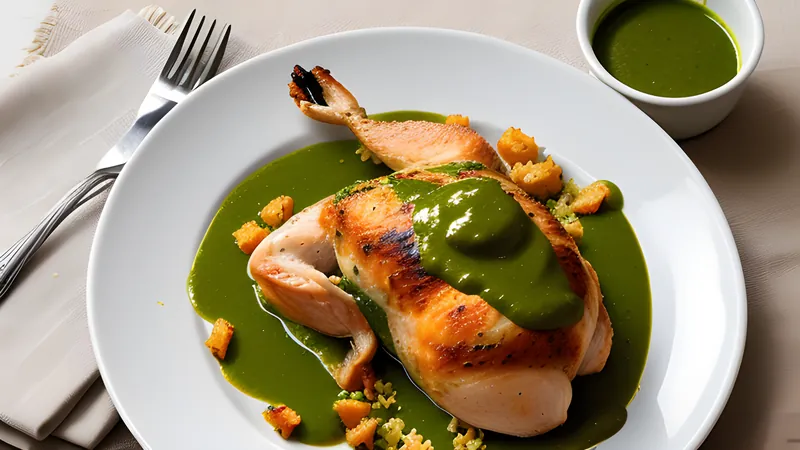
- Meanwhile, make the green sauce: blitz the mayonnaise, coriander, chilli, garlic and lime juice together with a pinch of salt until smooth and vividly green. Thin with a teaspoon of water if too thick to drizzle.
- Rest the chicken for 10 minutes before carving. Serve with the green sauce, fries and a simple salad.
An accidental national dish
Pollo a la brasa’s invention is credited to Roger Schuler, a Swiss expatriate, and his business partner Franco Ossio, who opened La Granja Azul, a restaurant on the outskirts of Lima, in 1950, building a large custom rotisserie designed to turn multiple whole chickens simultaneously over charcoal heat, basted as they cooked and finished with a specific marinade. The restaurant’s chicken became wildly popular through the following decade, and rather than guard the recipe as proprietary, Schuler licensed the rotisserie design and technique out to other operators across Lima and eventually the rest of the country, an unusually generous business decision that let the dish spread nationwide within a couple of decades rather than staying confined to one restaurant’s reputation.
By the late twentieth century, pollerias, restaurants built specifically around pollo a la brasa and its usual accompaniments of fries and salad, had become one of the most common restaurant categories anywhere in Peru, and the dish had achieved a status few countries grant any single meal: genuinely eaten across every social class, from workaday family dinners to celebratory gatherings, without the class associations that attach to many national dishes elsewhere. Peru now marks a national Pollo a la Brasa Day each June, an official recognition of quite how central the dish has become to Peruvian identity in barely seventy years. La Granja Azul itself is still operating today, decades after Schuler’s original rotisserie first turned, and the dish’s spread abroad has followed Peruvian emigration closely: pollerias are now a familiar sight in cities with large Peruvian communities, Miami, Paterson in New Jersey, and parts of Madrid and Milan among them, run largely by Peruvian families who brought the specific rotisserie technique and marinade recipe with them rather than adapting it for local tastes. That fidelity to the original method, right down to the charcoal rather than gas heat many pollerias still insist on, is unusual for a diaspora food; plenty of national dishes drift and simplify once they travel, but pollo a la brasa abroad tends to stay remarkably close to what’s served in Lima, charcoal smoke and all.
Ceviche gets more international attention as Peru’s culinary calling card, and dishes like papa rellena carry more street-food romance, but pollo a la brasa is the one Peruvians actually eat most, and it’s worth taking that seriously as a data point about what a national cuisine really looks like day to day, once the tourist-board highlights are set aside: often the simplest, most reliably delicious thing on the menu, cooked the same careful way at thousands of pollerias every single night.
What the marinade is actually doing
The marinade’s specific mix, dark beer, soy sauce, vinegar and aji panca, is doing several distinct jobs rather than simply flavouring the surface of the meat. Dark beer’s slight bitterness and roasted-malt character work similarly to the way stout functions in a braise, adding a savoury depth that plain water or stock can’t replicate, while its mild acidity, alongside the vinegar, begins gently breaking down surface proteins in the chicken skin and flesh, which helps both seasoning and colour develop more effectively during roasting than an unmarinated bird would achieve. Soy sauce contributes glutamates that deepen savoury flavour throughout the meat and, just as importantly for the finished colour, sugars that caramelise under dry heat into the specific dark mahogany the dish is known for, the same basic browning chemistry at work in a Jamaican brown stew, even though the two dishes otherwise share almost nothing in technique or flavour.
Aji panca, Peru’s mild, dark red chilli paste, supplies a fruity, smoky background note without much raw heat, distinct from the sharper, greener sting of aji amarillo used in the accompanying sauce; the two chillies play genuinely different roles in Peruvian cooking and aren’t really interchangeable, aji panca built for slow, mellow depth in marinades and braises, aji amarillo built for bright, upfront heat in sauces and ceviche.
The basting during roasting matters at least as much as the initial marinade. Repeated applications of the reserved marinade every fifteen to twenty minutes keep building layers of glaze on the skin’s surface as the chicken cooks, each application drying slightly and caramelising further before the next goes on, which is how a home oven, without a true rotisserie’s constant, even rotation over live coals, still manages to build up something close to the deep, lacquered colour a proper polleria achieves.
What can go wrong
Pale, underdeveloped skin colour despite a full roasting time is the most common disappointment, and it usually means the basting schedule slipped rather than anything wrong with the marinade itself. Each application of reserved marinade needs to dry and set slightly before the next goes on to build up real layers of glaze; basting too often, or with too much liquid at once, keeps washing the surface wet rather than letting it caramelise, which paradoxically produces a duller result than basting less frequently but more precisely on the fifteen-to-twenty-minute schedule. A chicken that’s dark on the outside but still pink near the bone at the thickest part of the thigh means the oven ran hotter than the skin colour suggested, browning the surface faster than the interior actually cooked; a probe thermometer checking for 74C at the thigh is a far more reliable guide than colour alone, especially with a marinade this dark to begin with. Dry, stringy breast meat alongside perfectly moist thigh meat is a near-universal problem with any whole roasted bird, spatchcocked or not, since the two cuts cook at different rates; positioning the chicken so the thicker thigh meat faces the hottest part of the oven, and pulling the bird the moment the thigh hits temperature rather than waiting for a specific time, protects the breast from overcooking while the thigh catches up. Marinade that never penetrates past the skin, leaving the meat underneath under-seasoned, usually means it wasn’t worked in underneath the skin thoroughly enough at the start; loosening the skin with clean fingers before pouring the marinade over and actually massaging some of it directly against the flesh makes a real, tastable difference by the time the bird comes out of the oven.
The recipe
Serves 4.
Ingredients
- 1.8kg whole chicken, spatchcocked
- 6 garlic cloves
- 1 tbsp fresh ginger, chopped
- 200ml dark beer or stout
- 3 tbsp soy sauce
- 2 tbsp red wine vinegar
- 2 tbsp vegetable oil
- 1 tbsp aji panca paste (or smoked paprika and mild chilli flakes)
- 1 tbsp ground cumin
- 1 tsp dried oregano
- 1 tsp salt, plus more to season
- 1/2 tsp black pepper
- 2 tbsp mayonnaise, for the green sauce
- 2 tbsp fresh coriander, for the green sauce
- 1 jalapeno or aji amarillo, for the green sauce
- 1 garlic clove, for the green sauce
- 1 tbsp lime juice, for the green sauce
Method
- Blend the garlic, ginger, beer, soy, vinegar, oil, aji panca, cumin, oregano, salt and pepper into a marinade.
- Marinate the spatchcocked chicken at least 6 hours, ideally overnight.
- Roast at 200C, basting every 15-20 minutes, for 55-70 minutes until deep mahogany and cooked through (74C internal).
- Finish under a hot grill briefly if more colour is needed.
- Blend mayonnaise, coriander, chilli, garlic and lime juice into a green sauce.
- Rest the chicken 10 minutes, then carve and serve with the green sauce.
Tips, substitutions and storage
A true rotisserie, if available, gives the most even result, since constant rotation bastes the whole bird in its own rendering fat as it turns; an oven with regular manual basting gets remarkably close over a slightly longer cooking time. Aji panca paste is sold in Latin American grocers and increasingly online; the smoked paprika and chilli flake substitute here gets close on colour and mild heat but misses some of aji panca’s specific fruitiness, worth the extra search if pollo a la brasa becomes a regular dish. Leftovers keep three days refrigerated and the green sauce, kept separately, holds for about the same time, though its bright colour dulls slightly after the first day; the sauce doesn’t freeze well due to the mayonnaise base, but the cooked chicken does, for up to two months. Spatchcocking the bird is worth doing even for an oven roast rather than only a barbecue, since it exposes more skin surface to direct heat and lets the whole chicken cook more evenly and quickly than it would trussed and upright; ask a butcher to remove the backbone if doing it at home feels daunting, or use sturdy kitchen shears and cut along either side of the spine, then press down firmly on the breastbone to flatten. Dark beer specifically, a stout or porter rather than a pale lager, contributes the roasted, slightly bitter depth the marinade depends on; a pale beer works in a pinch but gives a noticeably thinner, less complex result. The green sauce, if it splits or looks grainy rather than smooth, usually just needs another minute in the blender with an extra teaspoon of oil to bring it back together.
Serve alongside papa rellena for a genuinely representative Peruvian home spread, or with a simple green salad and thick-cut fries in the classic polleria style, the way it’s eaten across Lima on any given weeknight.
Variations
A spicier version increases the aji amarillo in the green sauce and adds a small amount of aji panca directly into a finishing baste brushed on during the last ten minutes of roasting, for those who want more heat than the base marinade provides. Some home cooks add a splash of pisco to the marinade in place of some of the vinegar, a small nod to Peru’s national spirit that adds a faint aromatic lift without overwhelming the beer and soy underneath. Whatever adjustments go into the marinade, the basting rhythm during roasting is the step that actually delivers the dish’s signature dark, glossy skin, and it’s worth setting a timer for those fifteen-to-twenty-minute intervals rather than trusting memory over an hour of roasting. Chicken pieces rather than a whole spatchcocked bird work for a faster weeknight version, marinated the same way but roasted for closer to 35-40 minutes depending on size, checking each piece individually for the same 74C internal temperature rather than relying on a single timing for the whole batch. A charcoal grill set up for indirect heat, with the coals banked to one side and the chicken sitting away from direct flame, gets closest to a genuine polleria result at home, adding real smoke flavour the oven version can’t replicate, though it demands more attention to keep the fire at a steady, moderate temperature over the full cooking time rather than flaring up and scorching the skin.
Related Content