Pisto Manchego: La Mancha's Unhurried Vegetable Fry
Four vegetables, a lot of olive oil, and no shortcuts
Contents
↓ Jump to recipeThere is a particular sound a pan of pisto makes about fifty minutes in, once the tomato water has gone and the oil has come back out of the mixture. It stops bubbling and starts to tick. That tick is the whole dish. Everything before it is the vegetables giving up their water; everything after it is the vegetables cooking in fat and getting sweet. Most pisto that disappoints has been pulled off the heat before the tick, while the pan is still, technically, boiling.
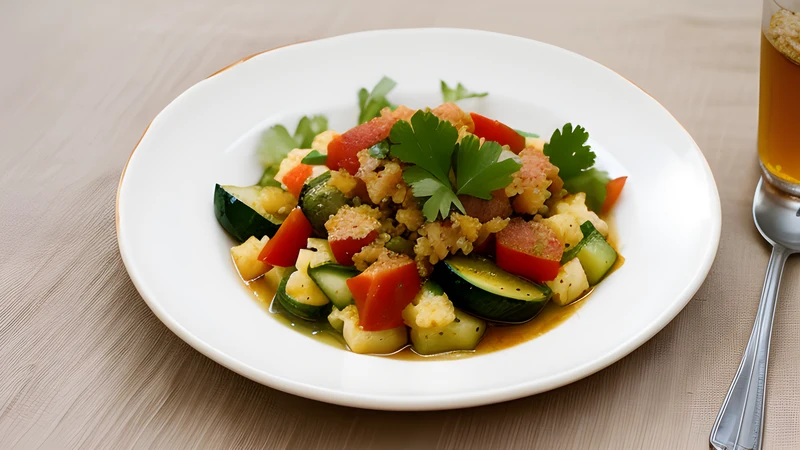
This is Castilla-La Mancha’s contribution to the enormous family of Mediterranean vegetable fries, and it is the plainest member of it. Four vegetables. Olive oil. Salt. No aubergine, no herbs, no wine. The rigour is the appeal.
Pisto Manchego: La Mancha's Unhurried Vegetable Fry
Ingredients
- 150 ml extra virgin olive oil
- 2 large onions (about 400 g), diced 1 cm
- 2 green Italian peppers (about 250 g), diced 1 cm
- 1 red pepper (about 180 g), diced 1 cm
- 3 garlic cloves, sliced thinly
- 600 g courgettes, diced 1.5 cm
- 1 kg ripe tomatoes, skinned and chopped, or 800 g tinned plum tomatoes, crushed by hand
- 1 tsp caster sugar
- 1.5 tsp fine sea salt, plus more to finish
- 1 tsp smoked sweet pimenton (pimenton de la Vera dulce)
- 1 tbsp sherry vinegar
- 4 eggs, to serve
- Crusty bread, to serve
Method
- Warm 100 ml of the olive oil in a wide, heavy pan over a low heat. Add the onions and a pinch of the salt and cook for 20 minutes, stirring every few minutes, until soft, sweet and pale gold with no colour on the edges.
- Add both lots of pepper and cook for a further 15 minutes, until they collapse and lose their raw squeak.
- Add the sliced garlic and cook for 2 minutes, until it smells sweet.
- Meanwhile, heat the remaining 50 ml oil in a separate frying pan over a medium-high heat. Fry the courgette in a single layer, in two batches, for 4 minutes per batch, turning once, until spotted brown but still firm. Set aside on a plate.
- Tip the tomatoes into the onion and pepper pan with the sugar and 1 tsp of the salt. Raise the heat to medium and cook for 25 to 35 minutes, stirring occasionally, until the mixture is thick and a rim of clear orange oil pools at the edge of the pan.
- Return the courgette to the pan and cook for 5 minutes more, just to warm through and let the flavours meet.
- Take the pan off the heat. Wait 1 minute, then stir in the pimenton and the sherry vinegar. Taste and add salt as needed.
- Rest the pisto for 10 minutes off the heat. Fry the eggs in a little olive oil until the whites are set and the edges are lacy, sit one on each portion, and serve with bread.
Pounded juice for invalids
The name is older than the dish, and it originally described something you would not want to eat. Pisto comes from the Latin pistus, the past participle of pinsere, to pound or crush — the same root that gives us pestle. In medieval and early modern Spain, a pisto was a restorative broth pressed out of pounded poultry and fed to the sick and the very old. Sebastián de Covarrubias defines it in that sense in his 1611 dictionary of Castilian, and the meaning survives fossilised in the Spanish idiom dar pisto, roughly to flatter or puff someone up.
How a pressed chicken tonic became a vegetable stew is a genuinely open question, and the honest answer is that nobody has documented the hinge. The likeliest route is the shared idea of crushing: both the tonic and the stew involve reducing something to a soft, spoonable mass. What is clearer is the timing. Pisto as we now eat it could not exist before the tomato and the pepper, and both are American plants that reached Spain in the sixteenth century and then sat around for two hundred years being suspected. Tomatoes appear in Spanish cookbooks as a curiosity in the seventeenth century and only settle in as an everyday ingredient in the eighteenth. The earlier ancestor of pisto was almost certainly onion, garlic and marrow fried in oil — the vegetable fry minus the New World.
La Mancha is a high, dry, windy plateau, the flat brown middle of Spain that Cervantes gave to Don Quixote in 1605 and which has never entirely escaped him. It is saffron country, sheep country, and enormous vineyard country. It is also a place where summer produces courgettes and peppers in volumes that no household could eat fresh, and pisto is one of the answers to that glut. Jars of it were put up for winter. The other answer is the fried egg: a plate of pisto with an egg cracked over it is a complete supper, and it costs almost nothing.
Every Mediterranean farming region worked out a version of this. Provence has ratatouille, which uses aubergine and herbs and traditionally fries each vegetable apart. Sicily has caponata, which pulls the whole thing sweet-sour with vinegar and sugar. The Balkans have ajvar, where the peppers are roasted rather than fried and the result is a relish. Georgia has ajapsandali. Pisto is the version with the shortest ingredient list and the longest cooking time, and I think that trade is deliberate: with nothing to hide behind, the technique carries it.
The order matters more than the knife work
The vegetables go in by how long they need, and by how much they resist. Onions first, on a genuinely low heat, for a full twenty minutes. Keep them pale. Brown onion makes pisto taste like French onion soup; what you want is a collapse into translucency, sweet enough to eat on their own. Peppers next, because they need fifteen minutes to lose the green vegetal squeak that ruins an underdone pisto. Garlic goes in near the end of that stage, where two minutes is enough and five minutes is bitter.
Courgette is the one that breaks the rule, and it gets its own pan. Courgette is roughly 94 per cent water. Add it raw to a wet pan and it poaches, dumps that water into the mixture, and turns to grey mush somewhere in the tomato stage. Fried hard and separately, in a single layer, it gets spotted brown, keeps its structure, and returns at the end as something you can still identify on the fork. It is five extra minutes of washing up and it is the difference between pisto and vegetable slurry.
Tomatoes last, with a teaspoon of sugar. The sugar is insurance against the acidity of tinned tomatoes and against underripe fresh ones, and in a good August with proper fruit you can leave it out. Then you wait for the tick.
The dice size is worth being fussy about, because it is doing structural work. A centimetre for the onion and pepper means they disappear into the base; a centimetre and a half for the courgette means it survives as an object. Cut them all the same size and the pisto goes uniform and dull, with nothing for the teeth to find. Cut them all bigger and the base never coheres into a sauce.
Skinning the tomatoes, and whether to bother
With fresh tomatoes, skin them. Tomato skin does not break down at pisto temperatures — it detaches from the flesh and rolls itself into small red tubes that end up on the fork like bits of tape. Score a cross in the base of each, drop them into boiling water for 30 seconds, then straight into cold water, and the skins slide off with a thumbnail. It takes four minutes for a kilo.
Seeds are a different argument and I fall on the side of leaving them. The jelly around tomato seeds carries a substantial share of the glutamate that makes tomatoes taste savoury, and in a dish cooked this long there is time to drive off the extra water it brings. Deseeding a tomato for pisto throws away flavour to save you six minutes.
Tinned plum tomatoes are a completely honest substitute for nine months of the year, and better than a pale February fresh tomato by a wide margin. Crush them by hand rather than blitzing them: a blender whips air into tomato and turns the pisto a chalky orange-pink instead of a deep brick red. Use the juice in the tin as well. It will cook off.
Blooming the pimenton off the heat
Here is the twist, and it is a borrowing I will admit to: pimenton de la Vera is from Extremadura, a couple of hundred kilometres west, where the peppers are dried over slow oak fires for a fortnight. It belongs to Extremadura, and a cook in Toledo would raise an eyebrow at it. It is also exactly what a pisto wants: a low smoky floor under all that sweetness, standing in for the wood smoke that a pot cooked over a fire would have picked up for free.
The timing is fussy for a real reason. Paprika of any kind contains sugars and carotenoid pigments that scorch fast, and scorched paprika is acrid in a way that no amount of salt will fix. Stir it into a bubbling pan and you have about fifteen seconds before it turns. So the pan comes off the heat, rests for a minute to drop below frying temperature, and then the pimenton goes in and swells into the warm oil without burning. The sherry vinegar follows for the same reason: a tablespoon into a hot pan mostly evaporates, while a tablespoon into a resting pan stays and lifts the whole thing.
Where it goes wrong
The commonest failure is impatience, and it shows up as a watery pool under the pisto on the plate. If that happens, put it back on a medium heat and keep stirring until the oil separates again — it is recoverable, it just takes ten more minutes.
The second failure is timidity with oil. A hundred and fifty millilitres for four servings looks like an error. It is the cooking medium, and much of it ends up pooled around the edge rather than eaten. Cut it to three tablespoons and the vegetables steam rather than fry, and pisto made by steaming tastes of nothing.
The third is salting the courgette in advance, which every recipe from about 1985 tells you to do. Modern courgettes have had the bitterness bred out of them — the cucurbitacins that made older varieties sharp are largely gone from commercial seed — and salting only draws out water you are about to fry off anyway, leaving flabbier flesh that browns worse.
The fourth is crowding the courgette pan. Two batches feels like fussing. One batch drops the pan temperature below the point where browning happens, so the courgette sits in its own steam and comes out pale and slack. If your frying pan is genuinely large, do it in one; most domestic pans are not.
A fifth, rarer failure: using a thin pan for the long stages. Pisto spends an hour over direct heat with a low ratio of liquid to solids, and a thin base develops hot spots that catch the onion. Cast iron, enamelled cast iron or a heavy stainless pan all work. A thin aluminium sauté pan will scorch somewhere around minute forty and put a bitter note through the lot.
Keeping and stretching it
Pisto improves for three days in the fridge, sealed, and it is markedly better on day two once the pimenton has settled through. Take it out an hour before eating: fridge-cold olive oil goes cloudy and waxy and mutes everything. It freezes for three months, though the courgette softens.
Cold, thick pisto is a filling. Spoon it into an omelette, pile it on toast under a slice of manchego and grill it, or fold it through pasta with the pan oil doing the work of a sauce. In La Mancha it turns up as a bar snack on bread and as a bed for salt cod, which is close cousin territory to bacalhau à Brás in its logic of stretching cheap protein with vegetables and egg.
For a heartier plate, fry 100 g of diced chorizo before the onions and cook everything in the red fat that renders out, the way chickpea and chorizo stew does. Add a tin of drained chickpeas at the courgette stage and you have supper for six. Purists in Ciudad Real will tell you both of these make it something other than pisto, and they are right, and I do it anyway.
The egg on top is the only part I am inflexible about. The yolk breaking into the oil is the sauce the dish otherwise lacks, and there is no substitute for it.
Related Content