Pissaladière: The Onion Tart of Nice
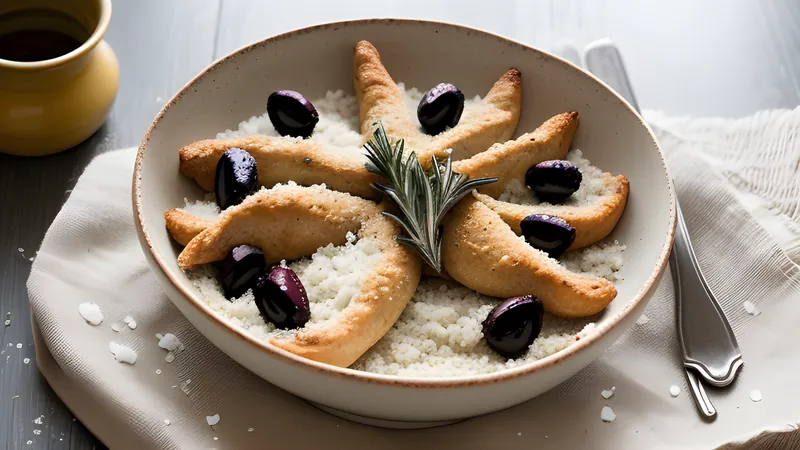
Two kilos of onions cooked to a pale jam, anchovy lattice, black olives
Contents
↓ Jump to recipeTwo kilos of onions makes about 600 g of pissaladière topping. That ratio is the recipe’s whole argument, and it is why almost nobody makes this properly. The instinct, standing over a pan that is heaped absurdly high with raw onion, is that you have overdone it. An hour and twenty minutes later you will be looking at a modest heap of pale gold jam and wondering whether you should have bought three kilos.
Pissaladière: The Onion Tart of Nice
Ingredients
- 350 g strong white bread flour
- 220 ml water, at 25C
- 5 g fast-action dried yeast
- 7 g fine salt, for the dough
- 3 tbsp olive oil, for the dough
- 2 kg onions, halved and sliced 3 mm thick along the grain
- 6 tbsp olive oil, for the onions
- 4 garlic cloves, sliced
- 3 bay leaves
- 4 sprigs thyme
- 1 tsp fine salt, for the onions
- 0.5 tsp freshly ground black pepper
- 16 salted anchovy fillets, or 20 g pissalat if you can get it
- 24 small black olives, Niçoise or Taggiasca, stones in
- 1 tbsp olive oil, to finish
Method
- Mix the flour, yeast and 7 g salt in a bowl. Add the water and 3 tbsp olive oil and bring together, then knead for 8 minutes until smooth and springy. Cover and leave to rise at room temperature for 1 hour 30 minutes, until roughly doubled.
- While the dough rises, heat 6 tbsp olive oil in a very large, wide pan over a low heat. Add all the onions, the garlic, bay, thyme, 1 tsp salt and the pepper. The pan will look absurdly full; it will collapse.
- Cover and sweat over a low heat for 20 minutes, stirring twice, until the onions have released their water and dropped by half.
- Uncover and cook on low for a further 50-60 minutes, stirring every 5 minutes and more often near the end. The onions should go from white to a pale straw gold and collapse to a soft jam with no free liquid. Keep them from browning; this is a blond confit.
- Fish out the bay and thyme. Taste and correct the salt. Spread the onions on a tray to cool to room temperature.
- Heat the oven to 220C fan with a heavy baking tray on the middle shelf.
- Oil a 30 x 40 cm baking tray. Press and stretch the dough out into the tray with your fingertips, right to the corners, about 8 mm thick. Leave it for 15 minutes to relax if it fights you.
- Spread the cooled onions over the dough in an even layer 1.5 cm thick, right to the edges.
- Split the anchovy fillets lengthways with a knife tip and lay them in a diamond lattice across the top. Press a black olive into the centre of each diamond.
- Slide the tray onto the hot tray and bake for 20-25 minutes, until the base is crisp and browned underneath and the onion tips are just catching. Trickle over 1 tbsp olive oil, cool for 10 minutes, and cut into squares. Eat warm or at room temperature.
Pissalat, and a name that has nothing to do with pizza
The tart is named for the paste, and the paste is pissalat — from the Niçard pei salat, salted fish. It is a purée of tiny fish, usually anchovy and sardine fry, salted and left to break down for weeks with cloves, thyme and pepper, then sieved into a brown paste.
Which makes pissaladière, strictly, a tart spread with fermented fish paste. It puts the dish in a direct line with Roman garum, the fermented fish sauce that seasoned essentially everything in classical cooking and that survived along the Ligurian coast in a form nobody bothered to rename.
Real pissalat is now nearly extinct — the fry it needs are protected, since they are baby fish — and Nice’s own bakers use whole anchovy fillets. That is what the recipe above does, and it is what you will be served in the Vieille Ville. If you find a jar of the real thing in an épicerie in Nice, thin it with a little oil and spread it under the onions instead, and use half as much as you think.
The connection to pizza is geographical rather than genealogical. Nice was Nizza and belonged to the Kingdom of Sardinia until 1860, and Ligurian sardenaira — the same tart with tomato added — is its cousin fifty kilometres east. The tomato went one way over the border and stayed there; Nice kept the onion version.
The onions, which are the entire dish
Slice them along the grain, from root to tip, rather than across. Onion cells are aligned along that axis, and a lengthways slice holds together as it softens where a crosswise slice falls into rings and then into shreds. You want strands you can see.
Yellow onions. Red ones turn a bruised purple-grey and taste thinner. Sweet varieties like Cévennes or Roscoff are lovely and unnecessary — the sugar you are after is the sugar an ordinary onion develops over an hour of low heat.
The two-stage cook matters. Covered for the first twenty minutes traps steam, which pulls the water out of the onions fast and drops the volume by half without any risk of colour. Then uncovered for the rest, so all that water can leave and the onions can concentrate.
This is a blond confit. Some recipes will tell you to caramelise the onions deeply, and that produces a magnificent dark sweet jam that belongs in caramelised onion marmalade or in French onion soup. A pissaladière’s onions should be the colour of straw or weak honey — sweet, soft, and still recognisably onion. Brown them hard and the anchovy has nothing to argue with.
Stir more often as you go. The first thirty minutes are forgiving. The last fifteen, with almost no water left, are when the base catches, and a scorched fleck is bitter and does not blend away.
What is actually happening in that pan
The hour is doing chemistry worth understanding, because it explains why you cannot rush it.
An onion is about 89 per cent water and carries a few per cent sugars, mostly fructose and glucose, along with the sulphur compounds that make raw onion sharp. Low heat does three things in sequence. It drives off water, concentrating everything that remains. It breaks down the sulphur compounds — those are volatile and largely leave with the steam, which is why a long-cooked onion loses its bite entirely. And it lets the enzyme alliinase, which produces the pungency, denature quietly instead of being blasted.
The sweetness you end up with is concentration rather than caramelisation. Real caramelisation of onion sugars starts at around 160C, and a pan of wet onions cannot exceed 100C until the water has gone. So for the first hour, nothing browns and nothing can; the onions simply get smaller and more intensely themselves. Turn the heat up to hurry it and you push the exposed strands past 160C while the buried ones are still boiling, and you get scorched flecks in wet onion.
An hour and twenty minutes is the honest floor for two kilos. In a narrower pan it is longer. Use the widest thing you own.
The dough question, which Nice does not agree on
Two camps. The bakery camp uses bread dough — yeasted, 8 mm thick, essentially a focaccia base — and this is what you buy from a pissaladière stall on the Cours Saleya and what the recipe above builds. The household camp uses a short pastry, thin and crumbly, closer to a tart.
The bread base wins for me on structure. Six hundred grams of wet onion jam sits on a pastry base for about four minutes before the base surrenders and goes soft underneath; a yeasted dough has enough crumb to absorb some moisture and enough gluten to stay a floor. It also means the tart eats well at room temperature three hours later, which is how it is actually eaten in Nice — from a stall, in paper, standing up.
Cool the onions completely before they go on. Hot onion melts the surface of raw dough and starts cooking it from above, and you get a grey band between base and topping.
The preheated tray underneath is the other structural trick, borrowed from pizza and doing the same job — a hard hit of conducted heat sets the base before the onion’s moisture can get into it. The base should be genuinely brown underneath when you lift a corner.
Anchovies and olives, and restraint
Salt-packed anchovies, rinsed and filleted, beat oil-packed ones by a distance — firmer, less muddy, more actually of fish. Oil-packed are fine and are what most of us have. Sixteen fillets across a 30 x 40 tray is enough; the lattice should be a decoration you meet occasionally rather than a fish blanket. The anchovy’s job is to put a spike of salt against a sweet, soft field, and too many collapse that contrast into a general saltiness.
Split each fillet lengthways with a knife tip. It halves the salt per strip, doubles your lattice for the same money, and is what the Cours Saleya stalls do.
The olives are small, black, and stones in. Cailletier — the Niçoise olive, sold in Britain as Taggiasca or simply Niçoise — is soft, faintly bitter, purple-black and small enough to sit in a lattice diamond without dominating. Kalamata is too big, too vinegary and too assertive; it turns the tart into something Greek. Pitting them makes them go floppy and leak in the oven, so leave the stones and tell people.
Some Niçois bakers press the olives in halfway through baking so they stay plump. It works.
Variations, and the border
Sardenaira or pizza all’Andrea, from Sanremo and Imperia in Liguria, is the same tart with tomato under the onions and capers among the olives. It is excellent and it is the Italian half of a dish that was split by a border in 1860. Make it once and you will understand what the tomato costs — the tart gets brighter and looser and the onion stops being the subject.
Some Niçois households add a scatter of thyme flowers over the finished tart, which is a good idea in June and impossible in January. A few press whole small anchovies in rather than filleting, which is more rustic and considerably saltier.
The variation I would push back on is cheese. It turns up on tourist-facing versions along the Promenade, and grated Emmental over a pissaladière is a decision made by somebody who wanted to sell a pizza. The dish has three flavours — sweet onion, salt fish, bitter olive — and every one of them is legible on its own. Cheese blurs all three into a general savoury warmth and the tart stops arguing with itself.
Where it goes wrong
Watery. The onions went on before their liquid had cooked off, or they went on hot. There should be no free liquid in the pan at all — tilt it and check.
Soggy base. No preheated tray, cold oven, or an onion layer over 2 cm.
Bitter. Scorched onion at the base of the pan, or too many olives.
Sad, thin topping. You used one kilo of onions. Everybody does this once.
The dough shrank back from the corners. Gluten that has been stretched and has not relaxed. Give it fifteen minutes and press it out again; it will go where you want on the second attempt.
Overwhelmingly salty. Anchovies plus olives plus a salted dough is three salts. The teaspoon in the onions is all they get.
Eating it, and what it sits with
Warm or at room temperature, cut into squares with a big knife, eaten in the hand. It makes a good starter, a better lunch, and an excellent thing to carry to somebody’s garden. In Nice it is street food and market food, and it is sold from the same stalls as socca, which is the other great cheap Niçois carbohydrate and the natural thing to eat alongside it. If it is the cream-and-bacon logic that appeals rather than the onion, flammekueche does the opposite thing at the opposite end of France.
Timing at home is easier than it looks, because the two halves of the work overlap almost exactly. The dough rises for ninety minutes; the onions cook for eighty. Start the onions the moment the dough goes under its cloth and both will be ready within ten minutes of each other, with the onions needing that gap to cool anyway. The onions can also be made up to three days ahead and kept in the fridge under a film of oil, which turns the tart into a twenty-five-minute job on the day.
Drink rosé from Bellet, the tiny appellation in the hills behind the city, if you can find it, or any dry Provençal rosé cold enough to hurt.
It keeps two days at room temperature under a cloth and gets slightly better on day one as the onion’s sweetness settles into the base. Refrigerate it and the base goes hard and stale — the fridge is where bread goes to die. If you must, reheat at 180C for eight minutes to bring it back. Freezing works: freeze the baked tart whole, thaw, and refresh in a hot oven for ten minutes.
Related Content