Pici Cacio e Pepe: The Hand-Rolled Pasta of Siena
Fat eggless worms of dough, rolled by palm, dressed in pecorino and pepper
Contents
↓ Jump to recipeThe dough is flour and water. The sauce is cheese and pepper. Between those two facts sits an hour of rolling and about four ways to ruin it, which is why pici cacio e pepe is one of the most reliably disappointing dishes on a British restaurant menu and one of the best things you can make at home.
Pici Cacio e Pepe: The Hand-Rolled Pasta of Siena
Ingredients
- 400g Italian 00 flour, or plain flour
- 200ml warm water, plus a little more if needed
- 2 tbsp extra-virgin olive oil
- 1 tsp fine sea salt
- Semolina flour, for dusting
- 150g pecorino romano, finely grated on a microplane
- 1 pecorino rind, about 5cm square
- 2 tbsp black peppercorns
- 20g unsalted butter (optional)
Method
- Mound the flour on a work surface and make a well. Add the salt, the olive oil and most of the warm water. Bring the flour into the liquid with a fork, then knead for 10 minutes until you have a firm, smooth, distinctly stiff dough. It should feel tighter than bread dough. Add water a teaspoon at a time only if it will not come together.
- Wrap the dough and rest it at room temperature for 30 minutes. This is not optional: the gluten must relax or the pici will spring back as you roll them.
- Toast the peppercorns in a dry frying pan over medium heat for 90 seconds, shaking constantly, until they smell sharp and floral. Tip out, cool, and crush coarsely in a mortar or under the base of a pan. Do not use a pepper mill; you want uneven grit.
- Bring a pan of water to the boil with the pecorino rind in it. Salt it lightly — the pecorino is very salty. Keep it at a simmer while you roll.
- Cut the dough into 4 pieces, keeping the rest wrapped. Roll one piece to a 1cm-thick rectangle and cut it into 1cm strips. Roll each strip under your flat palms, starting in the centre and moving outwards, until you have a rough worm 2 to 3mm thick and 25 to 30cm long. Dust with semolina and coil on a tray. Repeat.
- Warm half the crushed pepper in a wide pan with a ladleful of the pecorino-rind water for 1 minute over medium heat. Take off the heat.
- Cook the pici in the simmering water for 4 to 6 minutes until they float and are tender with a chew. Reserve two mugfuls of the water. Drain.
- In a bowl, mix the grated pecorino with 80ml of the pasta water, whisking to a smooth, thick paste with no lumps. Add the drained pici and the butter to the pepper pan off the heat, toss, then add the pecorino paste and toss hard for a minute, loosening with more pasta water until glossy. Serve at once with the remaining pepper.
Poor food, made by hand, from the Val d’Orcia
Pici come from southern Tuscany — Siena, Montalcino, Pienza, Montepulciano — and the giveaway is what is absent. No egg. Eggs meant chickens, chickens meant a smallholding with something to spare, and the hills of the Val d’Orcia in the centuries this pasta comes from were sharecropper country where the landlord took half of everything. Flour and water was what a mezzadria kitchen had.
The compensation for the missing egg is labour. Each strand is rolled between the palms, one at a time, and a plate for four is roughly a hundred and twenty of them. This is why pici are unevenly thick, why one end is often fatter than the other, and why the surface has the faint spiral texture that sauce clings to. The word probably comes from appiciare, to stick or to attach, describing the rolling motion.
The shape is genuinely old. There is a fresco in the Etruscan Tomba dei Rilievi at Cerveteri, from around the fourth century BC, showing what look convincingly like rolling pins and pasta boards, and Sienese food historians have been enthusiastically claiming an Etruscan lineage for pici ever since it was discovered. The evidence is thin and the claim is charming.
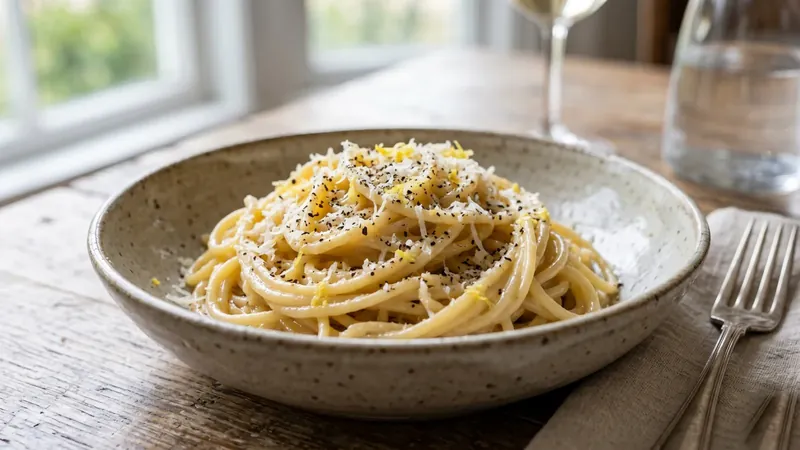
Cacio e pepe is Roman rather than Sienese, and the pairing is a modern marriage that works because the two things need each other. Pici’s rough, thick, chewy strands give the sauce something to grip that a smooth spaghetto never will, and the sauce’s salt and heat give the plain dough something to say.
The dough: stiff, and rested
Two hundred millilitres of water to 400g of flour is 50% hydration, which is dry — bread dough runs at 65% or higher. The dough will look wrong for the first five minutes of kneading. It comes together.
That stiffness is the point. A wet dough is easy to knead and impossible to roll into worms, because it sticks to your palms, stretches unevenly and tears. A stiff dough rolls into a strand that holds its shape and survives six minutes in boiling water without an egg to bind it.
Knead for a full ten minutes. You are developing gluten, and gluten is the only structure this pasta has. Underworked pici disintegrate in the pan and you serve soup. The dough is ready when it stops looking shaggy, feels smooth and slightly tacky, and springs back slowly when pressed.
Then rest it, wrapped, for thirty minutes at room temperature. Gluten that has just been worked is under tension, and tense dough fights back — roll it and it contracts to two-thirds the length within seconds. Thirty minutes lets the protein network relax and the flour hydrate fully. Cooks who skip this stage assume they are bad at rolling.
The olive oil is regional and slightly contentious. Sienese purists use water alone. Two tablespoons make the dough more pliable and the finished pici marginally more tender, and I use it.
Rolling, which takes an hour the first time
Roll a quarter of the dough to 1cm thick, cut 1cm strips, and roll each strip under flat palms from the centre outwards. Light pressure, long strokes. The strand lengthens as it thins, and you want 2 to 3mm and 25 to 30cm.
Almost nobody gets this right immediately. The two common failures: pressing too hard, which flattens the strand into a ribbon instead of rounding it, and rolling on a floured surface, which stops the dough gripping so it just skids under your hands. Roll on a bare, clean, unfloured wooden board or worktop. The slight friction is what does the work.
Dust the finished pici in semolina rather than flour and coil them loosely on a tray. Semolina is coarse and behaves like tiny ball bearings; plain flour absorbs moisture off the surface and glues them together into a nest.
Unevenness is correct. Fat ends stay chewier, thin ends cook softer, and a plate of pici that all look identical was made by a machine and misses the point. If you want to speed up, work in pairs — one person rolls, one person coils — or roll everything before you put the water on, since pici hold happily on their tray for an hour.
The pepper, toasted
Two tablespoons of peppercorns, toasted dry for ninety seconds and crushed coarsely, is the difference between cacio e pepe and cheesy pasta.
Black pepper’s heat comes from piperine, which is stable and survives anything. Its aroma comes from a set of volatile terpenes — pinene, limonene, caryophyllene — that sit in the outer husk and evaporate steadily from the moment the corn is cracked. Pre-ground pepper has lost nearly all of them, which is why it tastes hot and smells of dust. Toasting drives the remaining terpenes to the surface and creates a few new roasted compounds; the pan should smell sharp and faintly of pine within ninety seconds.
Crush in a mortar or under a heavy pan base. You want gravel — some pieces nearly whole, some near-powder. A pepper mill produces uniform particles and a monotone heat, and the uneven grind gives you bursts of pepper against a background of it, which is what makes the dish interesting to eat.
Then bloom it: a minute in a wide pan with a ladle of hot pasta water, off the heat before the pasta arrives. Piperine and the terpenes are fat- and water-soluble to different degrees, and warming them in liquid pulls the flavour out into the sauce rather than leaving it sitting on top.
The rind trick, and not splitting the sauce
Here is the twist and the thing that fixes the dish. Drop a pecorino rind into the pasta water before you cook.
Cacio e pepe splits because pecorino romano is a hard, aged, low-moisture cheese. Its fat and protein are locked together, and heat breaks that bond: the protein clumps into rubbery strings and the fat pools out. The classic fix is starchy pasta water, and starch alone is a fairly weak stabiliser for a cheese this dry.
A rind simmered for twenty minutes gives the water something extra. Rind is the cheese’s outer layer, and it leaches calcium salts and small soluble peptides into the water, both of which help keep casein dispersed rather than clumping. You also get a little more glutamate, which does the flavour no harm. The water goes faintly cloudy and slightly savoury, and it dresses pici in a way plain salted water simply does not.
Beyond that, the rules are mechanical and absolute. Grate on a microplane, so the cheese hydrates instantly. Make a paste in a bowl first with 80ml of hot water, whisked until it is smooth as custard. Dress off the heat. Above roughly 65C the casein seizes, and a hot pan is the single most common cause of a plate of stringy grey lumps.
If it splits anyway, take it off the heat, add a splash of cold water and toss hard. It usually recovers.
Cooking pici, which is its own skill
Fresh eggless pasta behaves very differently from the dried stuff, and the first batch catches most people out.
Pici go into water at a simmer rather than a rolling boil. A hard boil throws them against each other and against the pan wall, and eggless dough at 50% hydration has no albumen holding it together — only gluten and gelatinised starch. Violent water tears the thinner sections. You want the surface just breaking, moving enough to keep the strands separate.
They cook in four to six minutes, and the range is real because your pici will vary in thickness along their own length. Fish one out at four minutes and bite the fattest part. You are after tender all the way through with a definite chew, closer to a thick udon than to al dente spaghetti. Undercooked pici have a pasty, raw-flour core that no sauce hides; overcooked ones go slack and start shedding starch into the water in earnest.
That shedding is the reason to use less water than instinct suggests. Enough to cover the pasta by a few centimetres is plenty, and the resulting water is thick, cloudy and genuinely useful. A vast stockpot dilutes the starch to the point where the pasta water is doing nothing but adding volume, and with the pecorino rind in there too you want that liquid concentrated.
Salt the water at half your usual strength — around 5g per litre rather than 10g. Between the pecorino romano, which is one of the saltiest cheeses in Europe at roughly 4% salt by weight, and the rind leaching into the water, the seasoning arrives from three directions. Salt the water as you would for a tomato sauce and the finished plate is inedible.
Drain the pici a touch early and let them finish in the pan with the pepper and the cheese paste. They will take on another thirty seconds’ worth of cooking from the residual heat, and they will drink sauce as they do it, which is the entire point of finishing pasta in the pan.
Tips, swaps and variations
Flour. 00 gives the silkiest strand. Plain flour works and is slightly chewier. Semolina rimacinata, mixed half and half with 00, makes a sturdier pici that suits heavier sauces.
Make ahead. Rolled pici keep on a semolina-dusted tray, uncovered, for 2 hours, or dry them fully for 24 hours and cook 2 minutes longer. They freeze well on the tray, then bagged, for 2 months — cook from frozen, adding 90 seconds.
Cheese. Pecorino romano is correct and ferociously salty; salt the pasta water at half strength. A 50/50 mix with parmesan is gentler and emulsifies more readily, which is a reasonable place to start.
Other sauces. Pici’s classic Sienese dressings are aglione — a slow tomato and giant garlic sauce — and briciole, toasted breadcrumbs in olive oil, which is genuinely the poorest and best of them.
Butter. The optional 20g is a safety net. Butterfat is a decent emulsifier and it makes the sauce considerably harder to break, at the cost of a little of the cheese’s edge.
For the Roman original on standard pasta, cacio e pepe is the same argument with less rolling, and spaghetti carbonara is what happens when you add egg and pork to it. If you have made this much dough by hand, potato gnocchi and trofie al pesto with potato and green beans are the next two shapes worth learning.
Related Content