Pesarattu: Green Moong Dosa with Ginger Chutney
A savoury pancake ground straight from whole green gram, no fermentation required
Contents
↓ Jump to recipePesarattu solves the one real inconvenience of a proper South Indian dosa: the two or three days of soaking and fermenting a rice-and-urad-dal batter needs before it tastes right. Grind whole green moong dal with ginger, cumin and a green chilli, and you have a batter that cooks up crisp and savoury within the hour, no fermentation involved at all. It is Andhra Pradesh’s answer to the question of what to eat on a weekday morning when nobody planned ahead, and it has become one of the most requested breakfasts on Telugu tables specifically because it rewards a lack of planning rather than punishing it.
The dish comes from the Krishna and Godavari river delta region of coastal Andhra, where green moong is grown widely and where Vijayawada in particular claims the pesarattu as a local specialty — dosa carts and breakfast stalls across the city serve almost nothing else before nine in the morning. The batter’s colour, a pale, faintly speckled green, comes entirely from the moong’s skin, left on rather than split and hulled the way it is for most dal dishes, which is also where a good part of the dosa’s flavour and body comes from.
Pesarattu: Green Moong Dosa with Ginger Chutney
Ingredients
- 300 g whole green moong dal (green gram), soaked 6-8 hours
- 2 tbsp raw rice, soaked with the moong (optional, for crispness)
- 1 tbsp fresh ginger, roughly chopped
- 2 green chillies, roughly chopped
- 1 tsp cumin seeds
- 1 small onion, very finely chopped, for topping
- 8 tbsp finely chopped onion, coriander and green chilli, mixed, for topping
- 1 tsp fine salt, plus more to taste
- 150-200 ml cold water, for grinding
- Vegetable oil or ghee, for cooking
- 8 tbsp dried semolina (rava), for a crisper edge (optional)
- 2 tbsp fresh ginger, peeled and chopped, for the chutney
- 3 tbsp roasted chana dal, for the chutney
- 2 dried red chillies, for the chutney
- 1 tbsp tamarind pulp, for the chutney
- 1 tsp jaggery, for the chutney
- 1/2 tsp mustard seeds and a few curry leaves, for tempering the chutney
Method
- Drain the soaked moong and rice. Grind with the ginger, green chillies, cumin seeds, salt and just enough cold water to form a thick, pourable batter, similar to double cream. Do not over-thin it.
- For the chutney, dry-roast the chana dal and dried red chillies for 2 minutes until fragrant, then blend with the ginger, tamarind, jaggery and a splash of water to a smooth paste. Temper with mustard seeds and curry leaves fried in a teaspoon of oil, and stir through.
- Heat a flat griddle or non-stick pan over a medium-high heat. Once hot, wipe with an oiled cloth.
- Pour a ladleful of batter onto the centre and spread outwards in a thin, even spiral using the back of the ladle, as you would a regular dosa.
- Immediately scatter a spoonful of the chopped onion, coriander and chilli mix over the surface and press gently with the back of the spoon so it sticks.
- Drizzle 1-2 tsp oil or ghee around the edges and cook for 2-3 minutes until the underside is golden and the edges lift cleanly from the pan.
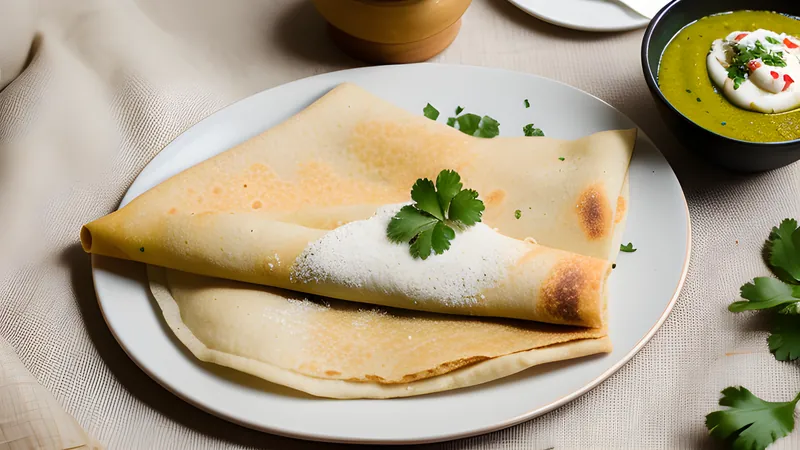
- Flip and cook the topped side for 1 minute more, until the onion is lightly caught. Fold in half or into thirds and serve immediately with the ginger chutney.
Why no fermentation
Classic dosa batter relies on wild fermentation to develop its characteristic tang and to leaven the batter slightly, using the natural yeasts and bacteria on rice and urad dal, a process that needs warmth and one to two days of patience. Pesarattu skips this entirely because green moong dal, ground raw with aromatics, already has enough starch and protein structure to hold together and crisp up on a hot griddle without any rise at all — it is closer in spirit to a savoury crepe than to a leavened bread. The trade-off is a flatter, denser dosa with a more pronounced bean flavour rather than the sour, almost yoghurt-like tang of a fermented one; neither is better, they are simply different tools for different mornings.
Soaking the moong for six to eight hours, or overnight, is still necessary, but for texture rather than fermentation: it softens the dal enough to grind smooth in a blender rather than leaving a gritty batter that won’t spread cleanly. A small amount of raw rice ground in with the moong is optional but genuinely useful, adding a crispness to the edges that pure moong batter, being higher in protein and lower in starch, does not achieve on its own.
Grinding and spreading
The batter should be thick enough to coat the back of a spoon heavily, similar to double cream, and no thinner — a too-loose batter refuses to hold its shape when spread and tears the moment you try to lift it from the pan. Grind with cold water rather than warm, since heat from a blender motor running for a couple of minutes can start to cook the batter’s edges and give it a slightly gritty, split texture once it hits the hot griddle.
Spreading pesarattu batter takes a slightly firmer hand than a fermented dosa, because there is no gluten-like stretch to help it along; work the ladle in a tight outward spiral from the centre, keeping consistent pressure, and accept that pesarattu will always be a touch thicker than a paper-crisp plain dosa — that thickness is part of its character, not a flaw to fight. The classic finishing touch, a scatter of very finely chopped raw onion, coriander and green chilli pressed into the batter the moment it hits the pan, cooks into the surface as the dosa sets, giving a savoury, slightly caramelised topping baked directly into the pancake rather than added afterwards.
Green moong versus the usual dosa lentils
Most South Indian batters, dosa and idli alike, are built on a combination of rice and split, hulled urad dal (black gram with its skin removed), which ferments readily and gives that familiar pale colour and mildly sour tang. Pesarattu breaks from this in two ways: it uses green gram rather than black, and it leaves the skin on rather than splitting and hulling it first. Whole green moong is higher in fibre than the split, skinless dal used elsewhere, and it carries a faintly sweet, grassy flavour that comes through clearly once ground raw rather than fermented, since fermentation is exactly the process that would otherwise mellow it.
This is also why pesarattu is considered one of the more nutritionally dense South Indian breakfasts on offer — whole green gram retains more protein and fibre than the polished, split dal in a standard dosa batter, and because nothing here is deep-fried, the only fat in the dish is what goes on the griddle. It has become something of a fixture on health-conscious Indian breakfast menus for exactly this reason, marketed as the “protein dosa” in a way that would have puzzled the coastal Andhra cooks who developed it purely because it was fast and used what grew locally.
Getting the chutney right
Ginger chutney for pesarattu is a distinct preparation from the coconut or tomato chutneys served with most other dosas, and it is worth making properly rather than reaching for a jar. The roasted chana dal is not a garnish here; it thickens the chutney and gives it a nutty backbone that balances the ginger’s sharpness, in the same way besan thickens a Gujarati kadhi. Roast it just until it smells toasted and turns a shade darker, since scorched chana dal turns bitter and will dominate the finished chutney no matter how much tamarind or jaggery you add afterwards to correct it.
Tamarind and jaggery both go in to round the ginger’s heat into something more rounded than simply hot, and the balance between the two is worth tasting and adjusting rather than measuring blind, since tamarind pulp varies considerably in concentration between brands. A tempering of mustard seeds and curry leaves fried briefly in hot oil, poured over the finished chutney rather than blended in, adds a final aromatic layer and a bit of visual interest against the chutney’s otherwise flat brown surface.
Pesarattu upma and other pairings
The most traditional way to eat pesarattu in Andhra Pradesh is folded around a spoonful of upma — the same semolina porridge served as a breakfast in its own right elsewhere in South India — creating a dish called pesarattu upma or MLA pesarattu (the name, the story goes, coined because a local Vijayawada politician ordered it so often the combination took his title). The soft, mildly spiced semolina inside plays against the crisp, bean-forward dosa outside, and it remains the single most ordered breakfast item on the city’s tiffin-stall menus.
Without upma, pesarattu is eaten simply folded in half or thirds with the ginger chutney, and sometimes alongside a bowl of sambar for a heartier plate. Its closest relative among other South Indian breakfasts is masala dosa with two-day fermented batter, which shows what the long-fermentation route achieves by contrast; a plate of medu vada alongside either makes a full tiffin spread, since vada relies on the same soaked-and-ground lentil principle from a different, fried, direction.
A dosa that travels well
Pesarattu also works its way into Andhra homes as a between-meals snack rather than strictly a breakfast, especially in its smaller, thicker form sometimes called pesara attu made without the onion topping, which holds up better wrapped in paper for a journey or a school lunchbox. Street vendors along the Krishna river towns will sometimes fold two dosas around a stuffing of spiced potato, closer to a Mysore-style masala dosa in construction, though this is very much a regional variant rather than the standard preparation.
What can go wrong
The most common failure is a dosa that tears when you try to spread it thin, which almost always means the batter is either too thick to move freely or was ground too coarsely to hold together as a sheet. Thin it very slightly with a tablespoon of water at a time until it spreads without dragging, and check that the moong was ground to a genuinely smooth paste rather than a still-textured one; a food processor tends to leave more grit than a proper wet-grinder or a good blender run for a full two minutes.
The other common problem is a pale, soft dosa with no crisp edge at all, which comes down to either too low a pan temperature or too little oil at the rim. The pan needs to be properly hot before the first ladleful goes on — test it with a drop of water, which should skitter and evaporate within a second — and a more generous drizzle of oil around the edge, rather than in the centre, is what actually crisps the border while the middle stays tender.
Serving, substitutions and storage
The ginger chutney is not optional garnish; its sharp, fresh heat is the traditional counterpoint to pesarattu’s mild, slightly grassy moong flavour, and a version made without the roasted chana dal loses the body that makes it cling to the dosa rather than run off it. If ginger chutney feels too sharp on its own, a simple coconut chutney alongside softens the meal, though most Andhra households would consider that an addition rather than a substitution.
A cast-iron tawa, well seasoned and never scrubbed with soap, holds heat more evenly across its surface than a thin non-stick pan and gives a more consistent crisp from edge to centre; if pesarattu keeps sticking on a non-stick pan, the issue is usually too little residual oil left from the previous dosa rather than the batter itself, so wipe and re-oil the surface between each one rather than only at the start.
Leftover batter keeps in the fridge for up to two days in an airtight container — it will not ferment or sour the way a rice-and-urad batter does, so there is no risk of it turning, though it may need a splash of water stirred back in as it thickens on standing. The chutney keeps for four to five days chilled. Pesarattu itself does not reheat well once cooked, since the crisp edge turns leathery in a microwave; if you have extra dosas, freeze the raw batter in portions instead and cook fresh whenever the mood strikes, which rather defeats the whole point of a dish designed to need no forward planning at all — but it is there if you want it.
Related Content