Pâté en Croûte: The Pastry Case of Lyon
Pork and veal in a rye and lard crust, with jelly poured through the chimneys
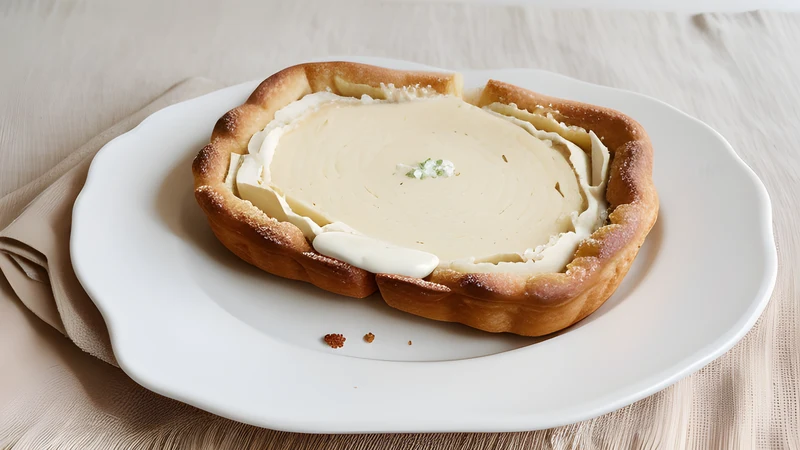
Contents
↓ Jump to recipePâté en croûte is a test, and Lyon treats it as one. There has been a world championship since 2009, held in the city, judged by Meilleurs Ouvriers de France on a hundred-point scale, and the thing they’re mostly looking for is a gap — specifically, the absence of one. Between the meat and the pastry there should be a thin, even ring of clear amber jelly. Too thick and the filling shrank. Missing and the jelly didn’t reach. Cloudy and the stock was boiled.
That gap is the whole engineering problem of the dish, and understanding why it exists makes the rest of it straightforward.
Pâté en Croûte: The Pastry Case of Lyon
Ingredients
- 300 g plain flour, for the pastry
- 100 g dark rye flour, for the pastry
- 120 g lard, cold and cubed
- 80 g unsalted butter, cold and cubed
- 1 egg, for the pastry
- 8 g fine salt, for the pastry
- 90 ml ice water
- 500 g pork shoulder, chilled, cut into 2 cm cubes
- 300 g veal shoulder, chilled, cut into 2 cm cubes
- 200 g pork back fat, chilled, cut into 1 cm cubes
- 150 g chicken livers, trimmed of green and sinew
- 60 ml dry white wine
- 30 ml Cognac
- 18 g fine salt, for the filling
- 3 g freshly ground black pepper
- 2 g ground mace
- 1 g ground allspice
- 2 garlic cloves, grated
- 1 shallot, finely diced
- 70 g shelled pistachios, unsalted
- 1 egg white, for the filling
- 1 egg yolk beaten with 1 tbsp milk, for the glaze
- 500 ml well-flavoured chicken or veal stock, for the jelly
- 12 g leaf gelatine, about 6 sheets
- 2 tbsp Madeira, for the jelly
Method
- Make the pastry. Rub the lard and butter into the plain and rye flours with the salt until the mixture looks like coarse breadcrumbs with pea-sized lumps remaining. Beat the egg into the ice water, pour it in, and bring together with a knife. Knead for 10 seconds only. Flatten to a slab, wrap and refrigerate for 2 hours.
- Toss the pork, veal, back fat, salt, pepper, mace, allspice, garlic, shallot, wine and Cognac together. Cover and refrigerate 12 hours.
- Chill the mincer parts in the freezer for 30 minutes. Mince two thirds of the marinated meat through a 6 mm plate into a bowl set over ice. Mince the remaining third with the chicken livers through the same plate.
- Beat the egg white into the finer mince, then fold the two minces together with the pistachios. Do not overwork. Fry a teaspoon of the mixture for 2 minutes and taste it for salt before you commit.
- Roll the pastry 4 mm thick. Cut a base and two long sides and two short ends to line a 30 x 8 cm hinged pâté mould, plus a lid. Line the mould, pressing the joins together firmly and sealing them with water. Leave 1 cm overhanging.
- Pack the filling in hard, in three layers, pressing each down with wet hands to expel every air pocket. Mound the top slightly.
- Lay on the lid, trim, and crimp the overhang against it. Cut two 1.5 cm holes in the lid and fit foil chimneys through them. Chill 1 hour.
- Glaze with the egg yolk and milk. Bake at 200C fan for 20 minutes, then reduce to 160C fan and bake a further 55 to 70 minutes, until a probe in the centre reads 68C. Cover the top with foil if it darkens too fast.
- Cool in the mould for 2 hours, then refrigerate 12 hours.
- Soak the gelatine in cold water for 5 minutes. Warm the stock to 60C, squeeze out the gelatine and whisk it in with the Madeira. Cool to 25C — thickening but still pourable.
- Pour the jelly through the chimneys in three goes, 20 minutes apart, until it stops sinking. Refrigerate 12 hours more before slicing.
Why the gap happens
Meat is roughly 70 per cent water. When you cook it, the muscle proteins denature and contract, and they wring out a portion of that water — perhaps 15 per cent of the filling’s volume leaves as juice and steam. The pastry, meanwhile, sets rigid at around 90C and then stays exactly the size it was.
So you bake a solid block inside a rigid box, and the block shrinks and the box doesn’t. You end up with a void. Every pâté en croûte has one; the medieval version simply had a void full of air, and the crust — the coffin, in old English cookery — was a container that got thrown away rather than eaten. Somebody in the seventeenth century worked out that you could fill the void with jellied stock instead, and at that point the crust became worth eating and the dish became French.
The chimneys are how you reach the void. They’re the only access once the lid is crimped on.
The rye and lard pastry
The twist here, and it’s a functional one.
The standard pâte à pâté is flour, butter, egg and water — a strong, slightly leathery shortcrust built to hold shape rather than to taste of much. It works, and it’s boring, and after all this effort you have a dish where a quarter of every mouthful is pastry that nobody would eat on its own.
Two changes fix it. Swap a quarter of the flour for dark rye. Rye brings a malty, faintly sour depth that stands up to an hour and a half in the oven and tastes like something rather than like a wrapper. It also has almost no gluten-forming protein, which makes the pastry more tender and — usefully — less prone to shrinking away from the mould as it bakes.
Replace 60 per cent of the butter with lard. Lard has larger fat crystals than butter and almost no water, and both matter. The crystals shorten the pastry more effectively, so it stays crisp against a wet filling for days instead of going soggy overnight. The absence of water means less steam, which means less gluten development, which means less shrinkage. It also tastes of pork, which is convenient given what’s inside.
The one cost is handling: a lard-heavy dough is more fragile and cracks if you roll it straight from the fridge. Let it sit 15 minutes at room temperature first, and patch any cracks with offcuts and a wet finger. Nobody will see the repairs and the jelly will find any hole you leave.
The mince: temperature is everything
Keep every component below 4C, including the mincer. Put the auger, blade and plate in the freezer for half an hour before you start.
The reason is that back fat smears. Above roughly 10C, the fat softens enough that the mincer’s blade drags it into a paste rather than cutting it into discrete cubes, and that paste coats the meat particles in a film. When the pâté bakes, that film melts and runs out, and you get a greasy, crumbly filling with a fat layer pooled under the lid. Cut, cold, the fat stays as visible white flecks that render in place and baste the meat from within.
Mince two thirds coarse and one third with the livers. The livers are there for texture and background. At 150 g in 1 kg of meat they sit below the threshold where anyone identifies them, and what they contribute is a smooth, cohesive binding and a darker colour to the fine portion. The egg white in the fine mince adds protein that sets and holds the whole thing together when sliced.
Fry a teaspoon and taste it. Every charcutier does this and every home cook skips it. Raw seasoned mince tastes nothing like cooked seasoned mince, and 18 g of salt in 1.15 kg is a calculated 1.5 per cent that you should still verify. You cannot re-season a baked pâté.
Packing, baking, and the probe
Pack hard. Wet hands, three layers, pressing each into the corners. Air pockets in the filling become jelly pockets, and a slice with a big amber blob in the middle looks like a mistake because it is one.
Bake hot then moderate. 200C for the first 20 minutes sets the pastry and colours it before the filling starts releasing liquid into it. Then 160C for the long haul, because a filling this thick cooked at high heat overcooks its outer centimetre by 15C before the middle arrives.
68C in the centre. Use a probe and trust it. Pork and veal are safe well below this, and past 72C the proteins have squeezed out so much moisture that the filling goes grey and grainy and the void gets embarrassingly large. Start probing at 50 minutes.
The mould, and what to do without one
A hinged rectangular pâté mould, 30 x 8 x 8 cm, fluted or plain. They cost about £30 and they exist because the hinge lets you unclip the sides and lift the baked pâté out without touching the pastry, which is fragile and hot and which will break if you try to invert it.
Without one, a 900 g loaf tin lined with a double layer of baking parchment with long overhanging handles works. You lose the fluted sides and you gain a real risk of tearing the case on the way out, so chill it hard — four hours minimum — before you attempt the lift. Do not grease the mould: greased pastry slides down the sides as it bakes and you end up with a thick base and a bald rim.
Whatever you use, put it on a heavy baking tray. Seams leak. Every pâté leaks a little, and rendered pork fat hitting the oven floor at 200C fills the kitchen with smoke and makes the whole exercise memorable for the wrong reasons.
The chimneys
Two holes, 1.5 cm across, cut in the lid and held open with rolled foil tubes pushed 2 cm into the filling.
They do two separate jobs at two separate times. During baking they vent steam. A sealed lid traps the steam the filling releases, and that steam has to go somewhere — it lifts the lid, cracks the crimp, or blows out a side seam, and once a seam has gone the jelly has nowhere to live. During jellying, they’re the pour holes.
Two of them, at opposite ends. One hole means the jelly you’re pouring in has to fight the air trying to get out through the same opening, and it glugs and stops. With a hole at each end, air escapes from one while jelly goes down the other, and it flows steadily.
Foil rather than baking parchment, which softens and collapses. Some people roll a proper pastry chimney, which looks beautiful and is one more thing to make.
The jelly, and the only unforgiving step
Cool the pâté completely — 12 hours in the fridge — before jellying. The void has to be at its final size, and a warm pâté is still contracting.
The jelly wants to go in at 25C: syrupy, beginning to thicken, still pouring. Hot jelly is thin and runs straight through into the base of the mould and out of the seams. Cold jelly won’t flow into the thin ring at all and sets in the chimney like a plug.
Pour in three goes, 20 minutes apart. The first pour fills the big spaces and the meat absorbs some. Twenty minutes later the level has dropped and you top it up. The third pour usually takes almost nothing, and that’s how you know it’s full.
Do not boil the stock. Boiling emulsifies fat and suspends protein, and the jelly sets cloudy — the single most common deduction at the championship. Warm it to 60C, no more, and if your stock isn’t already crystal clear, strain it through a coffee filter before you start.
Variations, and what the championship actually rewards
The competition version is usually pork, veal and duck or game, with foie gras through the middle and a pistachio pattern arranged by hand so every slice shows the same cross-section. Some entries inlay a whole seared duck breast down the centre so each slice has a pink medallion in it. That is a garnish problem rather than a cooking one, and it’s why the thing takes a professional two days.
At home, worthwhile changes:
Prunes soaked in Armagnac. 100 g, stoned, soaked overnight, folded through with the pistachios. The sweetness sits well against the mace and it’s a Gascon habit rather than a Lyonnais one.
Game. Swap the veal for 300 g of pheasant or rabbit. Both are leaner than veal, so raise the back fat to 250 g or the filling dries.
More liver. Push the chicken livers to 250 g if you want the pâté to read as liver-forward. Past that it turns metallic and the colour goes muddy.
What I’d avoid is reducing the fat. 200 g of back fat in 1 kg of meat looks alarming written down, and it is exactly the amount that keeps the filling moist through 70 minutes at 160C. Take it to 100 g and you will slice into something dry and sandy, and you will have spent two days getting there.
Slicing, storage, and being realistic
Another 12 hours in the fridge after the last pour. Then a long thin knife, dipped in hot water and wiped between every slice, cutting 1.5 cm thick in one steady draw. Sawing tears the pastry away from the jelly.
It keeps five days, wrapped, and it’s best on days two and three. It does not freeze — the jelly weeps on thawing and the pastry turns to cardboard.
This is a two-day project with an ingredient list longer than most of what I cook. It’s worth doing once to understand what the champions are actually being judged on, and then perhaps once a year at Christmas. On a weeknight, make rillettes instead — same pork, same patience, none of the pastry — or a leek and cheese pie if it’s the crust you’re after.
Related Content