Pastizzi: Malta's Diamond of Ricotta and Pastry
Rough lamination, a lot of margarine, and a spoon of miso
Contents
↓ Jump to recipeA pastizz costs about fifty cents in Malta and comes in a paper bag that is transparent with grease within four seconds. You eat it standing up, outside the pastizzerija, at any hour the shop is open, which in some cases is all of them. It is Malta’s national snack in the way that a bacon sandwich is Britain’s: unfancy, and the thing the country would genuinely miss most.
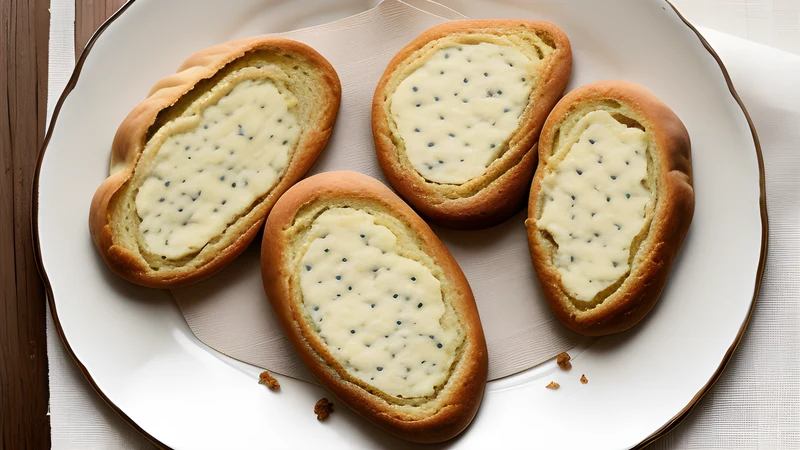
Two fillings exist. Pastizzi tal-irkotta are ricotta. Pastizzi tal-piżelli are a curried mushy-pea mixture. You order them by shape — the ricotta ones are diamonds, the pea ones are ovals — and no Maltese person has ever needed to look.
Pastizzi: Malta's Diamond of Ricotta and Pastry
Ingredients
- 500 g plain flour
- 1 tsp fine salt
- 260 ml cold water
- 1 tbsp white wine vinegar
- 40 g lard or vegetable shortening, for the dough
- 220 g lard or margarine, softened to a spreadable paste, for laminating
- 600 g ricotta, drained overnight in a sieve
- 2 eggs
- 1 tbsp white miso paste
- 3 tbsp chopped flat-leaf parsley
- 1/2 tsp coarsely ground black pepper
- 1/4 tsp fine salt
Method
- Rub the 40 g lard into the flour and salt with your fingertips. Add the water and vinegar and bring together into a rough dough.
- Knead for 10 minutes until smooth and distinctly elastic — this dough needs strong gluten. Wrap and rest at room temperature for 1 hour.
- Drain the ricotta overnight in a sieve set over a bowl in the fridge. Discard the whey.
- Mix the drained ricotta with the eggs, miso, parsley, pepper and salt until smooth. Chill until needed.
- On a large, lightly oiled surface, roll the dough as thin as you can, then stretch it with the backs of your hands until it is translucent and roughly 80 cm across. Tears at the very edge are fine.
- Spread the softened 220 g lard over the entire sheet with your hands, right to the edges.
- Roll the sheet up tightly into a long rope from one edge. Stretch the rope gently until it is about 1 metre long, then coil it into a spiral, cover, and chill for 45 minutes.
- Cut the coil into 16 discs. Working with the cut face up, press each disc flat with your thumbs into a 10 cm oval, keeping the spiral pattern facing you.
- Place 1 heaped tablespoon of filling in the centre. Bring the two long sides up and pinch them together along the top, then pinch each end to a point, forming a diamond.
- Space on lined trays and bake at 200C fan for 32-35 minutes until deep gold and visibly blistered. Cool for 10 minutes before eating.
The pastry works like strudel dough
Understand this before you start, because it saves you from making the wrong thing carefully.
Proper puff pastry is a laminated dough: a block of butter enclosed in dough, folded and turned, producing hundreds of discrete alternating layers that inflate on steam. Pastizzi pastry is made by a completely different route. You stretch a strong, elastic dough until it is translucent — closer to strudel dough than to détrempe — smear it with soft fat, roll it into a rope, and coil the rope. The layers come from the spiral.
The consequence is that pastizzi flake in a distinctive way: long, shattering, slightly irregular sheets rather than the neat vertical rise of puff. They are also, frankly, greasier, and the grease is the point. Maltese bakeries use xaham, a lard-based fat, and they are not shy with it. If you use butter here it will fail — butter’s 16 per cent water content will produce steam pockets and a chewy, bready result, and butter is too firm at room temperature to spread over a translucent sheet without tearing it.
Lard or a hard vegetable shortening, softened to about the texture of thick paint. That is the correct fat.
The dough needs the opposite treatment from most pastry: knead it hard for ten full minutes. You are building gluten deliberately, because a weak dough will not stretch to translucency without shredding. The tablespoon of vinegar helps — mild acid relaxes gluten slightly and makes the sheet easier to pull thin after the hour’s rest.
Malta, Sicily and the Ottomans
Pastizzi are usually traced to Sicily, and Sicilian pastry to the Arab period, which puts the technique in the same lineage as börek, baklava and every other coiled or stretched pastry from the eastern Mediterranean. The Maltese archipelago sat directly on that route: Arab rule from 870, then Norman, then the Knights of St John from 1530, then British from 1800. The language itself is Semitic with a Romance overlay, which tells you roughly everything about how the food got there.
One consequence of that long Sicilian connection is that pastizzi have close relatives you may already know. Sicilian sfoglio uses a similar stretched-and-coiled dough. The Neapolitan sfogliatella riccia is the same technique executed with obsessive precision — hundreds of visible layers fanned out like a clam shell — and it is essentially a pastizz that went to finishing school. Malta’s version is the rustic one, and I would argue the more pleasurable one, because the irregular layers shatter unpredictably instead of peeling off in tidy sheets.
What is distinctly Maltese is the ricotta. Malta makes irkotta from sheep’s milk, and the island’s version is drier and more granular than the Italian cow’s-milk ricotta most of us can buy. This matters practically: wet ricotta in a pastizz produces a soggy interior and a base that will not crisp. Drain yours overnight in a sieve. You will be surprised how much whey comes out — often 100 ml or more from 600 g.
The pastizzerija as an institution
A word about where these are meant to be eaten, because it shapes what you are aiming for.
The classic Maltese pastizzerija is a hole in a wall with a counter, a hot cabinet, and a queue. Many are attached to band clubs — the village musical societies that are the backbone of Maltese social life — and a fair number keep hours that can only be described as permissive. Serkin’s in Rabat, better known as the Crystal Palace, has been selling pastizzi to farmers, drunks and tourists at four in the morning for decades and is the one everybody names.
What they sell is deliberately cheap. Thirty to fifty cents each, which is a price point that has barely moved in twenty years, and it means the ingredients are flour, water, lard and ricotta and nothing else. There is no version of this dish that involves butter and free-range anything. The economics are part of the recipe.
It also means the pastizz is calibrated for eating immediately, standing up, at a temperature just short of dangerous. A pastizz that has cooled fully is a diminished thing — the lard firms up and coats your mouth. Ten minutes out of the oven is the window, and it is why the shops bake in small batches all day rather than once in the morning.
The twist: a spoonful of white miso
Maltese irkotta has an edge to it that supermarket ricotta does not. It is slightly savoury, slightly funky, a bit further along the road from milk to cheese. Standard ricotta tastes of clean dairy and nothing.
A tablespoon of white miso in 600 g of drained ricotta closes that gap almost exactly. Shiro miso is fermented for a short time and is mild, sweet and heavily glutamate-rich — around 400-500 mg of free glutamate per 100 g. Stirred into ricotta it disappears entirely as a flavour of its own and reappears as depth: the filling tastes more like cheese, saltier without being salty, with a savoury tail that lingers. Nobody who eats it will identify miso. Several people will ask what kind of ricotta you used.
It also brings a little salt, which is why the added salt drops to a quarter teaspoon. Taste before you commit to more.
Doing the shaping
Stretching the dough is the part that feels impossible and takes one attempt to learn. Oil your worktop lightly, roll the dough as thin as a rolling pin will take it, then get the backs of your hands underneath and walk them apart. Gravity does most of it. Aim for a sheet you can read a newspaper through. Holes in the middle are a problem; holes at the very edge do not matter, because that edge ends up in the centre of the coil.
When you cut the coil into discs, keep the spiral facing up as you press each one out. Your thumbs push from the centre outward, which spreads the spiral into concentric rings — that ring pattern is what becomes the flakes. Press it out with a rolling pin and you crush the layers flat and get a biscuit.
Pinch hard. The seam wants to open in the oven, and an open pastizz vents all its steam and dries out.
Bake hot. 200C fan. Lower and the fat melts out before the pastry sets, which gives you a pastizz sitting in a pool of its own lard with pale, dense layers. Hot, and the water in the dough flashes to steam and lifts the spiral before the fat has time to escape.
What goes wrong
The sheet tears in the middle while stretching. Your dough was underkneaded, or underrested. Ten minutes of kneading and a full hour’s rest are both minimums. A dough that fights back when you pull it has not relaxed enough — walk away for another twenty minutes.
The fat tears the sheet as you spread it. The lard was too cold. It needs to be soft enough to spread with your palm without pressure, roughly the texture of emulsion paint. Ten minutes near the oven fixes it.
Flat, dense pastizzi with no layers. Either the coil was crushed when you shaped it, or the oven was too cool. Press the discs out with your thumbs from the centre, and check the oven with a thermometer — domestic ovens routinely run 15 degrees below their dial.
Filling leaking out of the seam. Underpinched, or overfilled. One heaped tablespoon per pastizz, and pinch hard enough to feel the layers compress.
Greasy, heavy pastry. Too much fat, or a slow oven. Two hundred and twenty grams across 500 g of flour is already generous.
Storage and the pea version
Baked pastizzi are best within an hour. They hold at room temperature for a day and reheat acceptably at 180C for eight minutes. The real answer is to freeze them raw, shaped, on a tray, then bag them — bake from frozen at 200C for 40 minutes. This is what the bakeries do, and it is why a Maltese freezer usually has forty of them in it.
For tal-piżelli: simmer 400 g dried split peas with a chopped onion, 1 tsp curry powder and 500 ml water for 40 minutes until collapsed, then cool completely. Shape as ovals with a plain seam along the top.
For nearby reading, rough puff pastry explains the laminating technique pastizzi deliberately avoid, and burek is the coiled Balkan cousin that arrived by the same Ottoman road. If it is the ricotta you are here for, honey and ricotta phyllo cups with walnuts takes it sweet.
Judging when they are done
Underbaked pastizzi are the commonest home failure and the reason is that thirty-two minutes feels like a very long time to leave pastry in a hot oven.
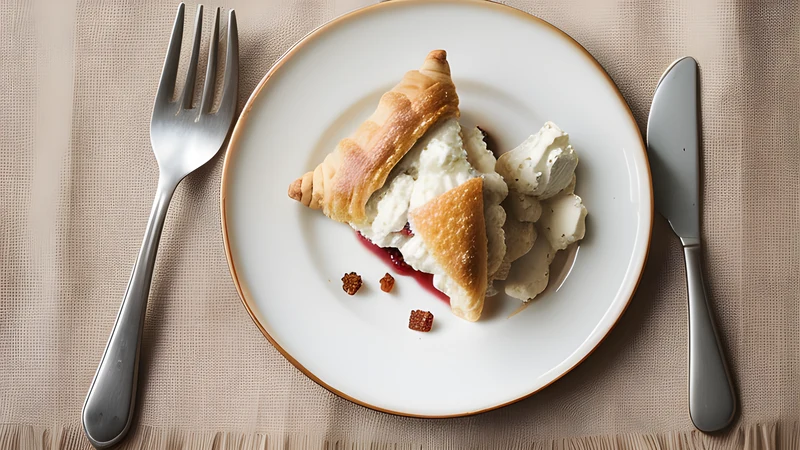
Leave them. The markers are specific. The surface should be deep gold, closer to the colour of a well-baked croissant than a pale pie lid. The layers should have visibly separated and blistered — you want to see the spiral lifting away from itself at the edges, with air between the sheets. And the base, which you should lift one with a palette knife to check, must be dry and crisp. A pale base means the lard has not fully rendered out of the bottom layers and the pastizz will be heavy and slick inside.
The other signal is sound. Tap a finished pastizz with a fingernail and it should sound hollow and papery. A dull thud means there is still moisture in the pastry.
If they are colouring fast but the base is pale, your tray is too high in the oven. Move it down and give them the rest of the time.
Buy the paper bags. You will need them.
Related Content