Pancit Palabok: Rice Noodles Under Shrimp Gravy
A noodle plate dressed for a fiesta
Contents
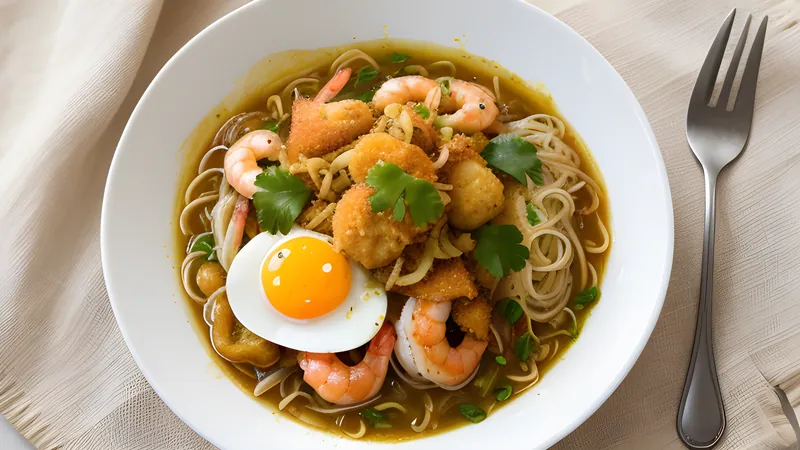
↓ Jump to recipeThe first time you see a plate of pancit palabok arrive at a Filipino table, it looks like it’s been dressed for a party it didn’t know it was invited to. Underneath the crushed pork crackling, the fanned egg slices, the fried garlic and the fistfuls of spring onion, there’s a plain tangle of rice noodles, and the whole architecture only makes sense once you understand what “palabok” actually means: to embellish, to dress something up beyond what it needs. This is a noodle dish built explicitly for showing off, and it earns the theatre.
Pancit Palabok: Rice Noodles Under Shrimp Gravy
Ingredients
- 400g bihon (dried rice vermicelli)
- 500g raw shrimp, shell-on, heads reserved
- 1.5 litres water
- 3 tbsp annatto seeds (achuete), or 2 tbsp annatto powder
- 4 tbsp neutral oil
- 6 cloves garlic, minced, plus 4 extra cloves thinly sliced for frying
- 1 white onion, finely chopped
- 3 tbsp fish sauce
- 4 tbsp cornstarch mixed with 100ml cold water
- 150g pork belly, finely diced (optional but traditional)
- 3 hard-boiled eggs, sliced
- 100g chicharron (pork crackling), crushed
- 2 tbsp tinapa (smoked fish) flakes or dried shrimp floss
- 4 spring onions, sliced
- 8 calamansi or 2 limes, quartered
Method
- Peel the shrimp, reserving shells and heads. Simmer shells and heads in the water for 20 minutes, then strain and discard solids — this stock is the base of the gravy.
- Toast the annatto seeds in the oil over low heat for 3 minutes until the oil turns deep orange-red. Strain out the seeds and discard; keep the coloured oil.
- In a wide pan, heat the annatto oil and fry the diced pork belly until rendered and golden, about 6 minutes.
- Add the minced garlic and onion, cook until soft, then stir in the fish sauce.
- Pour in the shrimp stock and bring to a simmer. Cook for 10 minutes to concentrate the flavour.
- Stir the cornstarch slurry and pour into the simmering stock, whisking constantly until it thickens into a glossy gravy, about 3 minutes.
- Add the peeled shrimp and cook for 2 minutes until just pink. Taste and adjust with more fish sauce if needed.
- Soak the bihon noodles in hot (not boiling) water for 8–10 minutes until pliable, then drain well.
- Fry the sliced garlic in a little oil until golden and crisp; set aside on kitchen paper.
- Arrange the noodles on a large platter, pour the hot gravy over the top, then scatter with crushed chicharron, sliced egg, tinapa flakes, spring onion and fried garlic. Serve with calamansi wedges for squeezing over.
Why the gravy is orange
The colour comes from annatto — small rust-red seeds called achuete, ground from the tropical Bixa orellana shrub that grows across the Philippines and much of Latin America. On their own the seeds are nearly flavourless; their job is entirely pigment. Toasted gently in oil, they bleed a deep orange-red into the fat, which you then strain out before it turns bitter. That coloured oil becomes the base of everything else in the dish. Annatto arrived in the archipelago the same way so much of Filipino pantry did — via the Manila-Acapulco galleon trade, when ships crossing the Pacific for over two centuries carried plants and techniques in both directions between the Philippines and the Americas. It’s the same seed that colours Yucatecan achiote paste and English red Leicester cheese, three cuisines that never otherwise overlap, all reaching for the same berry to make food look richer than a purely flavour-driven sauce would.
The shrimp stock underneath is what actually carries flavour, and it is not optional. Skip it, use plain water and rely on the fish sauce alone, and you get a passable orange gravy with nothing behind it. Simmer shrimp shells and heads for twenty minutes first and you get a stock with real backbone — this is the difference between a palabok that tastes of something and one that tastes of cornstarch dyed orange. Restaurant versions sometimes push further with crab fat (aligue) stirred through the gravy at the end, which adds a briny richness that home cooks reserve for special occasions, since good crab fat isn’t cheap and isn’t always available fresh.
A noodle dish built for a crowd
Palabok belongs to the same family as pancit bihon, pancit canton and the dozens of other pancit varieties that trace back to Hokkien Chinese immigrants who settled in the Philippines centuries ago, bringing noodle-eating traditions with them — the word “pancit” itself comes from the Hokkien “pian i sit”, meaning “convenient food.” What makes palabok distinct within that family is the wet gravy poured over dry-fried noodles rather than noodles stir-fried directly in sauce, and the sheer number of garnishes stacked on top. It’s a fiesta dish, a birthday dish, a dish for when relatives are coming and you want the table to look generous. The layering isn’t decorative excess for its own sake — each garnish does a job. The chicharron adds crunch against the soft noodle. The egg adds richness. The tinapa flakes add a smoky, salty hit that cuts through the coconut-adjacent sweetness of the gravy (even though there’s no coconut in this particular dish, the annatto oil reads similarly rich). The calamansi at the end brightens everything that’s come before it, and a plate of palabok without a squeeze of citrus tastes flat by comparison.
There’s a closely related dish called luglug, which uses thicker rice noodles and a slightly denser gravy, and in some regions the names get used almost interchangeably — ask three different families where luglug ends and palabok begins and you’ll get three different answers, usually involving noodle thickness and how loose the gravy is meant to be.
Method notes
Soak the bihon in hot water rather than boiling it directly in a pot — dried rice vermicelli cooks almost entirely through rehydration, and boiling it risks turning the strands mushy and clumped before they ever reach the plate. Eight to ten minutes in water just off the boil, checking by pulling out a strand and biting through it, gets you noodles with a slight bite that will hold up once the hot gravy hits them.
Keep the noodles and gravy separate until the moment you’re ready to eat. Pancit palabok does not sit well pre-assembled — the noodles absorb moisture from the gravy and turn gluey within twenty minutes, so plate it at the table right before serving rather than assembling it ahead of time.
When you thicken the gravy, add the cornstarch slurry gradually while whisking continuously. Cornstarch that hits hot liquid in a clump seizes into little translucent lumps that never fully smooth out, and a gravy full of gel pockets undermines an otherwise good dish. Whisk continuously and you get a gravy with a uniform, glossy sheen — the texture should coat the noodles like a sauce rather than pool on the plate like a soup.
What can go wrong
The most common mistake is under-salting the stock and then trying to fix it entirely with fish sauce at the end, which tips the whole dish towards a one-note saltiness rather than a rounded savouriness. Build seasoning in layers — a little fish sauce early with the aromatics, then taste and adjust once the shrimp go in.
The second is skipping the pork belly. It’s listed as optional because plenty of home versions leave it out for a lighter, more purely seafood-forward gravy, but the rendered pork fat gives body that shrimp stock alone doesn’t fully replace. If you do skip it, add an extra tablespoon of oil to the gravy base to compensate for the missing richness.
Substitutions and variations
No calamansi where you are — it’s a small, intensely fragrant citrus that doesn’t travel well and rarely appears fresh outside Southeast Asia and parts of the diaspora — lime is the standard substitute, though it’s sharper and less floral. If you can find bottled calamansi juice at a Filipino or Asian grocer, that’s closer to the real thing than fresh lime.
Tinapa flakes (smoked, dried fish, usually bangus or galunggong) can be swapped for dried shrimp floss or simply omitted, though you’ll lose a layer of smoky depth the dish is built around. Chicharron is sold ready-made at most Asian grocers; pork scratchings from a UK supermarket work in a pinch, crushed the same way.
For a version closer to what you’d find at a Manila carinderia, some cooks add sliced firm tofu, fried until golden, as an extra garnish alongside the egg and chicharron.
Storage
The gravy keeps well in the fridge for up to three days in a sealed container and reheats gently on the stove with a splash of water to loosen it back to pouring consistency — it will thicken further as it cools. The noodles don’t keep once soaked; only prepare as much bihon as you’re serving that sitting. If you have leftover gravy and no noodles, it also works spooned over plain steamed rice.
Serve alongside lumpia shanghai for the fried-and-crunchy half of a fiesta spread, or after something braised and rich like kaldereta — the bright calamansi finish on the palabok resets the palate between courses in a way few other noodle dishes manage.
Malabon and the coastal versions
Travel north of Manila to Malabon, a fishing city on the bay, and you’ll find pancit malabon — often treated as a cousin of palabok rather than a separate dish, though the two get conflated constantly. Malabon-style versions lean harder into seafood, piling on oysters, squid rings and boiled quail eggs alongside the usual shrimp, and the noodles used are frequently the thicker luglug-style strands rather than fine bihon. Some coastal cooks stir a spoonful of squid ink into the gravy for a version that reads almost black rather than orange, though this is far less common than the standard annatto-based sauce and tends to show up more at specific carinderias known for it than as a general home-cooking practice. What all these variants share is the same underlying logic: a savoury, thickened gravy poured over noodles at the table, then buried under garnishes chosen for contrast — crunchy against soft, smoky against bright, rich against sharp.
Setting the table
Because palabok is built for gatherings, the serving ritual matters as much as the cooking. It’s traditionally brought out on one large platter rather than portioned into individual bowls, set in the middle of the table so everyone can see the full arrangement of garnishes before it gets disturbed by serving spoons. Guests spoon their own portion onto smaller plates, and it’s entirely normal for the calamansi and extra fish sauce to travel around the table separately so each person adjusts the acidity and salt to their own taste. This is one of the reasons the dish reads as festive rather than everyday — a plate of adobo gets ladled straight from the pot, but palabok gets presented, and the presentation is half the point of making it at all.
Cooking ahead for a party
If you’re making this for a gathering, the stock and gravy base can be built up to a day ahead and refrigerated without the cornstarch thickening — bring it back to a simmer, whisk in a fresh slurry, and add the shrimp only once you’re near serving time so they don’t overcook and turn rubbery from a second reheat. Boil the eggs, fry the garlic and crush the chicharron the morning of, storing each separately in an airtight container so the garlic stays crisp rather than going soft from trapped steam. The only element that genuinely needs last-minute attention is the noodle soak, since bihon left sitting in water for too long turns soft and starts to break apart when you try to plate it. Time that soak for fifteen minutes before you actually intend to serve, well after every other element is ready to go.
Leftovers rarely last long enough to be a real problem at a party, but if you do have gravy left with no noodles to pair it against, spoon it over pan-fried tofu or thick-cut chips — it works surprisingly well as a savoury topping outside its usual noodle context, since the annatto and shrimp stock carry plenty of flavour on their own without needing the bihon to complete them.
Related Content