Panang Curry With Peanut and Kaffir Lime
a thick, clingy curry built on ground peanuts and shredded lime leaf
Contents
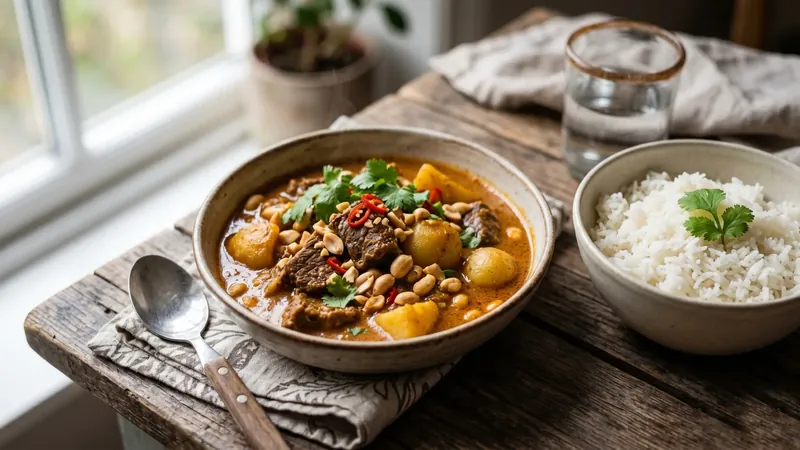
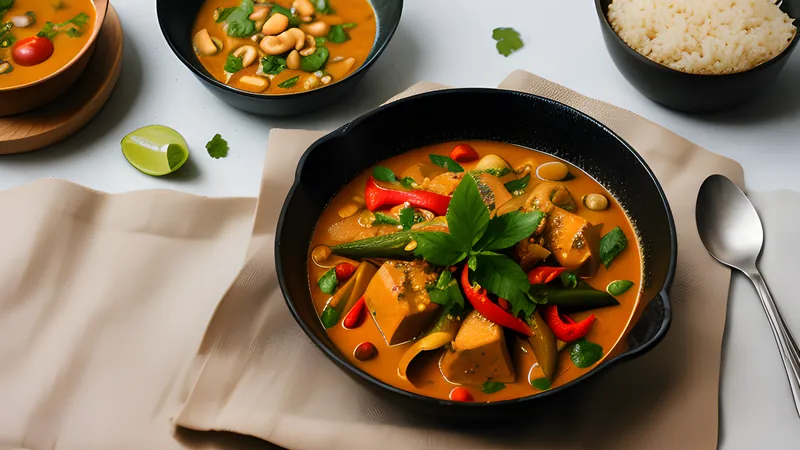
↓ Jump to recipeMost curries want to be thin enough to pool round the rice. Panang wants the opposite: a sauce reduced until it sits on the meat like a glaze, split with visible beads of coconut oil, thick enough that a spoon dragged through it leaves a trail that doesn’t close up. If your panang looks like a soup, something went wrong two steps back — usually the cream wasn’t reduced hard enough before the paste went in.
Panang Curry With Peanut and Kaffir Lime
Ingredients
- 400g beef chuck or brisket, sliced against the grain into thin strips (or 500g chicken thigh, cubed)
- 2 x 400ml tins full-fat coconut milk, unshaken
- 4 tbsp panang curry paste (shop-bought Maesri or Mae Ploy work; see notes for a from-scratch version)
- 60g roasted unsalted peanuts, ground to a coarse meal
- 2 tbsp palm sugar, grated
- 2 tbsp fish sauce
- 1 tbsp tamarind concentrate
- 6 kaffir lime leaves, spine removed, 4 shredded to hair-thin ribbons and 2 left whole
- 1 red chilli, sliced on the diagonal, for garnish
- 2 tbsp vegetable oil (only if using shop-bought paste that hasn't been fried already)
- steamed jasmine rice, to serve
Method
- Chill the tins of coconut milk if you have time — the cream separates and rises, which makes the first step easier.
- Open the tins without shaking. Spoon off the thick cream from the top of both tins into a wok or wide, heavy pan — you want roughly 150ml of cream. Set the remaining thin coconut milk aside.
- Heat the cream over medium heat, stirring, until it splits and the oil starts to bead and separate at the edges — this takes 6-8 minutes and is the step that gives panang its depth, so do not rush it.
- Add the curry paste and fry in the split cream for 4-5 minutes, stirring constantly, until it darkens slightly and smells toasted rather than raw.
- Add the beef or chicken and turn to coat in the paste. Cook for 2-3 minutes until the outside is no longer pink.
- Pour in the reserved thin coconut milk. Bring to a gentle simmer and cook, uncovered, for 15-20 minutes for beef or 10-12 minutes for chicken, until the meat is tender and the sauce has reduced and thickened.
- Stir in the ground peanuts, palm sugar, fish sauce, tamarind concentrate and the two whole kaffir lime leaves. Simmer for a further 5 minutes until the sauce clings to the back of a spoon.
- Taste and adjust — more fish sauce for salt, more palm sugar to round out the heat, more tamarind if it needs brightness.
- Remove the whole lime leaves. Spoon into shallow bowls, scatter with the shredded lime leaf and sliced chilli, and serve with jasmine rice.
Where panang sits among Thai curries
Panang is often filed as “a milder red curry” and that undersells it. Red curry (gaeng phet) and green curry share a base of chilli, galangal, lemongrass, garlic and shrimp paste pounded into a paste, then loosened with coconut milk into something you’d happily eat with a spoon on its own. Panang takes a version of that same red paste and pushes it toward a satay — ground peanuts go in, the coconut milk is reduced rather than added at volume, and the whole dish stays close to the pan rather than spreading into a bowl of broth. It’s closer in texture to a dry-fried Massaman than to a green curry, even though the paste itself descends from the same chilli-galangal family as Thai green curry and Massaman.
The name is disputed territory. Some cookbooks trace it to Penang, on the Malaysian side of the strait, and point to a shared taste for ground peanuts in a curry base as evidence of trade contact. Thai food historians push back — Penang-style curries in Malaysia don’t actually resemble panang all that closely, and the dish reads as thoroughly Thai in construction: same paste-frying technique as every other Thai curry, same reliance on fish sauce and palm sugar for the salt-sweet spine, same use of kaffir lime as the top note. The likeliest answer is that the name migrated without the recipe following it, which happens constantly in food history and rarely gets resolved by anyone insisting harder.
What’s not disputed is the texture. Restaurant panang that arrives thin and orange has been made with a paste diluted straight into thin coconut milk with no reduction step. The dish is meant to be rich enough that a small bowl is a full meal, the sauce thick enough to sit on rice rather than run through it, and the peanut flavour present as texture, not just as an aftertaste from a spoonful of peanut butter stirred in at the end.
The technique that actually matters: cracking the cream
Every Thai curry recipe worth following starts with “cracking” the coconut cream — heating the thick cream that rises to the top of an unshaken tin until the fat separates from the milk solids and you see oil beading at the surface. Skip this step and fry the paste in oil instead, and you lose the specific toasted-coconut depth that separates a good curry from one made by just tipping everything into a pan at once.
The physics are straightforward: coconut cream is roughly 20-24% fat. Left alone in a tin, that fat rises and concentrates. Heated slowly without stirring too aggressively, the proteins and sugars in the milk solids brown very slightly against the hot pan while the fat renders out around them — you get a shallow fry happening inside the cream itself. It takes patience and a pan that isn’t too thin, because thin pans scorch the solids before the fat has had time to separate. A wok works well because the wide surface area speeds up the process without concentrating heat on one small patch.
Panang leans on this step more than most curries because so little liquid gets added afterwards. If the cream isn’t properly cracked, the paste never gets a real fry and the whole curry tastes flat and vaguely gritty rather than layered.
Ground peanuts vs peanut butter
Reach for a jar of peanut butter and the curry will taste sweeter and smoother than it should, because most jarred peanut butter carries added sugar and an emulsified texture that doesn’t match the slightly gritty bite panang is built around. Roasted peanuts, blitzed in a food processor or pounded in a mortar until coarse rather than smooth, keep some texture in the finished sauce and let the nut flavour read as savoury rather than dessert-adjacent. If a food processor turns the peanuts into paste before you’ve reached the texture you want, stop a few pulses earlier than feels right — the sauce will smooth the rest of the way as it simmers.
Meat and timing
Beef chuck, sliced thin against the grain, holds up to the full simmer and picks up more flavour from a longer cook. Chicken thigh works if you want a faster dinner — cut it small and it’s tender in under 15 minutes, whereas beef wants closer to 20 to break down properly without turning tough. Either way, slice the meat thin. Thick chunks either undercook in the time the sauce needs to reduce, or force you to simmer so long the sauce over-reduces and starts to split unpleasantly rather than glossily.
Prawns are the other common option and need almost no cooking at all — add them in the last 3-4 minutes so they don’t turn rubbery, and skip the initial browning step entirely since there’s no fond to build with shellfish.
Kaffir lime leaf: two textures, one ingredient
The leaves do two different jobs in this recipe and get cut two different ways for it. Whole leaves, torn slightly to release oil but left in large pieces, simmer in the sauce and are fished out before serving — their job is to perfume the curry without anyone biting into a leathery leaf at the table. Shredded leaves, cut with scissors into threads as fine as you can manage after removing the tough central spine, go on at the very end as a garnish and are meant to be eaten — the fragrance is far more intense raw than cooked, and the texture is fine enough not to be unpleasant.
If kaffir lime leaves aren’t available fresh, frozen leaves (often sold in Asian supermarkets) work almost as well and keep for months. Dried leaves are a distant third option — the essential oils that carry the citrus-floral smell degrade badly in drying, so a dried leaf mostly just adds a vague bitterness.
Making your own paste from scratch
Shop-bought panang paste is genuinely good and most Thai home cooks reach for a jar on a weeknight, but a from-scratch version is worth making at least once to understand what the jar is standing in for. Pound or blend together 8 dried long red chillies (soaked in hot water until soft, seeds removed for less heat), 2 stalks lemongrass (tough outer layers removed, sliced thin), a thumb of galangal, 4 garlic cloves, 2 shallots, a teaspoon of shrimp paste, a teaspoon of coriander seeds and half a teaspoon of cumin seeds toasted briefly in a dry pan, the zest of a kaffir lime, and a tablespoon of roasted peanuts. Pound in a mortar in the order listed, driest ingredients first, until you have a thick, fairly smooth paste — a food processor works too, though it never quite matches the texture a mortar gives, since pounding bruises and releases oils that blending simply purées without. This makes roughly the 4 tablespoons the recipe calls for, and any extra keeps in the fridge under a film of oil for a week, or freezes in an ice cube tray for months.
What can go wrong
A thin, orange, soup-like panang almost always traces back to skipping or rushing the cracked-cream step — either the cream wasn’t hot enough for long enough to split, or thin coconut milk got tipped in alongside the cream from the start rather than held back until after the paste has fried properly. If your finished curry looks more like a red curry than a glaze, there’s no fixing it at the end by simmering longer without adding more reduced cream or extra ground peanuts to bring the body back.
A gritty, separated sauce that looks slightly curdled rather than glossy usually means the heat was too high once the coconut milk went in, particularly after the peanuts are stirred through — coconut-based sauces can split if boiled hard rather than kept at a gentle simmer. Bring the heat down and swirl gently rather than stirring vigorously if you see this starting to happen; a curry that’s just begun to split will often re-emulsify with patience and a lower flame, though one left to boil hard for several minutes may not fully recover.
An overly sweet, one-note curry usually means the palm sugar and fish sauce went in without tasting as you went — panang wants a proper three-way balance of salt, sweet and the sour brightness from tamarind, and skewing any one of them out of proportion flattens the other two. Add each in stages, tasting between additions, rather than measuring once and moving on.
Serving and what to put alongside it
Jasmine rice is non-negotiable — the curry is thick enough that it needs a neutral, slightly sticky base to sit on rather than a loose grain that lets the sauce run off. A side of pickled vegetables or a simple cucumber relish cuts through the richness, since panang carries more fat than a thin red curry and benefits from something acidic on the side. If you’re building a full Thai spread, panang sits well next to something clean and sour, such as a bowl of tom yum goong — the hot-sour brightness of the soup resets the palate between spoonfuls of the denser curry.
Storage and make-ahead
Panang curry keeps well and, like most curries built on a fried paste, tastes better the next day once the flavours have had time to settle. Cool it fully before refrigerating, and it will keep for up to three days in an airtight container. Reheat gently in a pan over low heat, adding a splash of water or thin coconut milk if the sauce has thickened past the point of comfort in the fridge — it firms up considerably once cold. Panang also freezes acceptably for up to two months, though the sauce may need a brief whisk after thawing to bring it back together, since coconut-based sauces can separate slightly on freezing and rejoin with gentle heat and stirring.
A note on shop-bought paste
Not every panang paste on the shelf is labelled correctly — some jars sold as “panang” are simply red curry paste with a different label, and the peanut content has to be added separately by you at the cooking stage regardless. Check the ingredient list if you can: a genuine panang paste usually lists ground peanuts or peanut oil among the ingredients, though even then, adding your own extra spoonful of ground roasted peanuts at the simmering stage makes the difference between a curry that merely mentions peanut and one built around it.
Related Content