Otak-Otak: Fish Paste Grilled in Banana Leaf
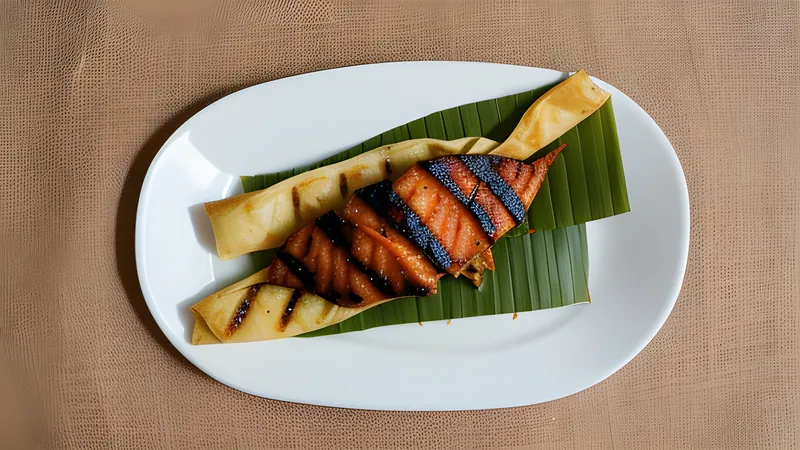
spiced fish paste folded into banana leaf parcels and grilled over charcoal until the leaf chars and the custard sets
Contents
↓ Jump to recipeOtak-otak means “brains” in Malay, a blunt, unglamorous name for a dish that, once cooked, has the soft, faintly wobbly texture of a savoury custard rather than anything resembling the organ it’s named after. Spiced fish paste, thickened with egg and a little coconut milk, is folded into a banana leaf parcel and grilled until the leaf chars and the mixture inside sets — a technique found with local variations across Malaysia, Indonesia and Singapore, wherever coastal communities had ready access to both fresh fish and banana leaves large enough to wrap it in.
Otak-Otak: Fish Paste Grilled in Banana Leaf
Ingredients
- 500g skinless mackerel fillet, roughly chopped
- 6 dried red chillies, soaked in hot water until soft
- 3 fresh red chillies
- 6 shallots, peeled
- 3 cloves garlic, peeled
- 15g fresh galangal, peeled
- 15g fresh turmeric, peeled, or 1 tsp ground turmeric
- 1 tsp shrimp paste (belacan), toasted
- 4 kaffir lime leaves, very finely shredded
- 150ml thick coconut milk
- 2 eggs
- 1.5 tbsp rice flour
- 1.5 tsp salt, plus more to taste
- 1 tsp sugar
- 2 tbsp vegetable oil
- banana leaves, cut into 20cm squares and softened over a flame
- cocktail sticks or kitchen string, to secure the parcels
Method
- Blend the soaked dried chillies, fresh chillies, shallots, garlic, galangal, turmeric and toasted shrimp paste to a smooth paste.
- Fry the paste in the oil over medium heat for 6-7 minutes, stirring often, until it darkens and no longer smells raw, then leave to cool slightly.
- Blitz the mackerel in a food processor with short pulses until finely minced but still textured, not a smooth puree.
- Combine the minced fish, cooled fried paste, kaffir lime leaf, coconut milk, eggs, rice flour, salt and sugar in a bowl, mixing until smooth and well combined.
- Fry a small spoonful of the mixture in a little oil to test the seasoning, adjusting salt and chilli to taste.
- Spoon 2-3 tbsp of the mixture into the centre of each softened banana leaf square.
- Fold the leaf over the mixture to form a flat parcel, securing each end with a cocktail stick or a tied loop of kitchen string.
- Grill the parcels over medium-high charcoal or under a hot grill for 8-10 minutes a side, until the leaf chars in places and the mixture inside has set firm.
- Rest for 2 minutes before unwrapping.
- Serve warm, straight from the leaf.
A dish shaped by what was locally available
Otak-otak’s basic method — mince fish, mix it with spice paste and a setting agent, wrap it in a large leaf and cook it directly over fire — belongs to a much broader family of Southeast Asian steamed or grilled fish parcels found from Cambodia to the Philippines, each shaped by whatever leaf, spice paste and thickener was locally abundant. In Malacca and Johor, where this recipe is most closely rooted, banana leaf is the standard wrapper, chosen for its size, flexibility once heated, and the faint grassy aroma it imparts as it chars against direct heat. Coastal communities without ready mackerel access have historically used other oily fish instead, and versions further inland occasionally use freshwater fish, though the flavour and setting properties change somewhat with a leaner fish.
Mackerel’s oil is doing structural work, not just flavour
Mackerel is the standard choice for otak-otak, and its natural oiliness matters beyond simply adding richness — the fat helps the mixture set into a cohesive, sliceable custard rather than a dry, crumbly mass once it hits direct heat. A leaner white fish can be used, but the finished texture will be noticeably firmer and less silky, closer to a fish cake than the soft, custard-like set mackerel gives. If mackerel isn’t available, look for another oily, firm-fleshed fish rather than substituting something delicate like sole, which lacks both the fat content and the structural firmness the mixture needs to hold together once minced and mixed with egg.
Why egg, coconut milk and rice flour all appear together
Three separate ingredients are working to set otak-otak’s texture, each doing a slightly different job. Egg is the primary setting agent, coagulating under heat the same way it does in a custard or a quiche filling, giving the mixture its soft, cohesive set rather than leaving it loose and sauce-like. Coconut milk adds richness and a faint sweetness, and crucially keeps the mixture from turning rubbery the way egg alone, cooked hard, tends to — it’s the same balancing act a good custard recipe relies on, richness moderating the firming effect of egg protein. Rice flour, used in a small quantity, adds just enough starch to help everything bind together without making the texture gluey or dense, unlike wheat flour, which would give a noticeably heavier, doughier result if substituted in the same quantity.
The paste: essentially asam pedas’s cousin, cooked differently
The spice paste behind otak-otak — dried and fresh chilli, shallot, garlic, galangal, turmeric and toasted shrimp paste — draws on almost exactly the same aromatics found in asam pedas, the sour chilli fish stew from the same coastal Malay tradition, though here it’s fried, cooled and folded directly into a fish mixture rather than loosened into a soured, simmering gravy. Frying the paste before it meets the fish matters just as much here as it does in any curry base: raw shallot, garlic and chilli have a sharp, unrounded edge that a few minutes in hot oil resolves into something deeper and rounder, and skipping that step leaves the finished parcels tasting harsh rather than balanced, no matter how well seasoned the mixture otherwise is.
Softening banana leaf without splitting it
Banana leaf needs a few seconds of direct heat — passed quickly over a gas flame or laid briefly in a hot, dry pan — to soften enough to fold without cracking along its ribs. Skipping this step is the most common reason a home cook’s first attempt at wrapping banana leaf ends in a split, leaking parcel rather than a neatly sealed one; the leaf is genuinely brittle when cold and genuinely pliable once warmed, and the difference between the two states is obvious within a few seconds of exposure to heat. If banana leaf genuinely isn’t available, baking paper wrapped in a double layer of foil is a workable substitute for holding the shape and the moisture during grilling, though you lose the faint charred, grassy aroma the real leaf contributes as it cooks directly over flame.
Two shapes, two names, and where you’ll meet each
Otak-otak turns up in at least two distinct forms depending on where you find it. The flat, folded banana leaf parcel described in this recipe is common across Malacca, Johor and much of Peninsular Malaysia, grilled directly and eaten straight from the leaf as a snack. In Singapore and parts of Indonesia, particularly around Palembang and the Riau islands, a firmer, more cylindrical version — sometimes wrapped tightly and steamed rather than grilled, or grilled after steaming for a firmer bite — is more commonly seen, closer in texture to a fish sausage than the softer, custard-set version here. Both trace back to the same basic idea of spiced, minced fish set with egg and wrapped in leaf, and the differences mostly reflect local preference for grilled char versus a firmer steamed bite rather than any fundamental disagreement about what the dish should be.
Grilling over charcoal versus other heat sources
Charcoal is the traditional and, by a real margin, the best method for cooking otak-otak, since the parcels are meant to char and blacken slightly on the outside of the leaf while the mixture inside stays soft and just set — a contrast between the leaf’s smoky, slightly bitter char and the mixture’s gentle richness that a purely indoor cooking method struggles to fully replicate. A hot grill pan or an oven grill setting gives a reasonable result and is the realistic option for most kitchens without outdoor charcoal access, though expect less of the actual charring on the leaf itself and a milder smoke flavour overall. Whichever method you use, resist the urge to turn the parcels more than once; too much handling risks the mixture leaking from the folded seam before it’s had time to set.
Testing doneness without unwrapping every parcel
A cooked otak-otak parcel should feel firm rather than liquid when pressed gently through the leaf — press the centre of a parcel with a finger or the back of a spoon, and if it gives with a slight wobble similar to a set custard rather than sloshing like liquid, it’s ready. Unwrapping one test parcel from the batch is a reasonable way to confirm doneness the first few times you make this, since the visual cue of a fully set, slightly glossy interior is easier to judge by eye than by touch alone through the leaf.
The role of kaffir lime leaf in an otherwise heavy mixture
Kaffir lime leaf, shredded as finely as possible before it goes into the mixture, is one of the few genuinely bright, sharp notes in an otherwise rich, oily fish paste, and it’s worth taking the time to shred it properly rather than tearing it roughly. Finely shredded leaf distributes evenly through the mixture, giving small, consistent bursts of citrus aroma in every bite, where roughly torn leaf tends to clump in a few spots and leave the rest of the parcel without much lift at all. If fresh kaffir lime leaf isn’t available, frozen leaves work almost as well and are commonly stocked at Asian grocers specifically because they hold their aroma far better frozen than dried leaves do, which lose most of their essential oil in the drying process and contribute little more than a faint, generic citrus note by comparison.
Serving and what to eat alongside it
Otak-otak is most often eaten as a snack or starter rather than a main course, served on its own straight from the unwrapped leaf, sometimes with a little extra sambal on the side for anyone who wants more heat than the parcel itself carries. It also works well grilled and then flaked into a bowl of warm rice for a more substantial meal, or served alongside sate lilit, another minced-fish-and-spice-paste dish from a related tradition further east, if you want to put together a wider spread of grilled, leaf-and-lemongrass-adjacent fish dishes from across the region.
What tends to go wrong, and how to fix it before it hits the grill
The most common problem is a mixture too loose to hold its shape once folded, usually from under-blitzing the fish so it hasn’t bound properly with the egg and rice flour, or from a paste added while still hot enough to start cooking the egg prematurely. Let the fried paste cool for a few minutes before mixing it into the raw fish and egg, and check the test patty holds a soft but distinct shape when fried rather than spreading thin — if it spreads, a little extra rice flour, added a teaspoon at a time, tightens the mixture without making it dense. The second common issue is scorching the banana leaf right through before the mixture inside has set, usually from grilling over too fierce a heat; medium-high rather than the hottest part of the grill gives the leaf time to char attractively while the interior catches up, and moving the parcels to a cooler part of the grill if they’re colouring too fast is a reasonable mid-cook adjustment.
Storage, and why otak-otak doesn’t keep as well as heartier dishes
Cooked otak-otak keeps for only about two days refrigerated before its soft, custard-like texture starts to break down and turn watery on reheating — this is a dish built to be eaten fresh off the grill rather than one designed for long storage, unlike the sturdier curries and stews elsewhere in this kitchen. Uncooked, wrapped parcels freeze well for up to a month; freeze them flat on a tray until solid before transferring to a bag, and grill from frozen with a few extra minutes on each side rather than defrosting first, which tends to make the raw mixture weep liquid before it ever reaches the heat.
Related Content