Nacatamal: Nicaragua's Sunday Parcel
A whole Saturday's work, folded into a plantain leaf and steamed overnight
Contents
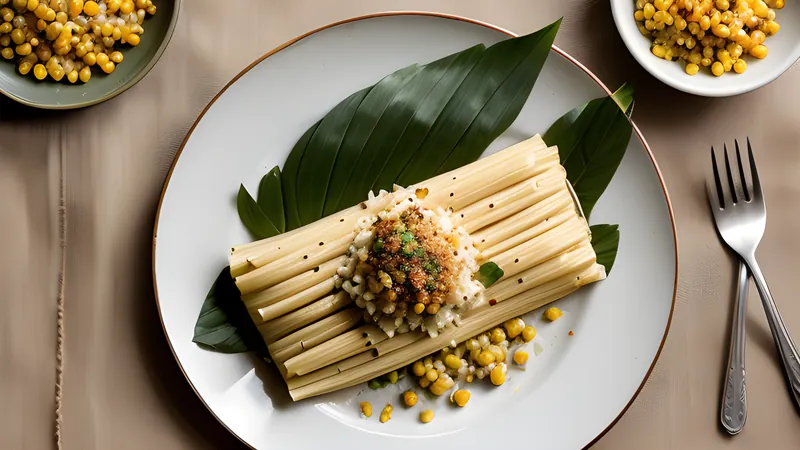
↓ Jump to recipeIn most Nicaraguan households, Saturday night belongs to the nacatamal. Someone marinates the pork, someone else soaks the rice, the masa gets mixed in a bowl big enough to need two hands, and the whole family sits around the table folding leaves until there’s a stack of parcels ready for the pot. They steam for hours, often overnight, and by Sunday morning there is a nacatamal for anyone who wants one, unwrapped at the breakfast table with a cup of coffee and, ideally, nowhere to be for the rest of the morning.
Nacatamal: Nicaragua's Sunday Parcel
Ingredients
- 1 kg pork shoulder, cut into 10 chunks
- Juice of 4 sour (Seville) oranges, or 2 limes plus 2 regular oranges
- 8 garlic cloves, crushed
- 1 tbsp fine salt, plus more for the masa
- 1 kg masa harina (or fresh corn masa)
- 200 g lard, or unsalted butter
- 2 tbsp annatto (achiote) seeds
- 1 litre warm chicken stock
- 2 tsp fine salt, for the masa
- 1 tsp sugar
- 200 g long-grain rice, rinsed and soaked 20 minutes
- 3 medium potatoes, sliced 1 cm thick
- 2 tomatoes, sliced
- 1 large white onion, sliced into rings
- 1 green bell pepper, sliced into strips
- 20 pitted green olives
- 20 pitted prunes
- 20 sprigs fresh mint (hierbabuena)
- 10 large plantain or banana leaves, wilted over a flame, plus kitchen string
Method
- The night before, combine the pork chunks with the sour orange juice, crushed garlic and 1 tablespoon salt in a bowl. Cover and marinate in the fridge overnight.
- Melt the lard in a small pan with the annatto seeds over low heat for 5 minutes until the fat turns deep orange-red, then strain out the seeds. Return the strained fat to the pan and cook over medium heat, swirling, until it turns golden and smells toasted and nutty, 3 to 5 minutes. Set aside to cool slightly.
- In a large bowl, mix the masa harina with the warm stock, the browned fat, 2 teaspoons salt and the sugar. Work it into a smooth, thick, spoonable paste, similar to a stiff porridge.
- Lay a wilted leaf flat, shiny side up. Spread a scant cup of the masa in the centre in a rough rectangle. Scatter a tablespoon of soaked rice over the masa, then top with a potato slice, a piece of marinated pork with a little of its marinade, a tomato slice, an onion ring, a strip of pepper, two olives, two prunes and a sprig of mint.
- Fold the leaf up and over the filling from both long sides, then fold in the ends to make a tight rectangular parcel, so the filling cannot leak. Tie firmly with kitchen string or strips of leaf. Repeat with the remaining leaves and filling.
- Stand the parcels upright or stack them in a large steamer or a big pot fitted with a rack, seam side down, cover with a lid, and steam over gently boiling water for 3 to 3.5 hours, topping up the water as needed, until the masa is fully set and pulls cleanly from the leaf.
- Rest the parcels for 10 minutes before unwrapping. Serve hot, straight from the leaf, with bread and coffee alongside.
A tamale, but not quite
Nacatamal belongs to the same broad Mesoamerican family as the Mexican tamal and the Honduran tamalito, corn dough steamed inside a leaf, but it is a considerably bigger and more heavily loaded proposition than most of its relatives. Where a Mexican tamal is often a single mouthful-scaled parcel with one filling, a nacatamal is closer to an entire meal folded into one leaf: masa, rice, potato, a substantial piece of marinated pork, tomato, onion, pepper, olives, prunes and a sprig of mint, all cooked together for three or more hours until the flavours have fully exchanged across every layer. The name comes from the Nahuatl nacatamalli, meat tamale, and the dish likely arrived in its current form through the same pre-Columbian corn culture that produced tamales across the wider region, then accumulated its distinctly Nicaraguan additions of sour orange, olives and prunes over the centuries since.
The prunes and olives are the detail that surprises people who haven’t eaten nacatamal before, since neither reads as an obviously Central American ingredient. Both entered Nicaraguan cooking through the same Mediterranean and Spanish colonial trade routes that brought olives to much of Latin America’s festive cooking, and by the time nacatamal took its current shape, the sweet-salty contrast of a prune and an olive tucked next to rich pork had become as fixed a part of the dish as the corn itself. Leave either out and Nicaraguans will tell you, correctly, that what you’ve made isn’t quite a proper nacatamal.
Why Sunday
Nacatamales take real time, both in prep and in the three-plus hours of steaming, which is precisely why they landed on Sunday rather than becoming an everyday food. Assembling a batch is genuinely a two-person job at minimum: someone spreading masa while someone else builds the filling, and a proper Saturday-night session for a big family can mean forty or fifty parcels going into the pot, enough for Sunday breakfast with extras to share with neighbours or freeze. That communal, unhurried rhythm is part of the dish’s identity as much as any single ingredient; a nacatamal made alone, quickly, on a Tuesday, misses most of the point even if the technique is identical.
Street vendors sell nacatamales too, wrapped and ready from early Sunday morning, and for many Nicaraguans living away from a family kitchen that’s the more common route to one. But the version made at home, timed so it comes off the steamer just as everyone wakes up, is the one people are nostalgic for, and the one worth the effort of reproducing properly in your own kitchen even if it takes a full afternoon.
The masa, browned
The one deliberate change I’ve made to a traditional nacatamal is browning the annatto-infused lard before it goes into the masa, rather than using it straight from the pan. Traditional recipes melt the fat with the achiote seeds just long enough to tint it red and then mix it warm into the corn dough; letting it cook a few minutes longer, until it turns a shade darker and smells distinctly toasted rather than simply melted, adds a nuttiness to the base masa that carries through the whole long steam. It’s a small change and an easy one, since you’re already melting the fat with the annatto regardless; the only difference is patience at a stage most recipes rush through.
If you’re using butter instead of lard, which works fine and gives a slightly cleaner flavour, the same principle applies: cook it past the point where the foaming stops and the milk solids at the bottom of the pan turn light brown, watching closely since butter scorches faster than rendered pork fat.
Folding without leaking
The fold is the part that intimidates first-timers, and the fix for almost every failure mode is simpler than it looks. Wilt the plantain leaves briefly over a gas flame or in a dry hot pan before working with them; raw leaves crack along the rib when folded, while wilted ones bend without tearing. Spread the masa in a compact rectangle rather than a thin sheet, leaving generous leaf border on all sides, since a tight fold with plenty of leaf to work with seals far better than a stingy one. Fold the two long sides in first so they overlap generously over the filling, then fold the ends in last and tie snugly; a parcel that feels loose before it goes in the steamer will leak once the masa expands and the pork fat renders during cooking.
If a leaf does split, a second layer of leaf wrapped around the outside solves the problem completely and is exactly what Nicaraguan cooks do rather than starting over. Banana leaves, more widely available outside Central America than plantain leaves, are a perfectly good substitute and behave the same way once wilted.
Steaming, storage and the morning after
Give the nacatamales the full three hours minimum; underdone masa stays gluey and separates from the filling rather than binding into the dense, cohesive texture a properly steamed one has. Check doneness by unwrapping one test parcel at the three-hour mark: the masa should pull cleanly away from the leaf in one piece rather than sticking in wet clumps. Keep the steamer water topped up throughout, since three-plus hours is long enough for a pot to boil dry if you’re not checking periodically.
Cooked nacatamales keep, still wrapped, in the fridge for up to five days, and freeze well for up to three months; reheat by re-steaming for 30 to 40 minutes from frozen, or 20 minutes from chilled, rather than microwaving, which dries out the masa unevenly. For a full Nicaraguan Sunday, serve alongside gallo pinto at breakfast the following day if there are leftovers, or pair a fresh batch with vigorón for a bigger spread — between the two, you’ve covered the country’s two most argued-over regional specialities in one sitting.
The sour orange and what it’s doing there
Marinating the pork overnight in sour orange juice, garlic and salt does more than season the meat; the acid in sour orange is considerably higher than in a sweet orange, closer to lime in its effect on protein, and an overnight soak visibly firms and lightly cures the pork before it ever meets the steamer. That’s important given how long the meat will cook: three-plus hours of steaming inside a sealed leaf is a gentle, moist method, more like a confit than a roast, and the marinade is doing work that a dry rub applied just before cooking couldn’t replicate in the same way. If you can’t find sour orange, the lime-and-sweet-orange substitute in the ingredient list gets close enough in acidity and aroma that the difference disappears once everything else in the parcel is in play.
Don’t skip the marinating time even if you’re short on patience elsewhere in the process. Pork marinated for only an hour or two will still taste fine, but it won’t have the faintly cured, deeply seasoned quality that a full overnight soak gives, and given that nacatamal is already a project built around planning a day ahead, there’s little reason to shortcut the one step that benefits most from time.
Mint, and why it matters more than it looks
The sprig of hierbabuena tucked into each parcel looks like a garnish and functions as something closer to a structural ingredient. Steamed for hours alongside rendering pork fat and starchy masa, the mint perfumes the whole parcel with a cooling, herbal note that cuts through the richness in a way nothing else in the filling does; pull it out before folding and the finished nacatamal tastes noticeably flatter and heavier, even though a single mint sprig looks like far too little to matter across an entire parcel. Fresh mint is worth seeking out specifically for this rather than substituting dried, since the volatile oils that make the difference don’t survive drying.
Chicken, and other regional variations
Chicken nacatamal, using bone-in thigh pieces in place of pork shoulder, is a common and entirely acceptable variation, particularly in households keeping halal or simply preferring poultry; marinate and cook it exactly the same way, though check for doneness slightly earlier since chicken thighs cook through faster than a tougher cut of pork shoulder. Some cooks in the Nicaraguan interior add a few capers alongside the olives, or swap raisins in for prunes for a lighter sweetness. Rivas and Masaya, both towns with strong nacatamal traditions, are known for slightly spicier versions with a chile or two blended straight into the masa rather than served on the side, a variation worth trying once you’ve got the base method down.
Size varies by household too. Some families make smaller, single-serving parcels using less masa and a smaller cut of pork, aimed at feeding more people from one batch; others go the opposite direction and make fewer, larger parcels meant to be shared, cut open and portioned out at the table rather than eaten whole by one person. Neither is more authentic than the other; it’s a household decision driven by how many mouths need feeding and how much masa is on hand.
Getting the masa consistency right
The single most common first-attempt mistake is mixing the masa too loose, closer to a batter than a dough. It should hold a rough shape on a spoon and feel like a stiff, spreadable porridge rather than something that pours; if yours seems thin, add masa harina a couple of tablespoons at a time until it thickens, and if it seems too stiff to spread without tearing the leaf underneath, loosen it with a little more warm stock. Getting this right on the first parcel is worth pausing for, since the same batch of masa will fill every remaining leaf, and it’s far easier to correct the consistency in the bowl than to fight a bad dough across forty parcels.
Related Content