Nabeyaki Udon: Udon in an Iron Pot
A single-serving hotpot of udon, tempura and egg, simmered and served in one vessel
Contents
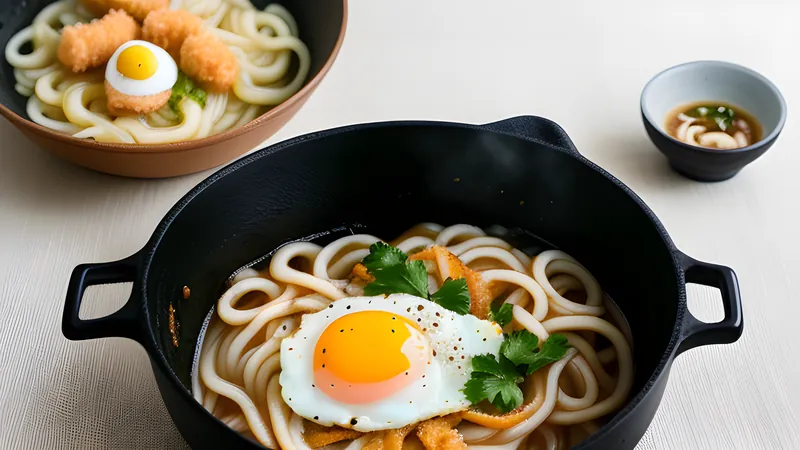
↓ Jump to recipeNabeyaki udon is a single-serving hotpot: thick wheat noodles, chicken, egg and often a piece of tempura, all simmered together in a small individual pot and served still bubbling at the table. Unlike most noodle soups, it isn’t assembled in a bowl after the fact — the pot it’s cooked in is the pot it’s eaten from, arriving at the table mid-simmer with the broth still moving.
Nabeyaki Udon: Udon in an Iron Pot
Ingredients
- 1 portion fresh or frozen udon noodles
- 400ml dashi
- 1.5 tbsp soy sauce
- 1.5 tbsp mirin
- 1/2 tsp salt
- 1 boneless chicken thigh, sliced
- 2-3 shiitake mushrooms, halved
- 2 leaves napa cabbage, roughly chopped
- 2 slices kamaboko (fish cake), optional
- 1 egg
- 1 piece pre-cooked tempura (prawn or vegetable), optional
- A few spinach leaves
- 1 spring onion, sliced, to serve
- Shichimi togarashi, to serve
Method
- Bring the dashi, soy sauce, mirin and salt to a simmer in a small individual pot (a donabe or any small, deep saucepan works).
- Add the sliced chicken and simmer for 3-4 minutes until nearly cooked through.
- Add the shiitake, cabbage and kamaboko if using, and simmer for a further 2 minutes.
- Add the udon noodles — fresh or thawed frozen — and simmer for 2-3 minutes until just tender and heated through.
- Push the noodles slightly aside, crack the egg into the broth, and cover the pot for 60-90 seconds until the white just sets and the yolk is still runny.
- Add the spinach and lay the tempura piece on top in the final 30 seconds, so it warms through without fully softening.
- Bring the pot straight to the table still bubbling, scatter with spring onion, and serve with shichimi togarashi on the side.
Built around the pot
The name literally means “pot-baked udon,” and the traditional cooking vessel — a small clay or cast-iron single-serving pot called a donabe, or sometimes an earthenware dish specifically shaped for this dish — is as central to the recipe as any ingredient in it. Serving the dish directly in its cooking vessel means the broth is still actively simmering when it reaches the table, so the noodles, egg and vegetables continue cooking gently in front of the diner rather than sitting static the way a bowl of ramen does the moment it’s plated.
That continuing simmer changes how the dish is meant to be eaten: the first mouthful, taken quickly, differs from the last, taken several minutes later once the noodles have absorbed more broth and softened further, and the egg has had more time to set. Regulars generally accept and even enjoy this evolution rather than trying to eat quickly enough to avoid it — the dish is built to change as you eat it, and rushing defeats a fair amount of its point.
At home, a small enamelled cast-iron pot, an individual Staub or Le Creuset cocotte, or even a small heavy saucepan that can go straight from stove to table all work as reasonable substitutes for a genuine donabe. What matters is that the vessel retains heat well and looks presentable enough to bring to the table directly, since decanting the dish into a separate serving bowl loses the entire point of the format.
Where this dish comes from
Nabeyaki udon developed as a regional variation within Japan’s much older udon tradition, which itself dates back over a thousand years to wheat noodle-making techniques brought from China. The specific single-pot, table-served format became popular through the twentieth century as a way of offering a complete, substantial meal — carbohydrate, protein, vegetable and egg all in one vessel — without requiring separate side dishes, making it a practical choice for udon restaurants serving fast, filling lunches to workers on a schedule.
Aichi Prefecture, particularly around Nagoya, is often cited as having a particularly strong nabeyaki udon tradition, sometimes serving the dish with thicker, chewier noodles distinct from the standard udon used elsewhere. As with many regional Japanese dishes, exact claims of origin are contested between areas, and the version most commonly eaten today draws on several regional variations rather than one single unbroken lineage.
Layering the ingredients in order
The technique that separates a good nabeyaki udon from a mediocre one is sequencing: each ingredient goes into the pot at the point in the cooking process where it will finish exactly when everything else does, rather than all going in together and getting simmered to the same degree regardless of how each one actually cooks. Chicken goes in first because it needs the longest simmer to cook through safely. Mushrooms and cabbage follow, needing a moderate few minutes to soften without disintegrating. Noodles go in only once everything else is close to done, since they need just two to three minutes to heat through and will turn bloated and mushy if left in simmering broth much longer than that.
The egg and any tempura go in last, in the final couple of minutes, specifically because both are ruined by extended cooking: the egg needs to set into a soft, barely-cooked state rather than a hard-boiled one, and pre-cooked tempura is added purely to warm through, since its entire appeal is a crisp coating that softens further with every extra second in hot broth.
A note on the egg
Cracking a raw egg directly into simmering broth and covering the pot is a gentler technique than it sounds, and it’s worth understanding why it works: the covered pot traps steam that cooks the egg white from above while the surrounding broth cooks it from below and the sides, so it sets faster and more evenly than an egg simply dropped into an open pan. Sixty to ninety seconds is usually right for a white that’s fully set but a yolk that’s still liquid at the centre — check by gently lifting the lid rather than leaving it fully closed the whole time, since pots vary in how much heat they retain.
If you’d rather avoid a raw or barely-set egg altogether, whisk it lightly in a small bowl first and pour it over the noodles in a thin stream in the final thirty seconds, which produces soft egg ribbons through the broth similar in style to a egg-drop soup, fully cooked rather than soft-set.
The broth
Nabeyaki udon’s broth is a simple dashi-based one, closer to the clear soy-forward broth used in shio ramen than to a thick miso or tonkotsu base — it needs to stay light enough that the noodles and toppings remain the focus rather than the broth itself. Dashi, soy sauce, mirin and a little salt is the standard combination; taste it before adding the noodles, since noodles absorb and dilute seasoning as they cook, so the broth alone should taste slightly stronger than what you’d want in a finished bowl.
Using a good dashi matters more here than in some other noodle dishes, because there’s so little else masking it — no thick tare, no rich pork fat, no heavy chilli oil. A proper kombu-and-katsuobushi dashi, or even a good-quality instant dashi powder used generously, gives the broth the clean savoury backbone the whole dish depends on.
Udon: fresh, frozen or dried
Fresh udon, sold refrigerated in vacuum packs at Japanese and well-stocked Asian grocers, gives the best chewy-yet-tender texture and needs only a couple of minutes in the simmering broth to heat through fully. Frozen udon is a close second and, counterintuitively, sometimes has better texture than fresh because the freezing process firms up the noodle’s starch structure — it needs slightly longer, closer to three to four minutes straight from frozen, since there’s no need to thaw it separately first.
Dried udon is the least suitable for this dish specifically, since it needs to be boiled separately in a large pot of water before it can go anywhere near the seasoned broth, which undercuts the whole point of a single-pot dish cooked and served in one vessel. If dried udon is genuinely all you have, cook it separately according to the packet instructions, then add it to the simmering broth just to heat through and pick up flavour in the final couple of minutes, rather than trying to cook it from raw in the seasoned dashi.
Chicken, tempura and other toppings
Thigh meat, sliced thin, is the standard protein — it stays tender through the simmer the way it does in oyakodon, and its fat renders slightly into the broth for extra richness. Kamaboko, the pink-and-white steamed fish cake sliced into decorative rounds, is a traditional garnish more for colour and texture contrast than flavour, though it’s easy to leave out if you can’t find it locally.
Tempura is the topping that defines nabeyaki udon in most people’s minds, and it’s almost always added pre-cooked rather than fried fresh at the table — a single prawn or vegetable tempura piece, added in the final thirty seconds, warms through while keeping some crispness at its very centre even as the outer coating softens in the broth. This is one of the few places in Japanese cooking where slightly softened tempura is the intended, correct texture rather than a failure of technique.
Choosing a pot at home
A genuine donabe, made from a specific heat-resistant clay, is built to go from a direct flame to the table without cracking, and distributes heat slowly and evenly in a way that metal pots don’t quite replicate — if you cook Japanese food regularly, a small one is a worthwhile investment and not especially expensive. Short of that, an enamelled cast-iron cocotte in a single-serving size holds heat well and looks presentable enough to bring straight to the table, which is really the two properties that matter most. A plain stainless steel saucepan works in a pinch but cools faster once off the heat, so the noodles stop actively simmering sooner and the dish loses some of the slow-evolving quality that makes it distinctive.
Whichever pot you use, make sure it has a lid that fits reasonably well — the egg-poaching step depends on trapped steam, and a loose or missing lid means a longer, less even set.
Common mistakes
Adding the noodles too early is the single most common way to ruin this dish — udon left simmering for five or six minutes instead of two or three turns bloated, waterlogged and structureless, having absorbed far more broth than it should and lost its characteristic chewy bite. Set a timer rather than guessing, especially the first few times you make this.
Using a pot that’s too shallow or wide is a subtler problem — nabeyaki udon wants a reasonably deep, narrow vessel that keeps the broth level high enough to properly submerge the noodles and toppings, rather than a wide, shallow pan that spreads everything out and cooks unevenly.
Variations
Kitsune-style nabeyaki udon adds a piece of aburaage, sweet fried tofu, in place of or alongside the tempura, borrowing directly from kitsune udon — a reasonable substitution if tempura feels like too much effort for a weeknight pot. Curry nabeyaki udon, with a spoonful of curry roux stirred into the broth, is a popular variant at casual udon restaurants across Japan and gives the dish a completely different character while keeping the same layered cooking technique.
Storage
Nabeyaki udon genuinely doesn’t keep — it’s designed to be eaten fresh from the pot it’s cooked in, and every component from the noodles to the egg degrades within an hour of cooking. If you have leftover broth without noodles or egg, it keeps in the fridge for up to two days and can be the base for a fresh pot the next day, built again from scratch with new noodles and toppings rather than trying to reheat a finished bowl.
Related Content