Mysore Pak: Ghee and Gram Flour Fudge
A palace sweet built from three ingredients and one very hot pan of ghee
Contents
↓ Jump to recipeMysore pak is built from three ingredients — gram flour, sugar and an amount of ghee that looks, the first time you measure it out, like a mistake. It is not a mistake. The ghee is what turns a simple gram-flour-and-syrup paste into something with a genuinely strange, porous, almost aerated texture, closer to a very rich, very dense sponge than to a standard fudge, and getting that texture right is entirely a matter of how the ghee is added and how long the mixture is worked before it sets.
The sweet takes its name directly from Mysore, the Karnataka city and former princely state, and its origin is one of the more specific and well-documented in Indian sweet-making: it is credited to Kakasura Madappa, a cook in the royal kitchens of Mysore Palace during the reign of Krishnaraja Wadiyar IV in the early twentieth century. The story goes that Madappa, experimenting with the palace’s ample supplies of besan, sugar and ghee, produced a new sweet on the spot for the maharaja, who asked what it was called; with no name ready, Madappa reportedly answered simply “Mysore pak” — pak, or paaka, referring generically to a sugar-syrup-based sweet across several South Indian languages. The dish stuck, the name stuck, and it remains one of the very few Indian sweets whose invention can be traced to a specific kitchen and a specific decade rather than lost to general history.
Mysore Pak: Ghee and Gram Flour Fudge
Ingredients
- 250 g besan (gram/chickpea flour), sifted
- 250 g granulated sugar
- 125 ml water
- 400 g ghee, warmed and kept liquid
- 1/4 tsp ground cardamom (optional)
Method
- Grease a 20 x 20 cm tin and line with baking paper. Sift the besan twice to remove any lumps.
- Warm 100 g of the ghee in a small pan until fully liquid. Set the remaining 300 g ghee in a separate pan over a very low heat, kept warm and liquid, ready to add gradually.
- In a heavy-bottomed pan, dissolve the sugar in the water over a medium heat, then bring to a boil and cook to a one-string syrup (a drop between finger and thumb forms a single thin thread when pulled apart), about 5-6 minutes.
- Reduce the heat to low. Add the sifted besan to the syrup in two additions, whisking constantly to break up any lumps as it forms a thick, smooth paste.
- Add the 100 g warm liquid ghee, a few tablespoons at a time, stirring continuously, letting each addition absorb into the mixture before adding the next.
- Continue adding the remaining warm ghee in small additions over 12-15 minutes, stirring constantly over a low-medium heat. The mixture will bubble, loosen, then thicken again each time, gradually turning porous and starting to leave the sides of the pan.
- Stir in the cardamom, if using. When the mixture leaves the sides of the pan cleanly and a dropped spoonful holds a soft shape without spreading, pour immediately into the prepared tin and spread level.
- Let it cool for 3-4 minutes until just set but still warm, then score into squares. Leave to cool completely before breaking along the scored lines.
The two textures
There are, broadly, two styles of Mysore pak made today, and they diverge entirely based on how much ghee is worked in and how long the mixture is cooked. The soft, porous style — the one this recipe makes — has a texture almost like a very dense, ghee-soaked biscuit crumb, full of tiny air pockets that form as the ghee is beaten in gradually and steam escapes the thickening paste; it should give slightly to a bite and almost dissolve on the tongue. The firmer, denser style, sometimes called hard Mysore pak, uses proportionally less ghee added all at once rather than gradually, and is cooked slightly further, producing a texture closer to a compact, chewy fudge that holds a cleaner cut edge.
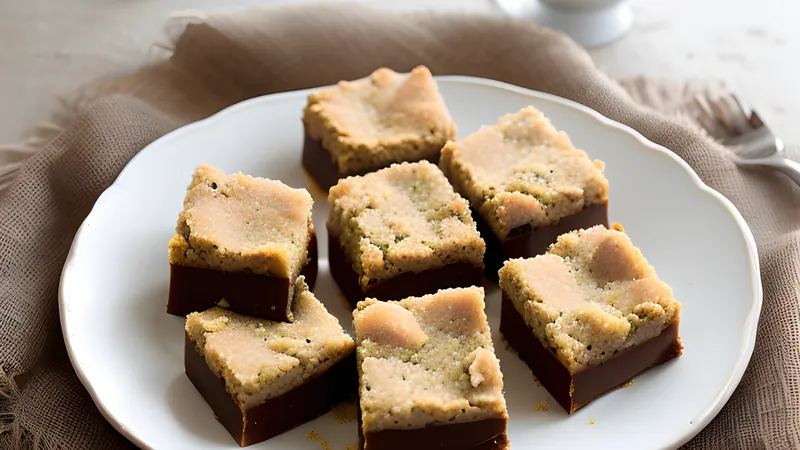
Neither is more authentic than the other — Karnataka sweet shops sell both, often side by side — but they need different techniques, and this recipe is written for the porous version, which most people mean when they picture Mysore pak from photographs: golden, faintly craggy on the surface, riddled with visible air holes when you break a piece in half.
Why the ghee goes in gradually
Adding all 400 g of warm ghee to the besan-and-syrup paste at once would simply flood it, leaving an oily, separated mixture that never develops the porous structure the dish is known for. Adding it in small increments instead, letting each addition fully absorb and the mixture visibly tighten again before the next goes in, forces steam to form and escape repeatedly through the thickening paste as it cooks — this is exactly what creates the network of tiny holes that define the finished texture. Each time the mixture loosens after a ghee addition and then re-thickens, you are watching that structure build, and rushing this stage by adding ghee too fast or too infrequently is the single most common reason home versions come out dense and greasy rather than light.
The syrup stage before the besan even goes in matters just as much. A one-string consistency — checked by pinching a drop of syrup between finger and thumb and pulling them apart to see a single unbroken thread — is the traditional test, and it needs the sugar fully dissolved and the syrup genuinely at that stage before the besan goes in, since an under-cooked syrup leaves the finished sweet too soft to hold its shape, while an over-cooked one crystallises and turns grainy the moment the besan hits it.
Judging when it’s done
The moment to pour is a narrow window, and Mysore pak sets fast once it passes it — within a minute or two of leaving the pan’s sides cleanly, the whole batch can go from pourable to unworkably stiff. Watch for the mixture pulling away from the edges of the pan in one cohesive mass rather than clinging, and test by dropping a small spoonful onto a plate: it should hold its shape in a soft mound rather than spreading flat or, at the other extreme, cracking as it falls. Have the tin greased and lined before you start the ghee additions, because there will be no time to prepare it once the mixture nears readiness.
Besan quality matters more than usual
Because Mysore pak is only three ingredients, each one is doing more work than it would in a more complicated recipe, and besan quality shows up clearly in the finished sweet in a way it might not in a heavily spiced curry. Buy besan from a shop with reasonable turnover rather than a tin that has sat at the back of a cupboard for a year — gram flour turns slightly rancid and bitter as it ages, and that bitterness has nowhere to hide once it is the dominant flavour in a sweet built almost entirely around it. Sifting it twice before use is not fussiness; besan clumps readily, and any lump that survives into the hot syrup will never fully dissolve, leaving a hard, gritty fleck in an otherwise smooth piece.
Some cooks lightly roast the besan in a dry pan for two or three minutes before it goes anywhere near the syrup, which deepens its flavour slightly and removes any last raw, starchy edge. This is not traditional in every household version, and it is easy to overdo — besan scorches quickly once it starts to colour — but a light toast, just enough to smell nutty rather than raw, is worth trying once you are comfortable with the base method, since it produces a rounder, less one-dimensional sweetness in the final piece.
Reading the palace story critically
The Kakasura Madappa story is widely repeated and almost certainly true in its broad strokes, though the precise details — the exact year, the exact words exchanged with the maharaja — vary between retellings the way any orally transmitted kitchen legend does. What is not in dispute is that Mysore pak represents a genuinely different style of Indian sweet-making from the syrup-soaked or milk-based sweets that dominate elsewhere on the subcontinent; there is no soaking stage here, no separate syrup poured over a fried or steamed base the way there is for a jalebi or a rasgulla. The syrup is fully incorporated into the body of the sweet itself, cooked down alongside the besan and ghee rather than added afterwards, which is part of why the dish reads as unusually rich even by the standards of Indian confectionery — every bite carries all three ingredients at once rather than layering a plain base against a separate sweet coating.
What can go wrong
A greasy, oil-slicked Mysore pak, with visible pools of ghee sitting on the surface once it sets, means the ghee was added too fast for the besan to properly absorb it — there is no fixing a batch once this has happened, but next time slow the additions down and make sure each one is fully worked in, with the mixture visibly tightening, before the next goes in.
A dense, hard result with none of the characteristic porous holes usually means the syrup was cooked past the one-string stage before the besan went in, or the whole mixture was cooked too long after the final ghee addition. Pull it from the heat the moment it leaves the pan’s sides rather than cooking a minute or two extra “to be safe” — Mysore pak firms up considerably as it cools, so it should look slightly softer than you want the final result to be at the point you take it off the heat.
A note on equipment
A heavy-bottomed pan is worth insisting on for this recipe specifically, more than for most fudge or sweet-making, because Mysore pak spends a genuine ten to fifteen minutes over direct heat while you work in the ghee, and a thin pan will develop hot spots that scorch the besan against the base long before the rest of the mixture has caught up. Stainless steel or a well-seasoned kadai both work; non-stick is worth avoiding here, since the constant vigorous stirring needed to break up lumps and check the mixture’s progress will scratch a non-stick coating over repeated batches, and there is no benefit to the coating’s non-stick properties in a recipe where you want a small amount of caramelisation at the pan’s edges anyway.
A sturdy, flat-edged wooden spatula or spoon makes the stirring considerably easier than a whisk once the besan has been added, since the mixture thickens well past the point a whisk can move through it efficiently; keep the whisk for the syrup stage only, and switch to a spatula the moment the besan goes in.
Serving, substitutions and storage
Mysore pak is traditionally served in small squares alongside coffee or as part of a larger festive sweet spread, particularly at Diwali. It sits comfortably next to other South Indian sweets with a similar gram-flour or ghee base; a plate of khaman dhokla offers a savoury gram-flour counterpoint from the same pantry, while gulab jamun in cardamom rose syrup makes a soft, syrup-soaked companion for a mixed sweet box.
Ghee cannot be meaningfully substituted here — its high smoke point and specific flavour are structural to the dish, not just a taste choice, and a neutral oil will not develop the same texture at all. Mysore pak keeps at room temperature in an airtight tin for up to two weeks, actually improving slightly over the first day or two as the ghee redistributes evenly through the piece; refrigeration firms it considerably and dulls the ghee’s aroma, so it is worth keeping at room temperature unless your kitchen runs unusually warm. It does not freeze well, since thawing tends to release the absorbed ghee unevenly and leaves a slightly weeping, greasy surface, so treat this as a make-and-share-within-a-fortnight sweet rather than one to bank away for later.
Related Content