Multekrem: Cloudberry Cream
Three ingredients, one berry you cannot farm, and a law written just for it

Contents
↓ Jump to recipeNorway has one berry so contested that it has its own law. A full statute, passed in 1970, carving an exception out of the country’s most cherished principle of public access, for the sake of a small orange fruit that grows in bogs.
That is multe, the cloudberry, and this is the pudding it exists for.
Multekrem: Cloudberry Cream
Ingredients
- 300 g cloudberries, fresh or frozen (Rubus chamaemorus)
- 60 g caster sugar, plus 1 tbsp for the cream
- 400 ml double cream, very cold
- 60 g full-fat crème fraîche, cold
- 1 tbsp aquavit (optional)
- 1 pinch fine sea salt
- 6 krumkake or thin wafers, to serve
Method
- If the berries are frozen, spread them on a tray and thaw in the fridge for 3 hours. Do not thaw at room temperature — the berries collapse and weep.
- Put a third of the berries, about 100 g, into a small bowl with the 60 g sugar and the pinch of salt. Crush them roughly with a fork and leave to macerate for 20 minutes, stirring twice, until the sugar has dissolved into a thick amber syrup.
- Chill the mixing bowl and the whisk in the freezer for 10 minutes.
- Whip the cold double cream with the extra 1 tbsp sugar until it reaches soft peaks — the whisk should leave a trail that slumps back within 2 seconds. This takes about 90 seconds by machine. Stop early; you will fold it further.
- Fold in the crème fraîche with a spatula, in two additions, using no more than 8 strokes in total.
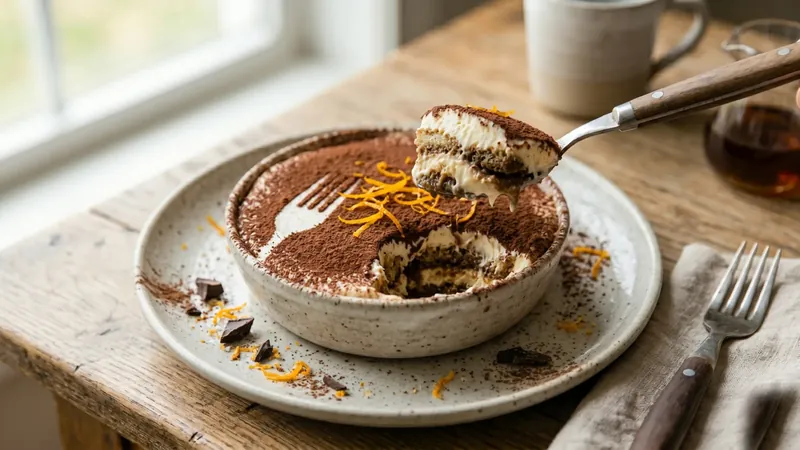
- Pour the macerated berries and their syrup over the cream, add the remaining whole berries and the aquavit if using, and fold with a spatula for no more than 6 strokes. The result should be marbled, with clear streaks of amber and whole berries visible.
- Spoon into a cold serving bowl or into 6 glasses. Chill for 30 minutes and no longer than 2 hours.
- Serve with krumkake cones alongside, and let people fill their own.
Molte, multe, hjortron, lakka
Rubus chamaemorus is a low herbaceous plant of the northern peat bog, a relative of the raspberry that has almost nothing in common with one. It grows in a ring around the top of the world — Norway, Sweden, Finland, Russia, Alaska, Canada, and in a few relict populations far enough south to be genuine botanical curiosities. It fruits in the second half of July and into August. The berry starts hard and red and, unusually, ripens to amber and softens rather than darkening, so that a patch shifts from ruby to gold over about a week and the ripe ones are the pale ones. Everything about it is backwards.
The flavour is genuinely difficult to describe without reaching for other fruit, and every comparison undersells it. There is apricot in there, and something of a baked apple, and a sharp resinous note that is entirely its own, and a texture of large, distinct drupelets that burst separately. Underripe, it is sour and faintly astringent. Properly ripe, it is one of the two or three best things that grow wild in Europe.
It is also a nutritional outlier. Cloudberries carry around 100 mg of vitamin C per 100 g — several times an orange — and, like lingonberries, a useful load of free benzoic acid, which is why a jar of cloudberries under sugar keeps for a year in a cold cellar without cooking. Nordic ships carried cloudberry preserve as anti-scurvy provisions for centuries, and Arctic expeditions packed it deliberately. A dessert with a public health record is a rare thing.
The law
Scandinavian allemannsretten — the right to roam — lets anyone walk, camp and forage on almost any uncultivated land in Norway, private or not. You may pick berries, mushrooms and flowers essentially anywhere.
Except cloudberries, in the three northernmost counties.
The Outlying Fields Act of 1970 gives landowners in Nordland, Troms and Finnmark exclusive rights to the cloudberries growing on their land. Anyone may still pick and eat them on the spot — the law protects the walker’s handful — and carrying them off requires the landowner’s permission. It is the single largest exception to the right to roam in Norwegian law, and it was written because the alternative was worse.
Cloudberry patches in the far north are family property in a way that has nothing to do with deeds. Locations are inherited and kept quiet. People do not tell you where theirs is, and asking is a mild social offence. Before the 1970 Act there were serious disputes about outsiders arriving in vehicles and stripping bogs that a family had picked for generations, and the disputes were not always confined to words. The statute exists because a berry was worth fighting over.
Why nobody has farmed it
Every fifteen years or so, someone announces that cloudberry cultivation is about to be solved. It never is, and the reasons are structural.
The plant is dioecious — male and female flowers grow on separate plants — so a stand needs both sexes in useful proportion and an obliging pollinator, and cloudberry pollination in a cold bog in June depends heavily on whether the bumblebees are flying. The flowers are also acutely frost-sensitive, and a single late-June frost on an open mire will take out the entire crop of a district. Yields consequently swing by an order of magnitude from year to year with no warning at all.
Then there is the habitat. Cloudberries want acidic, waterlogged, nutrient-poor peat — precisely the conditions that agriculture spent two centuries learning to drain away. Norway and Finland both run serious research programmes, there are cultivars, and the total farmed output remains a rounding error against the wild harvest.
So the price stays where it is: cloudberries in a Norwegian shop cost more per kilo than most cuts of meat, and a good picker in a good year in Finnmark can make a genuinely useful sum in three weeks. Myrens gull, the bog’s gold, is a market description.
Buying them, and the honest word about substitutes
Fresh cloudberries outside the Nordics are close to unobtainable. Your realistic options:
Frozen, from a Nordic food importer. This is the best route and the berries are genuinely good — freezing suits them, and they arrive whole. Thaw in the fridge, on a tray, over three hours. Thaw them on the counter and they slump into orange mush.
Jarred multesyltetøy. Already sweetened, often heavily. If you use it, drain off the syrup, skip the 60 g of sugar entirely, and taste before you add anything.
Substitutes. Here is the honest position: there is no substitute. The usual suggestion is a mixture of apricot and raspberry, which gets you into the right postcode and misses the resin and the texture completely. If you cannot get cloudberries, make Danish red berry pudding instead and be happy. Making multekrem out of apricots is making something else and calling it a Norwegian Christmas.
The twist: 60 g of crème fraîche
Multekrem is three ingredients and there is nowhere to hide, which makes the one change I make worth explaining properly.
Fold 60 g of full-fat crème fraîche into the whipped cream before the berries go in.
Two things happen. The first is flavour: cloudberries are sharply acidic and 400 ml of sweetened double cream is a wall of fat and sugar for that acid to hit. Crème fraîche brings its own lactic tang and a savoury edge that meets the berry halfway, so the bowl stops tasting like fruit sitting on top of cream and starts tasting like one thing.
The second is structural. Whipped cream is a foam stabilised by partially coalesced fat globules around air bubbles, and it is fragile — particularly once you introduce acid and fruit juice, which is exactly what the macerated berries are. Crème fraîche is cultured cream: its proteins are already partially denatured by the lactic fermentation and its fat is more solid at fridge temperature. Folded in, it acts as ballast. A plain multekrem starts weeping syrup at the bottom of the bowl within an hour; this one holds for three.
The aquavit is optional and traditional in a lot of households. One tablespoon, no more — alcohol destabilises a cream foam, and three tablespoons will collapse the whole bowl in front of your guests.
Folding, and the fourteen strokes
The technique is entirely about restraint.
Whip to soft peaks and stop. The trail from the whisk should slump back on itself within two seconds. Every subsequent fold whips the cream further, so a bowl whipped to firm peaks arrives at the table stiff and grainy. Cream taken past that point has begun separating into butter and buttermilk, and there is no recovery — the fat globules have coalesced permanently.
Eight strokes for the crème fraîche, six for the berries. Count them. Multekrem is meant to be marbled, with visible amber streaks and whole berries suspended in it. A uniformly orange bowl is a bowl that has been overworked: the berries are crushed, their juice has thinned the foam, and the texture of individual drupelets bursting — the best thing about the dish — has been mixed out of existence.
Crushing a third of the berries with the sugar first is what lets you get away with so few strokes. The syrup distributes instantly, so the sweetness is even, while the two-thirds you left whole stay whole.
Everything cold. Bowl in the freezer, cream from the back of the fridge. Cream whips fastest and most stably between 2 and 4°C, because the fat globules need to be solid enough to partially coalesce rather than smear.
What goes wrong
Weeping syrup at the bottom. Overfolded, or made too far in advance. Thirty minutes’ chill is the target and two hours is the ceiling.
Grainy. Over-whipped. It is on its way to butter.
Uniformly orange. You folded it like a cake batter. Fewer strokes.
Too sour. Underripe berries. Add sugar to the macerating third, tasting as you go, rather than to the cream.
Too sweet and flat. Jarred jam with the sugar added on top of it. Drain first, always.
Variations
Multekrem med eggedosis. Fold in 2 egg yolks beaten with 30 g sugar until pale and ribboning. Richer, custard-adjacent, and the version served in a lot of western Norwegian households. Use pasteurised eggs if you are feeding anyone frail.
Hjortronparfait. The Swedish direction. Fold the same mixture into 200 ml of whipped double cream stabilised with an Italian meringue, freeze in a loaf tin for 6 hours, and slice. The berries stay soft because their sugar depresses the freezing point, so you get amber pockets in a white parfait.
On skyr. Swap half the cream for thick skyr or strained Greek yoghurt. It stops being a Christmas pudding and becomes a very good breakfast, and it uses half as many cloudberries per person, which given the price is a serious argument.
With brunost. Grate 20 g of brown whey cheese over the top just before serving. The caramel and the sour berry do something unexpected, and it is the sort of thing a Norwegian will try once and either adopt permanently or never mention again.
Christmas Eve
Multekrem is the pudding on 24 December in a very large number of Norwegian households, arriving after the ribbe or the pinnekjøtt when nobody has room for it and everybody eats it anyway. It is served in a single big glass bowl, from the middle of the table, with a stack of krumkake cones next to it so people can fill their own — the wafer stays crisp for about four minutes once filled, which is the reason the two things are never assembled in the kitchen.
The rest of the year it turns up on waffles, on rolled lefse, spooned over rice porridge, or eaten from the bowl with a spoon at half past eleven while the house is quiet.
Three ingredients, a berry with a statute, and fourteen strokes of a spatula. Norway has spent a thousand years in a cold bog and this is what it came back with.
Related Content