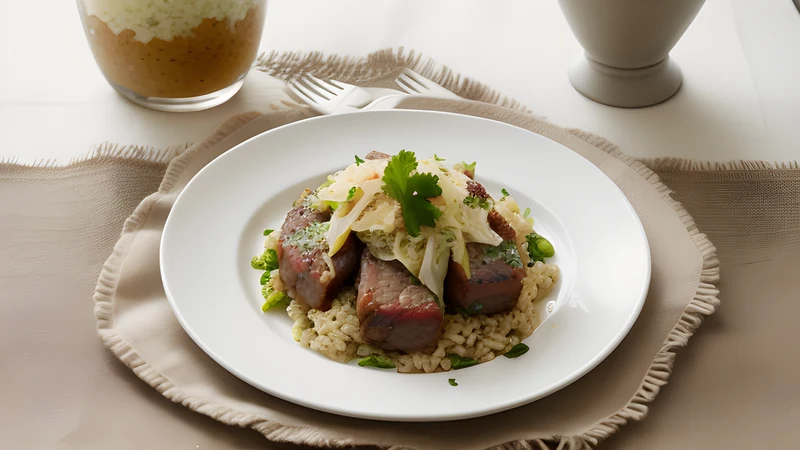
Mulgikapsad: Estonian Pork and Sauerkraut With Barley
The dish that flax money built, and never stopped eating
Contents
↓ Jump to recipeMulgikapsad is a dish that flax paid for. That sounds like a stretch until you look at what happened in Viljandi county in the second half of the nineteenth century, when Estonian farmers in the region called Mulgimaa bought their land out of the manorial system on the back of a flax boom and became, briefly and spectacularly, the richest peasantry in the Baltic provinces. They were known across Estonia by their long black coats, the mulgi kuub, and by a reputation for money that other Estonians found faintly irritating. And they were known for eating pork and sauerkraut with barley in it, which was a rich person’s version of a poor person’s dinner.
The barley is the giveaway. Sauerkraut and pork is what everybody in northern Europe ate through the winter. Adding grain to it makes it go further, but adding good pork to it — a proper belly, plenty of it, not a scrap of salted fat waved over the pot — is what says the household could afford to. Mulgikapsad is a stew with a class marker built into the ratio.
Mulgikapsad: Estonian Pork and Sauerkraut With Barley
Ingredients
- 700 g pork belly or shoulder, skin off, cut into 4 cm chunks
- 1 tbsp lard or neutral oil
- 1 large onion (about 180 g), roughly chopped
- 800 g sauerkraut, drained (keep 150 ml of the brine)
- 120 g pearl barley, rinsed
- 700 ml water or light pork stock
- 2 bay leaves
- 1 tsp whole black peppercorns
- 1/2 tsp caraway seeds
- 1 tsp fine salt, plus more to finish
- 1 tsp caster sugar
- 150 ml reserved sauerkraut brine
- Boiled potatoes and soured cream, to serve
Method
- Pat the pork dry. Heat the lard in a heavy casserole over high heat and brown the pork hard in two batches, 4-5 minutes a batch, until deeply coloured on at least two sides. Lift the meat out onto a plate.
- Drop the heat to medium. Add the onion to the fat in the pot and cook 6-8 minutes until soft and picking up the brown from the base.
- Weigh out 600 g of the drained sauerkraut and add it to the pot. Set the remaining 200 g aside in the fridge. Stir the kraut through the onion for 2 minutes.
- Return the pork and any resting juices. Add the barley, water or stock, bay, peppercorns, caraway, 1 tsp salt and the sugar. Stir once, bring to a bare simmer.
- Cover with a lid set slightly ajar and cook at the lowest simmer for 1 hour 40 minutes, stirring every 30 minutes and scraping the base. The barley will swell and thicken the pot; add a splash of water if it grips.
- Stir in the reserved 200 g raw sauerkraut and the 150 ml brine. Cook uncovered for a final 20 minutes.
- Fish out the bay leaves. Break the pork into rough pieces with a spoon. Taste and adjust salt — it will usually want another 1/2 tsp. The finished pot should be thick enough that a spoon leaves a track that closes slowly.
- Serve in bowls with boiled potatoes and a heavy spoonful of soured cream on top.
The Mulgi, and how a stew got a postcode
Estonian dishes are mostly anonymous. Hapukapsad is just sauerkraut, sült is just brawn, kartulipuder is just mashed potato. Mulgikapsad is one of the very few that carries the name of the people who made it, and that is worth pausing on, because it means somebody outside Mulgimaa was impressed enough to label it.
Mulgimaa is a small area in the south of Estonia, roughly the parishes around Viljandi, Karksi, Halliste, Paistu and Tarvastu. In the 1860s and 1870s the flax trade turned the region into an anomaly: Estonian tenant farmers there bought their farms outright decades before most of the country managed it, and they did so with cash. The wealth was visible — bigger houses, better horses, the black wool coats — and it earned the Mulgi a national reputation for being tight-fisted and pleased with themselves, which is roughly what every farming region says about the one next door that got rich first.
Food followed the money. A household with pigs to spare could put real quantities of pork into a cabbage pot on an ordinary day rather than at a slaughter feast, and mulgikapsad is what that looked like. The name is other Estonians pointing at it. The dish has since gone national, and it turns up now on restaurant menus in Tallinn as often as in Viljandi, generally with the pork sliced neatly on top rather than broken through the pot, which looks better and eats worse.
Mulgimaa’s other export is mulgipuder, potato and barley mashed together with fried pork fat poured over — the same three ingredients, minus the cabbage, arranged differently. Between them the two dishes tell you exactly what the region grew, kept and could afford. The barley, again, is the constant, and the fact that it is toasted to a flour in kama and boiled whole into everything else is the clearest statement Estonian cooking makes about its own climate.
What the pot is actually doing
Three ingredients, two hours, and almost all of the work happens in the interaction between them.
Sauerkraut is cabbage that lactic acid bacteria have already partly digested. It arrives sour, crunchy and aggressive. Under long, gentle heat it goes through a real transformation: the acidity mellows as volatile compounds cook off, the cabbage sugars that survived fermentation begin to caramelise faintly, and the fibres soften from crunchy to silky. Kraut that has been stewed for two hours tastes almost sweet. It also tastes flat, which is the problem this recipe solves.
Pearl barley is doing two jobs. It absorbs the pork fat and the kraut liquor and holds them, so each grain is a small carrier of everything else in the pot. And its starch leaches out into the liquid and thickens it into something between a stew and a porridge. This is exactly the mechanism a risotto uses, and it fails the same way — barley left to sit on the base without stirring will glue itself down and scorch, and once scorched the bitterness is in the whole pot and there is no fixing it. Stir every half hour and scrape properly.
The pork gives fat and gelatine. Belly is right because it has both; shoulder works and gives a leaner, shreddier result. Browning it hard first is the step people skip, and it is the difference between a pot that tastes of pork and a pot that tastes of boiled pork. Those brown fragments in the base go into the onions and then into the whole dish.
The two-stage kraut
Here is the one change I make to the traditional method, and it is small and it fixes the dish’s only real weakness.
Traditional mulgikapsad puts all the sauerkraut in at the start. Two hours later it is mellow, soft and slightly sweet, and it has lost the sharp, bright top note that made you want sauerkraut in the first place. The pot is comforting and a bit monotone.
So hold back a quarter of the kraut, raw and cold, and stir it in for the last twenty minutes along with a splash of its brine. It softens just enough to belong to the dish and keeps its acidity and a trace of crunch. Now every spoonful has both: the deep mellow stewed cabbage underneath and a live sour ping through it. The pork fat has something to push against, and the whole pot lifts.
The brine matters as much as the raw kraut. Sauerkraut liquor is the most concentrated flavour in the jar and most recipes tell you to throw it away. It carries the acidity, the salt and the lactic funk in a form you can dose precisely at the end, when you can actually taste what you are doing.
If you ferment your own — cabbage, salt and time is genuinely the whole of it — you will have brine to spare and kraut with more character than anything in a jar. Shop-bought is perfectly good, provided it is refrigerated and unpasteurised. Pasteurised kraut in a tin has been heated to death already; it will go to mush in an hour and taste of vinegar rather than fermentation.
Getting the barley right
Pearl barley has had its bran polished off, which is why it cooks in under an hour rather than two and why it releases starch freely. Pot barley or hulled barley keeps the bran, takes twice as long and thickens far less — if you use it, add 30 minutes and expect a looser, chewier pot.
Rinse pearl barley under cold water before it goes in. A minute under the tap takes off surface starch and dust, and it stops the first ten minutes of cooking turning gluey. Do not soak it; soaked barley loses the graduated absorption that makes the timing work, and you will get grains that blow out before the pork is done.
The 120 g here is deliberately modest. Estonian recipes vary from 80 g to well over 200 g, and the high end produces something closer to a barley porridge with pork in it, which is authentic and which I find heavy. At 120 g the barley is a texture and a thickener while the cabbage still reads as the main event. If your pot looks thin at the end, take the lid off for ten minutes; if it looks like cement, a ladle of water and a stir will bring it back.
Barley in the sour end of the store cupboard has form all over this part of the world. It thickens rassolnik, the Russian pickle and barley soup the same way, and it is what fills verivorst, the Estonian Christmas blood sausage, where the grains stay whole rather than dissolving. The same grain, doing three different jobs, depending only on how you treat it.
The caraway is doing more than flavour. Caraway and cabbage have been paired across northern Europe for centuries partly because the seed’s essential oils genuinely help with the digestive consequences of a large bowl of fermented brassica, and partly because the anise-adjacent note fills a gap that sauerkraut leaves open. Half a teaspoon is right; a full teaspoon and the pot starts tasting like rye bread.
Salt at the end. Sauerkraut arrives salted, and the amount varies by a factor of two between brands. Season the pot at the beginning as if the kraut were unsalted and you will overshoot badly, with nothing you can do about it two hours later. The 1 tsp in the method is a base; the real seasoning happens in the last five minutes, with a spoon in your hand.
What to serve, and what to leave out
Boiled potatoes and soured cream. Estonians will not negotiate on this and they are correct. The potatoes are neutral ground; they mop and they cool. The soured cream, stirred in at the table so it streaks rather than disappears, is the cold, fatty, gently acidic thing that makes the second half of the bowl as good as the first.
Rye bread on the side is welcome. So is a spoonful of mustard, which nobody in Mulgimaa would recognise and which works.
Do not add tomato. Do not add paprika. Both are pulling towards a Central European kraut stew like Czech vepřo knedlo zelo or Alsatian choucroute garnie, which are good dishes and different dishes. The Estonian version is pale, and its restraint is the point.
Make-ahead, storage and variations
This is better on day two, without qualification. The barley finishes absorbing overnight, the acidity settles and the pork gives up more of itself. Cool it fast, chill it, and reheat gently with a splash of water — it will have set solid in the fridge. It keeps 4 days and freezes for 3 months, though the barley softens further on defrosting.
For a smoky version, swap 200 g of the belly for a piece of smoked hock or a chunk of smoked bacon added whole at the start and shredded in at the end. This is common in southern Estonia and it makes the dish considerably more assertive.
Some households add a peeled, quartered potato to the pot itself, which collapses and thickens further. Some add a tablespoon of pearl barley flour. Both are honest, both are unnecessary if your barley is doing its job.
The sugar is a corrective. One teaspoon against 800 g of sauerkraut takes the hard edge off the acid so the pork can be tasted through it. Leave it out and taste, then add it and taste again — it is the clearest demonstration of what a pinch of sugar does to an acidic braise that I know of.
Related Content