Muffuletta: The Olive Salad Sandwich of New Orleans
A round sesame loaf packed with cured meats, cheese and a vinegary olive salad that needs a night in the fridge to work
Contents
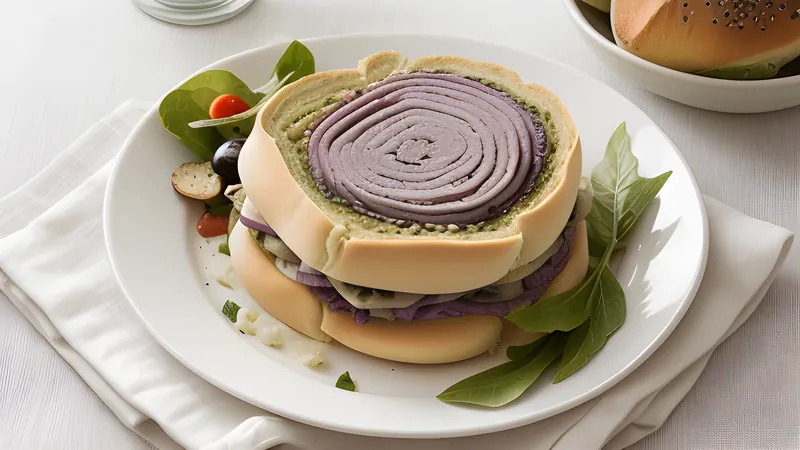
↓ Jump to recipeThe muffuletta is a round loaf split and layered with cured Italian meats and cheese, then piled with a vinegary, oil-slicked olive salad that soaks into the bread rather than sitting as a separate garnish. Unlike most sandwiches, it improves with time under pressure, and a muffuletta eaten the moment it’s assembled is a lesser version of the same sandwich eaten a few hours later once the bread has taken on the olive salad’s oil and acid all the way through.
Muffuletta: The Olive Salad Sandwich of New Orleans
Ingredients
- 1 large round sesame-seeded loaf (about 25cm diameter), such as muffuletta bread or a large focaccia
- 200g pitted green olives, roughly chopped
- 100g pitted Kalamata or other black olives, roughly chopped
- 3 tbsp giardiniera (pickled cauliflower, carrot and celery), chopped, plus 2 tbsp of its brine
- 2 tbsp capers, drained
- 2 garlic cloves, finely grated
- 1 tsp dried oregano
- 120ml olive oil
- 2 tbsp red wine vinegar
- 150g sliced mortadella
- 150g sliced Genoa salami
- 150g sliced capicola (or another cured, peppery ham)
- 150g sliced provolone
- 150g sliced mozzarella or emmental
Method
- Combine the green and black olives, giardiniera and its brine, capers, garlic and oregano in a bowl.
- Stir in the olive oil and vinegar and mix well; this is the olive salad, and it should be loose and spoonable, not a dry chop.
- Cover and refrigerate the olive salad for at least 2 hours, or overnight, to let the flavours meld; it also keeps for up to two weeks in the fridge, so making extra ahead is worthwhile.
- Slice the loaf horizontally in half, and if it's very thick and fluffy inside, pull out a little of the soft crumb from both halves to make more room for the filling.
- Spoon half the olive salad, including its oil, generously over the cut side of the bottom half, letting it soak into the bread.
- Layer the mortadella, salami, capicola, provolone and mozzarella evenly over the olive salad.
- Spoon the remaining olive salad over the meats and cheese.
- Place the top half of the loaf on and press down firmly.
- Wrap the whole sandwich tightly in cling film or foil and weight it down with a heavy pan or a couple of tins for at least 1 hour at room temperature, or refrigerate wrapped and weighted for up to 8 hours.
- Unwrap, slice into wedges and serve; the bread should be softened and stained by the olive oil right through, not just at the surface.
Sicily, by way of the French Quarter
The muffuletta was created at Central Grocery, an Italian grocery store in New Orleans’ French Quarter founded in 1906 by Sicilian immigrant Salvatore Lupo. The story, well documented in New Orleans food history, holds that Sicilian labourers working the docks and markets nearby would come into the shop at lunchtime and order the same combination separately: a piece of round Sicilian-style bread called muffuletta, some cured meats, some cheese, and a scoop of olive salad, then try to eat it all standing up or perched somewhere without a table. Lupo’s insight was simply to combine the components into one sandwich for convenience, splitting the loaf and building it in layers, and the sandwich took the bread’s own name rather than being christened as something new.
Central Grocery still sells muffulettas today, and the sandwich remains closely associated with New Orleans’ Sicilian immigrant community, one of the largest and most historically significant Sicilian populations in the United States, concentrated in the French Quarter through the late 19th and early 20th centuries. The bread itself, round, roughly 25cm across and generously seeded with sesame, is a specific style associated with Sicilian baking traditions, and while it’s sold under the muffuletta name at bakeries across New Orleans, a large round sesame loaf or a thick focaccia gets you close enough if you’re making this outside Louisiana.
The olive salad is the whole point
Most of what makes a muffuletta distinctive from any other layered cold-cut sandwich is the olive salad, and it’s worth taking seriously rather than treating as an afterthought. A proper olive salad combines both green and black olives (the contrast in flavour and colour matters, not just one or the other), giardiniera, the Italian-American pickled vegetable mix of cauliflower, carrot and celery, and enough olive oil and vinegar that the mixture is genuinely wet and spoonable rather than a dry, finely minced relish. Capers add a briny sharpness that rounds out the olives’ flatter salt, and garlic, added raw and finely grated rather than cooked, gives the salad a sharp bite that mellows only slightly as it sits.
Making the olive salad ahead isn’t just a convenience; it’s close to essential. A fresh-mixed olive salad tastes disjointed, individual ingredients rather than a cohesive whole, where a salad rested for at least two hours, and ideally overnight, lets the garlic mellow, the oil pick up the brine’s saltiness, and the whole mixture come together into something that reads as a single flavour rather than a chopped list. Central Grocery and most serious New Orleans delis make their olive salad well ahead of assembling any sandwiches, sometimes keeping a batch going for weeks, topping it up rather than starting fresh each time.
Why the sandwich needs weight and time
Pressing the assembled sandwich under weight isn’t about flattening it for aesthetic reasons; it’s what forces the olive salad’s oil down into the bread rather than leaving it pooled at the surface where the filling meets the crust. An unpressed muffuletta, eaten immediately, tastes like a good cold-cut sandwich with a wet garnish on top; a properly pressed one, given at least an hour and ideally several hours under weight, tastes like a sandwich where the bread itself carries flavour all the way through, softened and stained a faint olive-oil yellow at the cut edge. This is the single most important technique point in the whole recipe, and skipping it is the most common reason a homemade version falls short of the deli original.
If you’re pressing at room temperature rather than in the fridge, don’t leave it much beyond the hour mark given the cured and fresh dairy fillings involved; refrigerated pressing for up to eight hours is the safer option if you want to make the sandwich well ahead of serving, for a picnic or a gathering, and it can come back to room temperature for 20-30 minutes before slicing if you want the cheese and meats at their best texture.
What can go wrong
A muffuletta that tastes flat and disjointed, despite a properly rested olive salad, is usually a pressing problem rather than a seasoning one; if the bread hasn’t spent at least an hour under real weight, meaning something genuinely heavy like a cast-iron pan or a couple of full tins, the oil never migrates far enough into the crumb, and the sandwich reads as a stack of ingredients rather than a unified whole. A soggy, falling-apart sandwich, on the other hand, usually means either the olive salad was too wet going in, in which case drain a little more of the oil off before spooning it on next time, or the loaf itself was too soft and open-crumbed to begin with; a dense, close-crumbed loaf holds up to the oil far better than an airy, holey one. If the olive salad tastes harsh and one-note rather than rounded, it hasn’t rested long enough; raw garlic in particular needs real time, several hours at minimum, to mellow into the mixture rather than sitting on top of it.
Serving and the rest of a Louisiana spread
A muffuletta is traditionally served cut into wedges rather than halves, since a full loaf this size feeds a genuine crowd, and it travels well once pressed and wrapped, making it a natural choice for a picnic in a way that a more delicate sandwich isn’t. If you’re building out a wider New Orleans-inspired spread, it sits well alongside Louisiana chicken and andouille gumbo for a heartier meal, or against something lighter like a simple green salad if the sandwich itself is the main event, since its richness doesn’t need much competition on the same table.
Leftover muffuletta keeps wrapped in the fridge for up to two days, and honestly holds up better than most sandwiches do, since the pressed, oil-soaked bread doesn’t turn soggy the way a fresh lettuce-and-tomato sandwich would; bring it back towards room temperature before eating, since cold refrigerated cheese and cured meat lose most of their flavour and texture straight from the fridge.
How it compares to other pressed sandwiches
The muffuletta belongs to a small family of American sandwiches defined by pressing and immigrant grocery-counter origins, most obviously the Cuban sandwich, which shares the instinct for combining cured pork, cheese and pickle into a single pressed loaf but presses with direct heat on a plancha rather than resting under cold weight, and uses roast pork and ham rather than the muffuletta’s Italian cold-cut trio. Both sandwiches emerged from immigrant grocery and deli culture in port cities with strong Mediterranean and Latin populations, Tampa and New Orleans respectively, and both rely on the bread absorbing moisture and flavour from what’s packed inside it rather than staying a neutral, structural element the way a plain sandwich roll would.
The key difference worth understanding if you’re comparing the two is temperature: a Cuban sandwich is pressed hot, on a griddle, so the cheese melts and the bread crisps; a muffuletta is pressed cold, so the bread softens rather than crisps, and the olive salad’s oil does the work that melted cheese and griddle heat do for the Cuban. Neither method is better, but they produce genuinely different eating experiences from a similar basic idea, and it’s worth making both if you want to understand how much a single variable, heat versus cold weight, can change a sandwich built on a similar principle.
A note on sourcing giardiniera and the bread
Giardiniera, the pickled vegetable mix that gives the olive salad much of its crunch and acidity, is widely sold jarred in the international or pickle aisle of most supermarkets, usually either “mild” or “hot” depending on how much pickled chilli is included; either works here, and the choice is really down to how much heat you want running through the finished sandwich. If you can’t find a jarred version, a rough chop of any pickled cauliflower, carrot and celery mix, even a homemade quick-pickle made a day ahead, does the job just as well. A jar of mixed Italian pickled vegetables sold simply as “antipasto” mix, drained and chopped, is another workable stand-in if giardiniera specifically isn’t stocked nearby, since it carries a similar balance of vinegar, vegetable and oil, though check the jar’s own oil and vinegar content before adding this recipe’s full quantities, in case it’s already quite wet.
For the bread, look specifically for a large, round, sesame-crusted loaf sold as “muffuletta bread” at any bakery with an Italian-American tradition, or fall back on a large focaccia or a round Italian-style loaf with a sturdy but not overly crusty exterior; what you want to avoid is anything with a very hard, crackling crust, since that fights against the pressing process rather than softening and absorbing the olive salad’s oil the way a proper muffuletta loaf does.
Swapping the meats and cheese
The classic trio of mortadella, salami and capicola is what Central Grocery uses, but the sandwich tolerates substitution more readily than its fixed reputation suggests; a good sandwich has come out of swapping in soppressata for the salami, or a milder boiled ham for the capicola if you’re feeding someone who doesn’t want the pepper-crusted heat capicola carries. Provolone is worth keeping as at least one of the two cheeses even if you swap the second, since its sharper, more assertive flavour holds its own against the olive salad in a way a purely mild cheese doesn’t; a muffuletta made with two soft, mild cheeses tends to taste one-dimensional next to the acidity of the salad. Whatever combination you land on, keep the total meat and cheese quantity roughly consistent with what’s listed here, since a muffuletta overloaded with filling relative to bread struggles to press down evenly and becomes difficult to hold together once sliced.
Related Content