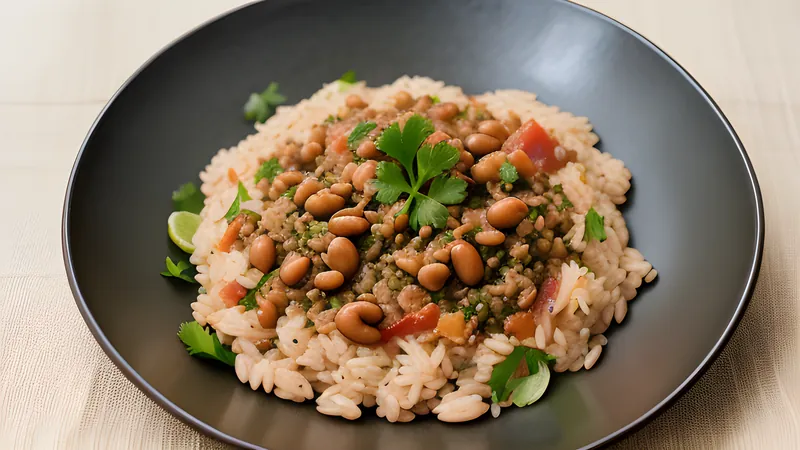
Moin Moin: Steamed Bean Pudding in Leaves
A Yoruba steamed bean custard, wrapped and set until it holds a clean slice
Contents
↓ Jump to recipeMoin Moin: Steamed Bean Pudding in Leaves
Ingredients
- 500g dried black-eyed beans (peeled, or peel yourself)
- 2 red bell peppers, deseeded
- 2 scotch bonnet chillies, or to your own heat threshold, deseeded
- 1 large onion, roughly chopped, plus half a small onion finely diced for the mix
- 150ml red palm oil
- 300ml cold water, for blending
- 2 stock cubes, crumbled
- 1 tsp salt, plus more to taste
- 3 hard-boiled eggs, sliced
- 1 x 200g tin corned beef or flaked smoked mackerel, optional
- 8 banana leaves or moin moin (uma) leaves, or 8 small foil parcels
Method
- Soak the beans in cold water for at least 4 hours, or overnight. Rub the beans between your palms under running water to loosen the skins, then float off the skins by pouring away the water repeatedly until only pale, naked beans remain.
- Blend the peeled beans with the peppers, chillies, roughly chopped onion and 300ml cold water until completely smooth — no visible bean fragments. This takes 3-4 minutes in a high-speed blender.
- Pour the batter into a large bowl. Whisk in the palm oil, diced onion, crumbled stock cubes and salt until the mixture lightens in colour and doubles slightly in volume, about 3 minutes by hand.
- Pass banana leaves briefly over a naked flame or dip in boiling water until pliable. Fold each into a cone, spoon in batter to two-thirds full, add a slice of egg and a spoonful of corned beef, then fold and tie shut with kitchen string.
- Stand the parcels upright in a steamer or a large pot fitted with a rack, packed tightly so they don't tip. Add boiling water to come a third of the way up the parcels.
- Cover and steam over medium heat for 1 hour, topping up boiling water as needed. The pudding is done when a skewer comes out clean and the parcel feels firm and springs back when squeezed.
- Rest for 10 minutes before unwrapping — moin moin firms up further as it cools and slices more cleanly once rested.
The bean that gives up its coat
Moin moin starts as an argument with a bean skin. Black-eyed beans carry a thin, papery hull that has to come off before blending, and there is no shortcut that doesn’t show up later as grit in the finished custard. Nigerian cooks have three ways to do it: rub the soaked beans between their palms under a running tap until the skins float free, spin them in a food processor fitted with a plastic blade for a few short pulses, or buy beans already split and peeled, sold in Nigerian and West African grocers as “moin moin beans” or “peeled beans.” I peel by hand because I like the ten minutes of repetitive work with the radio on, but if a bag of pre-peeled beans is sitting on a shelf near you, buy it and skip straight to blending.
The name moin moin (also spelled moimoi) describes the sound the pot makes as it steams — a soft, rhythmic “moin, moin” as the water knocks the lid. It’s a Yoruba dish from southwestern Nigeria, though it has spread across the country and the wider West African diaspora as party food, church potluck food, and Sunday lunch food in roughly that order of frequency. Where akara takes the same blended bean batter and drops it into hot oil, moin moin takes it in the opposite direction: wrapped, steamed gently, and set into something closer to a savoury custard than a fritter. Same bean, same starting paste, completely different eating experience. If you’ve made akara, you already understand the batter; moin moin is what happens when you don’t fry it.
Why leaves, and why it matters
Traditional moin moin is wrapped in the leaf of Thaumatococcus daniellii, known locally as moin moin leaf or uma leaf, and it isn’t decoration. The leaf is slightly waxy, holds heat evenly, and imparts a faint green, almost tea-like note to the outer layer of the pudding that foil simply cannot replicate. Banana leaf is the closest widely available substitute outside West Africa and does a genuinely good job — pass it over a gas flame for a few seconds per side until it goes glossy and pliable, which stops it cracking when you fold it. Foil works and is what most people outside Lagos actually use, including me on a Tuesday, but it steams the pudding in its own moisture without that leaf perfume, and the finished texture is very slightly denser. Ramekins covered in foil are the laziest and most forgiving option: no folding, no tying, no leaks, and a clean unmoulded pudding if you oil the ramekin first.
Getting the aeration right
The single biggest variable between a moin moin that slices like a firm custard and one that comes out heavy and gummy is how much air gets whisked into the batter before it goes into the leaves. After blending, the raw bean paste looks flat and slightly grey. Whisking in the palm oil by hand, in one direction, for a full three minutes changes its colour to a warmer terracotta and visibly increases its volume — that trapped air is what gives the steamed pudding its characteristic light, slightly spongy interior instead of a dense brick. A stand mixer with a whisk attachment does this in ninety seconds if your wrist gives out first. Skip this step and the beans will still cook, but the result eats more like stiff hummus than a pudding.
Where it sits on the table
Moin moin rarely appears alone. At Yoruba parties it’s plated alongside jollof rice as a textural counterpoint — cool, dense, custard-like protein against hot, loose, smoky grains. At Sunday lunch it often turns up next to a stew rather than rice at all, playing the role a side of baked beans or a savoury bread pudding might play elsewhere: something starchy, something protein-rich, something that can sit at room temperature for an hour without suffering. Church harvest lunches and naming ceremonies lean on it heavily for exactly that reason — it travels well, holds its shape once unwrapped, and scales easily to feed forty people if you have enough leaves and a big enough pot.
It also has a life as breakfast. A slice of cold or gently reheated moin moin next to a mug of tea or a bowl of custard is a normal Nigerian morning, and the pudding’s density means a modest slice is genuinely filling in a way a slice of bread rarely manages. Street vendors sell single portions wrapped in their leaf, still warm from the pot, out of insulated coolers near bus stops and school gates — the leaf keeps the heat in for hours, which is part of why the wrapping tradition has survived decades of cheaper, faster foil.
Method notes
Once the parcels are wrapped, packing them upright and tightly in the steamer matters more than most recipes let on — parcels that lean or float tend to cook unevenly, setting round the edges while the centre stays loose. A pot with a steaming rack, or even scrunched foil balls in the bottom of a stockpot to keep the parcels above the waterline, does the job. Keep the water at a steady simmer rather than a hard boil; a violent boil can force water in through the leaf seams and make the finished pudding soggy at the edges. Check the water level at the halfway mark — an hour of steaming evaporates more than people expect, and a dry pot scorches fast.
The test for doneness is tactile as much as visual: press the top of a parcel gently through the leaf. Raw batter gives immediately and feels liquid; cooked moin moin has a slight spring and resists the pressure. A skewer inserted through the leaf and into the centre should come out clean, without wet batter clinging to it.
Tips for a silky set
Salt the batter before you taste for balance, not after — palm oil and stock cubes both carry salt, so under-seasoning at the mixing stage is the more common mistake than over-seasoning. If your beans won’t blend perfectly smooth, add the blending water in two additions rather than all at once; a too-wet blend early on struggles to catch the last stubborn bean fragments against the blade. And if you’re using a food processor instead of a jug blender, expect to stop and scrape down the sides three or four times — the batter is thick enough to climb the walls and hide unblended bits at the bottom.
Substitutions
Brown or honey beans work in place of black-eyed beans and give a slightly earthier, sweeter result; they’re a common substitute in Nigerian kitchens when black-eyed beans aren’t available. Vegetable oil can replace palm oil if you want a paler pudding without the fruity, slightly smoky palm note, though you lose some of the traditional colour and flavour. For a vegetarian version, drop the corned beef and mackerel and add sautéed spinach or a few crayfish-free vegetable stock cubes instead — smoked fish flakes (any firm, dry-cured white fish) are a good pescatarian middle ground. Ground crayfish, stirred into the batter itself rather than added as a filling, is the addition most Nigerian home cooks would consider non-negotiable; if you can find dried ground crayfish, a tablespoon lifts the whole dish.
Storage and reheating
Moin moin keeps, still wrapped, in the fridge for up to four days, and the leaf or foil parcel makes it genuinely good packed-lunch food — nothing to spill. To reheat, re-steam the wrapped parcel for 10-15 minutes rather than microwaving it directly in the leaf, which can dry out the edges unevenly. It also freezes well for up to two months; thaw overnight in the fridge before re-steaming. If you’ve unwrapped a portion into a container, cover it tightly, since the exposed surface dries out and toughens faster than the leaf-protected interior.
Variations
Some cooks add a layer of shredded cabbage or grated carrot to the batter for texture and colour against the smooth base. A well-known party variation embeds a whole boiled egg in the centre of each parcel rather than slices, so every serving reveals a full yolk when cut. For a lighter, faster version that skips the leaf entirely, pour the batter into a lined loaf tin, cover tightly with foil, and steam the whole tin for about 75 minutes, then slice once cooled — closer to a bean terrine than individual puddings, but the flavour is identical. However you wrap it, moin moin sits well alongside ewa agoyin on a party table, or on its own with a spoon of stewed tomato and pepper sauce for lunch.
A note on ground crayfish and stock
Most Nigerian households treat a spoonful of dried ground crayfish as close to mandatory in moin moin batter — it adds a savoury, faintly briny depth that stock cubes alone can’t reach, and its absence is one of the more common reasons a home cook’s first attempt tastes flat compared to a version made by someone’s aunt. Crayfish is sold ground or whole (grind it yourself in a spice grinder) in West African and Asian grocers; if you can’t find it, a small anchovy fillet mashed into the batter gets you partway there, though the flavour isn’t identical. Fresh, good stock cubes matter too — an old, stale cube tastes chalky rather than savoury, and since the batter isn’t cooked before steaming, there’s no chance for a poor stock cube to mellow the way it might in a long-simmered stew.
Scaling up for a crowd
Doubling or tripling this recipe for a party is straightforward as long as your steamer setup keeps pace — the batter itself scales linearly, but a single large pot can only hold so many upright parcels before the ones in the centre struggle to cook through. Past about sixteen parcels, it’s worth running two pots side by side rather than overcrowding one, or steaming in batches and keeping finished parcels warm, still wrapped, in a low oven. For a big batch, blend the beans in stages rather than forcing an overloaded blender jug — an overfilled blender leaves the top layer of beans barely touched while the bottom turns to soup, and that unevenness carries straight through to a gritty finished pudding. It’s the same batter logic that makes red red forgiving at scale: black-eyed beans hold their character whether you’re cooking for two or twenty.
Related Content