Mititei: Romanian Grilled Garlic Sausages
Skinless, garlicky, bicarbonate-bouncy, and best eaten standing up
Contents
↓ Jump to recipeThe story attached to mititei is too neat to be entirely true, which is exactly why every Romanian tells it. Sometime in the 1860s or 1870s, at a Bucharest inn called La Iordache on what is now Strada Covaci, the kitchen ran out of sausage casings on a busy night. Rather than turn customers away, the cook shaped the seasoned mince by hand and threw it on the grill naked. The customers preferred it. The inn kept doing it.
Whether or not it happened that way, the name gives the game away. Mititei means “little ones”, and the singular mititel is a diminutive so affectionate it barely translates. They are also called mici, which just means “small”. A nation named its national grilled meat after the fact that it is quite small. There is something very Romanian about that.
Mititei: Romanian Grilled Garlic Sausages
Ingredients
- 500g beef chuck, minced coarsely (5mm plate)
- 300g lamb shoulder, minced coarsely (5mm plate)
- 200g pork belly, minced coarsely (5mm plate)
- 10 garlic cloves, crushed to a smooth paste
- 120ml cold beef stock, well chilled
- 8g bicarbonate of soda
- 18g fine sea salt
- 6g coarsely ground black pepper
- 4g ground coriander seed
- 3g dried savory (cimbru), or dried thyme
- 1g ground allspice
- 1g ground caraway
- 1 tbsp sunflower oil, for the grill
- Mustard and white bread, to serve
Method
- Chill the minced meats in the freezer for 20 minutes until they are firm and very cold, around 2C. Warm fat smears rather than binds, and a smeared mince gives a crumbly sausage.
- Combine the garlic paste with the cold stock in a small jug and stir. Keep it in the fridge.
- Put the three minces in a large bowl with the salt, bicarbonate, pepper, coriander, savory, allspice and caraway. Mix with your hands for 30 seconds, just to distribute the seasoning.
- Add the garlic stock in three additions, kneading firmly between each. Work the mixture for a full 8–10 minutes until it turns noticeably sticky, tightens, and pulls away from the side of the bowl in a single mass. A pinch lifted between two fingers should stretch before it breaks. This is the step that makes mititei bouncy — do not shorten it.
- Cover the bowl and refrigerate for at least 12 hours, and up to 24. The bicarbonate needs this time to raise the pH and the salt needs it to dissolve the muscle proteins. Mititei shaped and grilled immediately are grey, flat and disappointing.
- Oil your hands lightly. Divide the mixture into 16 pieces of about 65g and roll each into a cylinder 8cm long and 3cm thick, with squared-off ends. Press a shallow groove down the length of each with your finger.
- Rest the shaped mititei on an oiled tray in the fridge for 30 minutes to firm up.
- Prepare a charcoal grill for direct high heat, or heat a heavy ridged griddle until a drop of water skitters. Oil the bars.
- Grill the mititei for 10–12 minutes total, turning every 2–3 minutes so all four sides colour, until deeply charred outside and just cooked through — an internal temperature of 71C.
- Rest on a warm plate for 2 minutes, then serve immediately with mustard and torn white bread.
What a mititel actually is
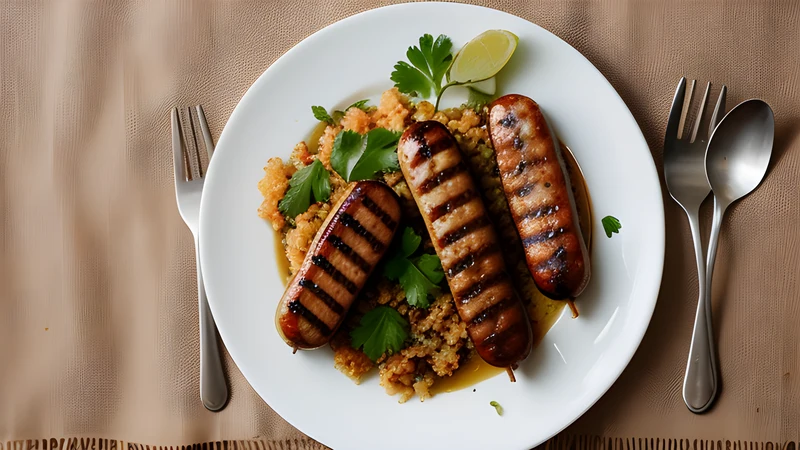
A mititel is a skinless sausage of coarsely minced beef, usually cut with lamb and pork, seasoned heavily with garlic and a specific spice set, and — the part that surprises people — leavened with bicarbonate of soda and slackened with cold stock. It is grilled over charcoal until charred, and eaten with mustard and bread while standing near the grill.
The texture is the entire point. A good mititel is springy, almost bouncy, and juicy in a way that a hand-formed burger never is. It gives against the teeth and comes back. Achieving that is a matter of chemistry, and it is worth understanding rather than following blindly, because every common failure traces to skipping one of two steps.
The beer garden that built them
The inn story explains the shape. What explains the ubiquity is what happened next.
La Iordache sat in the Lipscani district, and by the 1880s Bucharest was in the middle of a building boom that had it briefly nicknamed “Little Paris” — boulevards, French architects, a new bourgeoisie with money and evenings to spend. Mititei landed exactly into that. They were cheap, they cooked in ten minutes, they were made from offcuts, and they required no plate and no cutlery. They became beer-garden food, and the Romanian beer industry — Luther, Bragadiru, Oppler, all founded in Bucharest in that same window — had every commercial reason to encourage a salty grilled snack that made people thirsty.
By the interwar years mititei were on every grădină de vară, every summer garden, in the country. Under communism they survived the way street food usually does: the state ran the grills, the meat ratios got worse, the bicarbonate got heavier, and the queue formed anyway. There is a genuine folk memory in Romania of 1980s mici being mostly bread and mystery, and a corresponding suspicion of anyone selling them cheap.
Today they are the default food of 1 May, of football, of any gathering with more than eight people and a bag of charcoal. The Romanian government has periodically had to intervene on labelling standards. In 2013 the EU briefly looked like it might restrict sodium bicarbonate in meat preparations, and the resulting Romanian panic — reported straight-faced in the national press as a threat to the mici — got the exemption sorted quickly.
Bicarbonate, salt, and the 12 hours
Here is the mechanism.
Salt dissolves myosin, the main muscle protein. Worked into cold mince with liquid, dissolved myosin forms a sticky, extensible network — the same thing that happens in a sausage emulsion, in a fish cake, in a Chinese meatball. That network traps fat and water, and when it sets in the heat it gives you bounce rather than crumble. This is why the mixture must be kneaded until it visibly tightens and stretches, and why eight minutes feels like far too long right up until the moment it works.
Bicarbonate does something different. It raises the pH of the meat from about 5.5 towards 6.2, and at that higher pH the muscle proteins repel each other slightly and hold considerably more water — the same trick behind velveted beef in a Chinese stir-fry. It also accelerates browning, because Maillard reactions run faster in an alkaline environment, which is why mititei char so aggressively for their short time on the grill.
Both processes need time. Salt takes hours to fully penetrate and solubilise protein through a coarse mince; bicarbonate takes hours to equalise pH. Twelve hours in the fridge is the floor, twenty-four is better, and thirty-six starts to push the texture towards rubbery and the flavour faintly soapy. Eight grams of bicarbonate in a kilo of meat is the ceiling — more than that and you will taste it, a metallic, alkaline note that no amount of garlic covers.
The cold stock is the third leg. It is water carried in on a flavour vehicle, and the protein network holds it. Traditionally it is a beef bone stock, sometimes with a little of the gelatinous liquid from boiled bones, and the gelatin helps. Use it fridge-cold. Warm stock softens the fat, and soft fat smears across the mince rather than staying in discrete pieces, which gives you a greasy, dense result.
The mince, and the fat
Coarse, and cut yourself if you can manage it. A 5mm plate gives you distinct particles that stay distinct; the fine mince sold as beef mince in most supermarkets has been through a 3mm plate and often twice, and it makes a paste.
The ratio is argued about endlessly. Half beef is the constant; the lamb and pork proportions shift by region and by butcher. Beef chuck brings flavour and the connective tissue that contributes gelatin. Lamb shoulder brings the fat that carries the garlic and savory. Pork belly brings the fat that keeps the whole thing moist at 71C. Total fat should land around 25–30%, which sounds like a lot and is the correct amount. At 15% you get a dry, tight, sad thing.
Some Bucharest grills use beef alone, which is the older and arguably more authentic version. Some add nothing but pork. I like all three, and the lamb is the flavour I would miss.
The spices, and the one that matters
Cimbru is the word that trips people up. It is usually translated as thyme, and it usually means summer savory — a different herb entirely, peppery and slightly bitter, closer to a cross between thyme and oregano with a bite. If you can find dried savory, use it; it is the flavour that makes mititei taste Romanian rather than merely garlicky. Dried thyme is a decent stand-in.
Garlic is the other non-negotiable, and ten cloves per kilo is not a typo. Crush it to a paste rather than chopping — you want it dispersed into the stock and through the network, invisible and everywhere. Mititei sold at a Romanian festival will announce themselves from thirty metres away, and that is the intended effect.
Coriander, allspice and caraway are the supporting cast, in small amounts, doing the warm background work. My one deviation is the caraway, which is a gram, is not standard everywhere, and picks up the lamb in a way I find hard to give up.
Where it goes wrong
Crumbly, falls apart on the grill. Under-kneaded. The protein network never formed. There is no fix at the grill stage.
Grey, flat, dense. You skipped the overnight rest. The bicarbonate and salt did not get their time.
Soapy or metallic. Too much bicarbonate, or it was unevenly distributed. Weigh it and mix it into the dry seasoning first.
Greasy, with fat pooling underneath. The mince got warm during mixing. Chill everything and work faster.
Dry. Not enough fat, or you grilled past 75C. Mititei are done at 71C and go from juicy to sawdust in about ninety seconds.
They stick and tear. Cold bars, or dirty bars. Get the grill properly hot and oil it.
Swollen into fat barrels, split along the top. Too much bicarbonate combined with too long a rest. The gas has nowhere to go and the surface gives way.
Bland despite all that garlic. Under-salted. Eighteen grams per kilo reads high and is right for something eaten with plain bread — fry a teaspoon of the mixture and taste it before you commit to shaping sixteen.
The groove, the char, and eating them
The shallow groove pressed down the length is functional. It gives the surface more area to char and it stops the cylinder swelling into a barrel as the bicarbonate does its work. Squared ends rather than tapered ones are the traditional shape, and they cook more evenly.
Charcoal is genuinely better here, and not for romantic reasons. Mititei drip fat, that fat hits the coals, and the smoke that comes back up is part of the flavour. A gas grill or a griddle gives you a good sausage without that. If you are indoors, use a ridged cast-iron griddle, get it hotter than feels sensible, and open a window.
Turn them every two to three minutes rather than leaving them. You are chasing four charred faces and an even interior, and a mititel left too long on one side burns before the centre catches up.
They are eaten with mustard — plain, sharp, yellow Romanian mustard, nothing grainy or fancy — and white bread, with a beer, standing up. That is not a serving suggestion so much as an observation. They belong on the same grill as pastrami de oaie, and the Balkan neighbours make ćevapi by an almost identical logic — skinless, minced, bicarbonate, char — which tells you the idea is older and wider than the story about the inn.
The raw mixture keeps 24 hours in the fridge and freezes well shaped, on a tray, then bagged. Grill from frozen at a lower heat for 16 minutes. Cooked ones reheat acceptably in a hot dry pan and never as well as they were.
Related Content