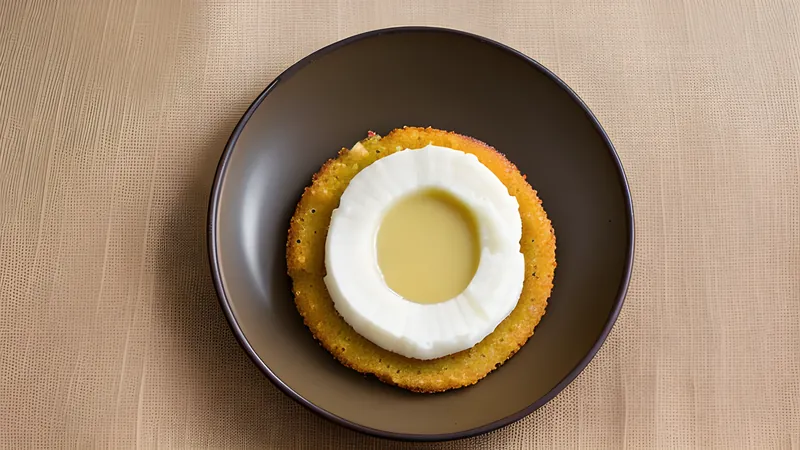
Mishti Doi: Baked Caramelised Yoghurt
Sweet yoghurt set slowly in a clay pot, the way Bengal ends a meal

Contents
↓ Jump to recipeMishti doi ends a Bengali meal the way a good dal starts one: quietly, without fuss, and doing exactly one job extremely well. It is sweetened yoghurt, set slowly after the milk has been reduced and part-caramelised, traditionally in small unglazed clay pots that a Bengali sweet shop will still hand over with the dessert already set inside. The dish is closely tied to the town of Bogura, now in Bangladesh, whose sweet makers built a national reputation over generations for a particularly good version, thick and deeply caramelised, and Bogura mishti doi is still referenced by name across Bengali-speaking regions the way a particular region’s cheese or wine might be elsewhere, a shorthand for quality rather than a strict protected designation. The result sits somewhere between a yoghurt and a custard: thick enough to hold a spoon upright, faintly tangy from the yoghurt culture, and carrying a deep caramel note that plain sweetened yoghurt anywhere else in the world simply does not have.
Mishti Doi: Baked Caramelised Yoghurt
Ingredients
- 1.5 litres whole milk
- 150g caster sugar, divided
- 3 tbsp plain live yoghurt, at room temperature (as the starter culture)
- 1/4 tsp ground cardamom
Method
- Pour the milk into a heavy-bottomed pot and bring to a gentle boil, then reduce heat and simmer for 25–30 minutes, stirring occasionally and scraping the sides, until reduced by roughly a third and slightly thickened.
- Meanwhile, put 100g sugar in a separate dry pan over medium heat and let it melt and caramelise undisturbed, swirling the pan gently once it starts colouring, until it turns a deep amber. Take off the heat immediately before it goes any darker.
- Carefully stir the hot caramel into the reduced milk a little at a time, off the heat, until fully dissolved and the milk has turned a warm tawny colour. Stir in the remaining 50g sugar and the cardamom.
- Let the milk cool until it is warm to the touch, around 40–45°C, comfortable to hold a finger in for a few seconds.
- Whisk the room-temperature yoghurt into the warm milk until fully combined, then pour into clay pots or small heatproof ramekins.
- Cover loosely and set in a warm, draught-free spot (an oven with just the light on, or wrapped in a towel near a radiator) for 6–8 hours, or overnight, until fully set.
- Refrigerate for at least 3 hours before serving chilled.
The Clay Pot Is Not Decoration
Unglazed clay pots, called matir bhaar, are not a rustic styling choice; they change the final texture of the doi in a way a glass or ceramic dish cannot replicate. The porous clay wicks a small amount of moisture out of the setting yoghurt over the hours it takes to firm up, concentrating the remaining custard and giving mishti doi its characteristically dense, slightly grainy-in-a-good-way texture rather than the smooth, wobbly set of a standard yoghurt. Sweet shops across West Bengal and Bangladesh have kept using clay pots for exactly this reason even as cheaper, more durable alternatives became widely available, and the pots themselves are traditionally used once and either kept as a small souvenir of the shop or, historically, simply discarded, since firing a fresh batch of cheap clay pots was never expensive relative to the sweets they held. Travellers bringing mishti doi back from Kolkata or Bogura as a gift would carry it stacked in its pots inside a tied cloth or a woven basket, and receiving a gift of mishti doi from someone’s hometown carried, and still carries, a small implicit boast about whose region makes it better, a rivalry not unlike the hilsa arguments that run through so much of Bengali food culture.
If you do not have access to unglazed clay pots, small heatproof ceramic ramekins will still give you a good result, just marginally softer and less concentrated in texture. Do not use metal containers if you can avoid it; the acidity of the yoghurt culture can react subtly with some metals over the long setting time, and clay or ceramic is the safer, more traditional choice regardless. Whichever vessel you use, keep the pots small — around 150ml each — rather than setting the whole batch in one large dish; smaller portions set more evenly all the way through and give you the individual, sweet-shop-style serving that the dessert is meant to arrive in, rather than something you have to spoon awkwardly out of a communal bowl.
Reducing and Caramelising the Milk
The two stages before the yoghurt culture ever gets involved — reducing the milk and caramelising a portion of the sugar separately — are what separate mishti doi from ordinary sweetened yoghurt. Reducing the milk by around a third concentrates its natural milk solids and proteins, giving the finished dessert more body than fresh milk alone could provide; skip this step and your mishti doi will set thinner and taste noticeably less rich. Caramelising a portion of the sugar separately, rather than simply dissolving all of it into the milk, is where the dish gets its distinctive tawny colour and the faint bitter-sweet depth that runs underneath the sweetness. Watch the caramel closely once it starts to colour: sugar goes from perfect amber to burnt in under a minute, and burnt caramel will make the whole batch taste acrid rather than deep. Pull it off the heat the moment it reaches a colour like strong tea, since residual heat in the pan will continue darkening it for several seconds even after it is removed from direct heat. Adding the hot caramel back into the warm reduced milk is also the moment most home cooks get nervous, since caramel spitting on contact with liquid is a genuine risk; add it gradually, in small pours, stirring constantly, and keep your stirring arm well back from the pot rather than leaning directly over it.
The Culture and the Set
Live plain yoghurt with active bacterial culture, stirred into the milk once it has cooled to a warm, hand-comfortable temperature, is what turns this from sweetened milk into set doi. Adding the culture while the milk is too hot kills the live bacteria outright and the mixture will never set; adding it too cold slows the fermentation dramatically and can let unwanted bacteria get a foothold before the culture takes over properly. Aim for a temperature you can hold a finger in comfortably for a few seconds, roughly body temperature or a little above, which is warm enough to keep the culture active without being hot enough to kill it.
The long, slow set — six to eight hours in a warm, undisturbed spot — happens through lactic acid fermentation, the same basic process behind yoghurt everywhere, but the added sugar and reduced milk here give the bacteria a richer environment to work in, which is part of why mishti doi tends to set with a slightly different character than a plain, unsweetened yoghurt made under the same conditions. Do not disturb the pots while they are setting; movement during fermentation can break the delicate protein structure forming in the milk and leave you with a looser, weepier set. Choosing a genuinely good starter culture matters more than people expect: a shop-bought live yoghurt with a short, simple ingredient list and a recent use-by date carries a more active culture than one that has been sitting near the back of a fridge for weeks, and a sluggish starter culture is one of the most common, least obvious reasons a first attempt at mishti doi comes out under-set.
Troubleshooting
A mishti doi that stays runny after the full setting time is nearly always a temperature problem, either the milk was too hot when the culture went in, or the room it sat in was too cold to sustain active fermentation. An oven with just the pilot light or interior bulb on, door closed, is a genuinely reliable warm spot in most kitchens and worth using deliberately rather than guessing at ambient room temperature. A batch that tastes bitter rather than pleasantly caramelised has usually had its sugar taken past the point of proper caramelisation; there is no fixing burnt caramel once it is in the milk, so it is worth practising the caramelising step on its own once before committing it to a full batch. A set that is fine in the centre of the pot but noticeably looser right at the very top usually means the covering was too tight and trapped condensation that dripped back down onto the surface during the long set; a loose cloth or a lid propped slightly ajar lets a small amount of moisture escape instead of pooling.
Storage
Mishti doi keeps for four to five days refrigerated in its setting pots, covered, and the flavour if anything improves slightly over the first day or two as the tang develops further. It does not freeze; freezing breaks the delicate set completely and what thaws out bears no resemblance to the dish. Keep a spoonful of an especially good batch aside, refrigerated separately, to use as the starter culture for your next round rather than buying fresh live yoghurt each time; Bengali households have traditionally propagated a single family’s doi culture this way for years, each batch slightly shaping the flavour of the next, not unlike a sourdough starter passed down in a bread-baking household. Serve it chilled, straight from the fridge, with a spoon and nothing else — no fruit, no garnish, no additional sweetness needed.
Variations
Some sweet shops add a few strands of saffron to the milk during reduction for a version with a more golden hue and a more floral top note than the plain caramel version. A scatter of chopped pistachio on top just before serving is common at celebrations, though it is a garnish rather than a core part of the traditional recipe. A version made with condensed milk instead of a slow reduction is a common shortcut in busier households and genuinely quicker, though it trades away some of the deeper, more developed flavour that comes from reducing whole milk from scratch over half an hour. If you are building a full Bengali meal, mishti doi is the dish to end on, after something like shorshe ilish or kosha mangsho; its cool, mild sweetness is a deliberate come-down from a meal that may have started with the bitterness of shukto and built through richer courses since. That arc from bitter to rich to sweet is the same deliberate sequencing that shapes a full Bengali meal from the first spoon to the last, and mishti doi is the note it is built to end on.
A Note on Patience
There is no shortcut through the setting time here, and every attempt to rush it — a warmer spot than recommended, extra culture stirred in to speed fermentation along — tends to produce a doi that sets unevenly, with a watery layer at the bottom and an over-firm layer near the top. Treat the six to eight hours as non-negotiable, start the process the evening before you want to serve it, and let the clay and the culture do the actual work while you do something else entirely. It is, in the end, a dessert that rewards planning over improvisation, and the reward for that planning is a pot of doi with a texture and depth of flavour that nothing bought at short notice from a supermarket dessert aisle can match.
Related Content