Melomakarona: The Honey-Soaked Christmas Biscuit of Greece
Olive oil, orange, cold syrup on hot biscuits, and a spoonful of tahini in the dough
Contents
↓ Jump to recipeThe smell of a Greek December is orange zest, cinnamon and hot olive oil. Every household makes melomakarona, in quantities that seem unhinged until you understand that they are given away in boxes and eaten continuously for a month.
They are honey-soaked, spiced, olive-oil biscuits, and they are one of the genuinely great uses of extra virgin olive oil in baking. My dough has three tablespoons of tahini in it, which is a Lenten borrowing rather than an invention, and which changes the crumb more than the quantity suggests.
Melomakarona: The Honey-Soaked Christmas Biscuit of Greece
Ingredients
- 500 g caster sugar, for the syrup
- 500 ml water, for the syrup
- 200 g Greek honey
- 1 strip orange peel
- 1 cinnamon stick
- 3 whole cloves
- 1 tbsp lemon juice
- 250 ml Greek extra virgin olive oil
- 3 tbsp light tahini, well stirred
- 100 ml freshly squeezed orange juice
- 60 g caster sugar, for the dough
- 60 ml brandy or Metaxa
- Finely grated zest of 2 oranges
- 1 tsp bicarbonate of soda
- 450 g plain flour
- 100 g fine semolina
- 1.5 tsp ground cinnamon
- 1/2 tsp ground cloves
- 1/4 tsp freshly grated nutmeg
- 1/2 tsp fine sea salt
- 150 g walnuts, toasted and finely crushed, to finish
- 1 tsp ground cinnamon, to finish
Method
- Make the syrup first. Put the 500 g sugar, 500 ml water, orange peel, cinnamon stick and cloves in a pan. Bring to the boil, stirring to dissolve, then boil without stirring for 5 minutes.
- Take off the heat, stir in the honey and the lemon juice, and leave to cool completely. It must be cold when the biscuits meet it — refrigerate it if you are short of time.
- Heat the oven to 170C fan / 190C conventional. Line two baking trays with baking paper.
- In a large bowl, whisk the olive oil, tahini, orange juice, 60 g sugar, brandy and orange zest together for 1 minute until well combined and slightly thickened.
- Whisk the bicarbonate of soda into the mixture. It will foam faintly as it meets the orange juice.
- In a second bowl, whisk the flour, semolina, ground cinnamon, ground cloves, nutmeg and salt together.
- Tip the dry into the wet and fold with a spatula, using as few strokes as possible, until there is no loose flour left. Stop the moment it comes together. It should feel soft, slightly oily and just short of sticky.
- Rest the dough for 10 minutes to let the semolina hydrate.
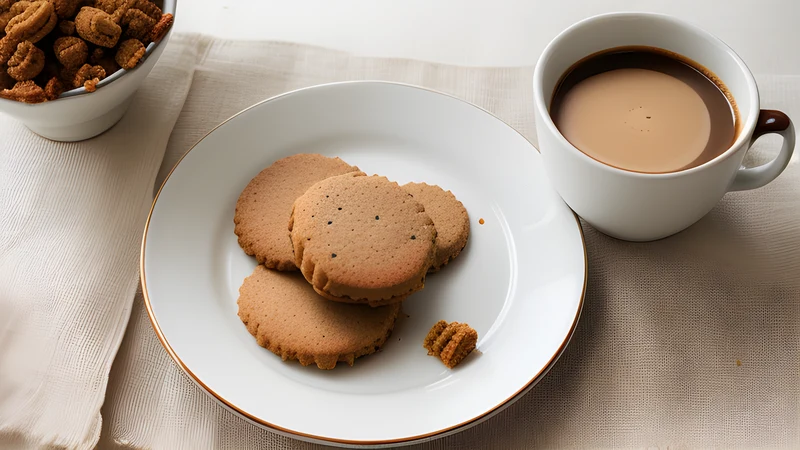
- Take walnut-sized pieces (about 30 g each) and roll into ovals, then flatten slightly to about 2 cm thick. Press the back of a fork over the top, or roll each one lightly over a fine grater, to give a rough textured surface.
- Space them 3 cm apart on the trays. Bake for 25-30 minutes, until firm, dry to the touch and evenly deep brown. They must be baked through and dry — a pale, soft biscuit will disintegrate in the syrup.
- The moment they come out of the oven, drop 5 or 6 hot biscuits at a time into the cold syrup.
- Leave them for 45-60 seconds only, turning once, then lift out with a slotted spoon onto a wire rack set over a tray.
- Scatter each one immediately with the crushed walnuts and a little cinnamon while the surface is still tacky.
- Leave to drain and set for at least 3 hours before eating.
The name, and what it used to mean
Melomakarono is meli, honey, plus makaronia. That second word is confusing, because it appears to say pasta.
The trail is odd and well documented. In medieval and later Greek, makaria referred to a piece of bread or a small cake eaten at a funeral meal, from makarios, blessed — the same root as the makaria offered for the blessed dead. The word attached to an oval-shaped commemorative cake, and there is a reasonable scholarly line running from that funerary makaria to Italian maccarone and eventually to macaroni, on the basis of shape rather than substance. So melomakarona are, etymologically, honey-soaked funeral cakes, and the shape they retain is the oval of the mourning cake.
They migrated onto the Christmas table alongside kourabiedes, the icing-sugar shortbreads, and Greek households take a firm position on which is superior. Melomakarona are the ones that improve for two weeks. Kourabiedes are the ones that go stale. The argument is not close.
Olive oil, and why there is no butter
Melomakarona are traditionally nistisima — suitable for fasting. The Nativity fast runs 40 days to Christmas and excludes dairy for observant households, which is why the fat here is olive oil and the liquid is orange juice and brandy.
The constraint produced a better biscuit. Olive oil is liquid at room temperature, so it cannot be creamed with sugar to trap air, which means the leavening comes entirely from bicarbonate of soda reacting with the acid in the orange juice. That gives a dense, short, sandy crumb with no elasticity, which is exactly what you need in a biscuit that is about to be submerged in syrup. An aerated, gluten-developed biscuit would swell and collapse.
Use real Greek extra virgin olive oil and use a decent one. Two hundred and fifty millilitres is a lot and you will taste it — that faint peppery bitterness in the background of a good melomakarono is the oil, and it is a feature.
The corollary is the mixing rule. Fold the flour in with the fewest strokes that get the job done. Every extra stroke develops gluten, and gluten in this dough gives you a biscuit that goes hard and rubbery in the syrup instead of drinking it. The semolina helps here too: it dilutes the gluten-forming flour and contributes the slightly gritty short texture that distinguishes a good melomakarono from a spice cookie.
Tahini in the dough
Three tablespoons. This is my addition and it comes from the same fasting logic that produced the recipe — tahini is a standard Lenten fat in Greek and Cypriot baking, and it appears in the nistisimo versions of several sweets.
What it does here is twofold. Sesame paste brings roasted-sesame aromatics that sit beautifully underneath the walnut topping and make the biscuit taste more nutty than nuts alone can manage. And, mechanically, tahini is roughly half fat and half solids, and those solids are ground seed — they behave like very fine flour that cannot form gluten. Adding tahini therefore shortens the crumb further, which makes the biscuit more absorbent. Mine take up syrup faster than the plain version.
Stir the jar properly first. Tahini separates, and a spoonful of the oil off the top does something entirely different from a spoonful of the paste from the bottom. The same discipline matters in charred lemon hummus, where unstirred tahini ruins the ratio.
Hot biscuit, cold syrup, sixty seconds
The rule for melomakarona is the inverse of the one for baklava, where cold syrup goes over hot pastry. Here the biscuit does the travelling: it comes out of the oven and goes straight down into cold syrup.
The physics is the same. Hot biscuits are full of hot air and steam in their pores. Dropped into cold syrup, that air contracts sharply and the biscuit draws syrup inward through capillary action. The pressure differential does the work in under a minute. If both are hot, nothing pulls; the biscuit floats and slowly turns to porridge on the outside while staying dry in the middle. The same principle runs through the syrup stage of galaktoboureko.
Sixty seconds is the ceiling, and it is the fault everybody commits. Melomakarona should be honeyed through with a dry-ish, spiced heart still present at the centre. Two minutes in the syrup gives you a soaked sponge that falls apart in the hand. Time it with a clock; the difference between 60 seconds and 120 is the difference between the dish working and not.
Bake them properly dark first. An underbaked melomakarono has moisture left in it and cannot absorb; it collapses instead. Dry, firm, and deep brown when it comes out of the oven.
The spice mix, and the orange
The spicing here is a Christmas spicing and it is closer to a British mince pie than to anything else in the Greek repertoire, which is a coincidence of trade routes rather than influence — cinnamon, cloves and nutmeg were the three great Indian Ocean spices, and every Mediterranean and northern European Christmas baking tradition converged on them for the same reason, which is that they were what the ships brought.
The ratios matter. A teaspoon and a half of cinnamon to 450 g of flour is assertive. Half a teaspoon of ground cloves is close to the ceiling — cloves are around 80 per cent eugenol by essential-oil weight and it is a compound that goes from warm to numbing to dental-surgery in the space of a quarter teaspoon. Nutmeg at a quarter teaspoon, grated fresh, is present as a rounding agent that nobody will identify.
Grind them yourself if you can be bothered. Ground cloves lose their volatiles faster than almost any other spice, and a jar that has been open two years is sawdust. Cinnamon: the Greek default is cassia, the thick dark bark, which is louder and more aggressive than Ceylon cinnamon and correct here.
The orange is the ingredient people underestimate. Both zest and juice go in, and they are doing different jobs. The juice is the acid that reacts with the bicarbonate — this is a chemical requirement, and swapping it for water gives you a flat, dense biscuit. The zest is the aroma, and it is where almost all the orange flavour lives, since the oil glands are in the coloured layer of the peel and there is very little aromatic in the juice at all. Two oranges’ worth of zest for thirty biscuits sounds like too much. It is the correct amount, and it is why a Greek kitchen in December smells the way it does.
Zest before you juice, obviously. And take only the orange, stopping at the white.
Shape, surface, and the reason for the fork
Thirty grams a biscuit, rolled into an oval and flattened to 2 cm. Uniformity matters here more than in most biscuit doughs, because the syrup step is timed — sixty seconds is calibrated to this size, and a batch containing 20 g and 45 g biscuits will give you some that are dry inside and some that have fallen apart. Weigh the first three, get your eye in, then work by feel.
The textured top is functional. The classic method is to roll each shaped biscuit lightly down the face of a box grater, which embosses it with a field of shallow pits; the back of a fork pressed across it does a coarser version of the same thing. The pits increase surface area, which speeds absorption in that sixty-second window, and they give the crushed walnuts somewhere to lodge instead of sliding off a smooth dome.
The 2 cm thickness is the other half of the calculation. A thicker biscuit cannot be soaked through in a minute and stays powdery at the core; a thinner one soaks through and disintegrates. Flatten them slightly and leave it there.
Space them 3 cm apart. They spread very little — there is no creamed butter and almost no gluten to hold gas — so the gap is for airflow rather than expansion. A crowded tray gives you pale sides, and pale means underbaked, and underbaked means they will fall apart in the syrup.
The brandy, and the bicarbonate
Sixty millilitres of brandy — Metaxa if you are being proper, which is a Greek brandy-and-muscat blend rather than a straight spirit — and a teaspoon of bicarbonate of soda. Both look incidental and both are structural.
The alcohol does two things. It evaporates in the oven and the vapour helps lift the crumb. More usefully, ethanol interferes with gluten formation: gluten proteins need water to hydrate and link, and alcohol competes for that water, so a dough with a decent slug of spirit in it stays shorter and more tender even if you have overworked it slightly. It is cheap insurance in a dough where overworking is the main risk.
The bicarbonate is the only leavening. It needs acid to do anything, and the acid is the orange juice — freshly squeezed, because the pasteurised carton stuff has had its pH shifted and its aromatics cooked. Whisk the bicarbonate into the wet mixture and you should see a faint foam within seconds. If nothing happens, your bicarbonate is old, and old bicarbonate gives a soapy, flat biscuit. Test it: half a teaspoon in a splash of vinegar should erupt.
Do not substitute baking powder. It is a different system with its own acid built in, and it will over-leaven this dough into something cakey that dissolves in the syrup.
Honey, walnuts, and the storage question
The honey goes in off the heat. Greek honey — thyme, pine, or a blend — carries volatile aromatics that a five-minute boil destroys, and boiled honey tastes flatly of caramel. Stir it into the syrup once it stops bubbling.
The lemon juice inverts a portion of the sucrose and stops the syrup crystallising in the jar or on the finished biscuits. Skip it and you may find a fine white bloom on the tray by the next morning.
Walnuts go on while the surface is tacky, within a minute of lifting. Wait five and nothing sticks.
Storage is the best part. In a sealed tin at room temperature, layered with baking paper, they keep three weeks and are at their peak somewhere around day four, once the syrup has fully equalised through the crumb. Never refrigerate them — the syrup crystallises and the olive oil goes waxy.
Variations. Some households stuff each biscuit with a walnut-and-honey paste before shaping. A little grated orange zest in the walnut topping is common and good. A dip of dark chocolate on the base is the Athens patisserie style, and for the same honey-and-spice register in a very different form, see loukoumades.
Related Content