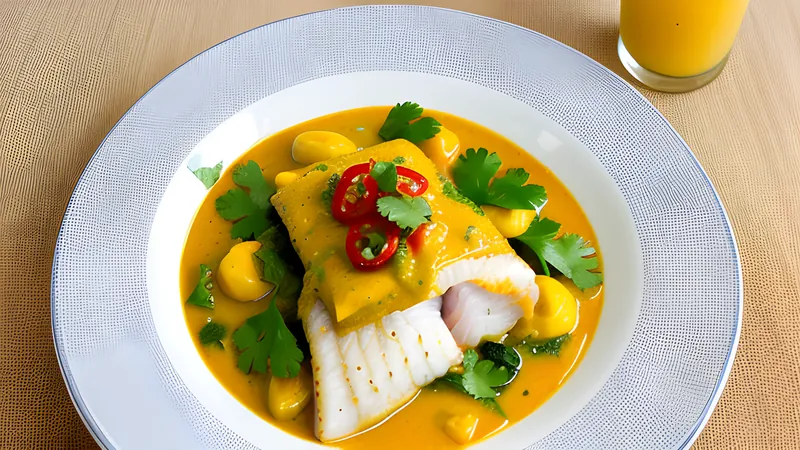
Meen Moilee: Kerala Fish in Coconut Milk
Firm white fish simmered gently in a pale, turmeric-gold coconut sauce
Contents
↓ Jump to recipeMeen moilee is Kerala’s answer to the question of what to do with good white fish when you want something gentler than the region’s usual fierce, tamarind-sharp curries. The sauce is pale gold rather than red or dark brown, coloured by turmeric alone rather than chilli powder, and built to be mild enough that the fish itself, rather than a wall of spice, stays the point of the dish. It is Kerala’s most exported curry in one sense — the anglicised “molee” or “moilee” spelling shows up on menus across the Indian diaspora precisely because it is the curry most palatable to someone new to Indian food, without losing any of the coconut-and-curry-leaf character that makes it recognisably Keralan.
My twist is searing the fish briefly in a hot pan before it goes anywhere near the sauce, rather than poaching it directly in the simmering coconut milk from raw the way many home versions do. Ninety seconds a side over high heat sets a light golden crust and firms the fish’s exterior just enough that it holds together through the gentler simmer to come, giving a more distinct textural contrast between a firm, faintly caramelised surface and the soft, delicate flesh underneath.
Meen Moilee: Kerala Fish in Coconut Milk
Ingredients
- 700g firm white fish fillets (kingfish, pomfret or cod), cut into large pieces
- 1 tsp ground turmeric, divided
- 1 tsp fine sea salt, divided, plus more to taste
- 3 tbsp coconut oil, divided
- 2 large onions, thinly sliced
- 1 thumb ginger, julienned
- 5 garlic cloves, thinly sliced
- 3 green chillies, slit lengthways
- 2 sprigs fresh curry leaves, plus extra to finish
- 1 cinnamon stick
- 3 green cardamom pods, cracked
- 400ml coconut milk (second extraction or thinner tinned)
- 150ml thick coconut milk (first extraction or the top layer of a tin)
- 1 tomato, thinly sliced
- 1 tsp black peppercorns, coarsely cracked
- 1 tbsp lime or vinegar, to finish
Method
- Pat the fish dry and rub with half the turmeric and half the salt. Set aside 15 minutes.
- Heat 1.5 tbsp coconut oil in a wide, shallow pan over medium-high heat and sear the fish pieces 90 seconds per side, just to colour the surface — they will finish cooking in the sauce. Remove and set aside.
- In the same pan, heat the remaining coconut oil and fry the onions gently over medium-low heat for 12-15 minutes until soft, translucent and only very lightly golden, not deeply browned.
- Add the ginger, garlic, green chillies and curry leaves and cook 2 minutes until fragrant, then add the cinnamon and cardamom and cook 1 minute more.
- Stir in the remaining turmeric and the sliced tomato, cooking 3-4 minutes until the tomato softens.
- Pour in the thinner (second-extraction) coconut milk and bring to a gentle simmer, not a boil. Season with the remaining salt and the cracked pepper.
- Slide the seared fish pieces into the sauce, spooning it over them, and simmer gently 6-8 minutes until just cooked through and opaque.
- Pour in the thick coconut milk, swirl through gently and warm for 1-2 minutes without boiling. Finish with lime juice or vinegar to taste and a scatter of extra curry leaves.
A dish with a Portuguese fingerprint
Kerala’s coast spent a long stretch of its history as a trading post for Arab, Chinese, Portuguese and Dutch merchants drawn by pepper, and meen moilee is one of the clearer culinary fingerprints that history left behind. Food historians generally trace the word “moilee” to the Portuguese molho, meaning sauce, arriving with the Portuguese who settled around Kochi from the sixteenth century onward and whose cooking habits blended into the existing Syrian Christian and Malabar Muslim kitchens already using coconut milk as a base for curries. The dish that resulted, fish gently poached in a mild, aromatic coconut sauce, sits closer to a European-style poached-fish preparation than to the fiercer, tamarind-and-chilli curries more typical of Kerala’s Hindu culinary tradition, which is part of why it reads as gentler to an unfamiliar palate.
The choice of fish matters and reflects the region it comes from. Kingfish (seer fish) is the most traditional choice in Kerala itself, prized for its firm, meaty texture that holds up through a simmer without flaking apart, though pomfret and even a firm cod or haddock abroad give a comparable result. Whatever you use, the flesh needs to be dense enough to survive both a hot sear and a subsequent simmer; a delicate, flaky white fish like sole will fall apart before the sauce even comes together.
Why the onions get a slow, gentle fry
Meen moilee’s onions are cooked slowly over medium-low heat until soft and only lightly golden, deliberately stopping well short of the deep caramelisation that a dish like beef ularthiyathu pushes its onions toward. The pale colour is not an oversight; deeply browned onions would pull the sauce’s colour toward brown and its flavour toward the roasted, savoury register those darker Kerala curries are built around, working against moilee’s whole purpose as the pale, gentle option on the table. Twelve to fifteen minutes over a gentle heat, stirring occasionally, softens the onion fully and builds a genuine sweetness without crossing into caramelisation — patience here, not high heat, is what gets the texture and colour right.
Two coconut milks, and why the order matters
As with several other Kerala coconut dishes, moilee benefits from using coconut milk in two distinct stages rather than pouring in a single tin all at once. The thinner, second-extraction milk goes in early to build the simmering sauce the fish actually cooks in, since it has enough body to hold a gentle simmer without breaking; the thick, first-extraction milk (or the concentrated top layer skimmed from a tin) goes in only at the very end, warmed gently rather than simmered, to add richness and a glossy sheen right before serving. Boiling thick coconut milk hard causes its proteins and natural oils to separate visibly, turning a silky sauce grainy and oily-looking, and there is no rescuing it once that has happened — the fix is entirely preventative, in the timing.
Sourcing and prepping the fish
Pat the fish thoroughly dry before searing; any surface moisture left on the fillets steams rather than sears in a hot pan, and you lose the light crust the initial fry is meant to build. Cut the fillets into pieces generous enough to survive two cooking stages without falling apart, roughly matchbox-sized or a little larger, and handle them gently once seared — turn with a wide spatula rather than tongs, which can tear the just-set crust before it has had a chance to firm up further in the simmering sauce.
Serving and keeping
Serve meen moilee with plain steamed rice, or with appam, whose lacy, soft-centred texture is built precisely for scooping up a gentle coconut sauce like this one. A squeeze of lime or a dash of vinegar right at the end lifts the whole dish, cutting through the coconut milk’s richness in a way that a curry this mild genuinely needs to avoid tasting one-note.
Leftovers keep for a day in the fridge, though the fish continues to firm up as it sits and the texture is never quite as delicate the second day; reheat very gently over low heat, never at a full simmer, to protect both the fish and the thick coconut milk from breaking. It is not a dish that freezes well — coconut milk sauces separate badly on thawing, and the fish’s texture suffers considerably more than it does from a single day in the fridge.
Getting the spicing balance right
Moilee’s short list of whole spices — cinnamon, cardamom, black pepper — is deliberately restrained compared to the long spice lists that show up in most Indian curries, and this restraint is the point rather than a shortcut. Each one is there to add warmth and fragrance rather than assertive heat: cinnamon and cardamom lend a gentle sweetness that plays against the coconut’s own natural sweetness, while the cracked black pepper supplies what little sharpness the dish has, standing in for the chilli powder that almost every other Kerala curry would reach for. Resist the urge to add chilli powder for colour or extra heat; doing so pulls moilee toward a completely different, more generic curry and away from the specific, pale, gently spiced dish it is meant to be.
Green chillies, slit rather than chopped, give a background warmth that infuses slowly into the sauce without the more aggressive heat that finely chopped chilli releases; slitting exposes the seeds and inner membrane just enough to let flavour and a moderate amount of heat escape into the coconut milk while keeping the chilli itself easy to fish out or avoid for anyone at the table who wants less heat than the rest.
Curry leaf, twice
Notice that curry leaves appear at two separate points in the method: once early, cooked into the aromatics base alongside the onions and ginger, and again at the very end, scattered fresh over the finished dish. This double use is deliberate and mirrors a technique common across Kerala’s coconut curries. The leaves cooked into the base soften and release their oils slowly into the sauce over the full cooking time, building a background savouriness that seasons the whole dish; the leaves added at the end are there purely for aroma, since curry leaf’s more volatile fragrant compounds cook off within a few minutes of hitting heat and are largely gone by the time a long-simmered curry reaches the table. Skipping the final fresh scatter and relying only on the cooked-in leaves gives a moilee that tastes correct but smells noticeably flatter the moment it is served.
A dish that scales for guests
Meen moilee is a forgiving dish to scale up for a table of guests, since the sauce base can be made well ahead — up to the point just before the fish goes in — and simply reheated and finished with fresh fish shortly before serving. This is worth knowing if you are cooking for a group: make the onion-coconut base a few hours ahead or even the day before, keep it in the fridge, then bring it back to a gentle simmer and sear and add the fish only in the final fifteen minutes before you plan to eat. The finished dish loses noticeably more quality sitting around with the fish already in it than the sauce does waiting on its own.
What goes wrong
The most common failure is a split sauce, and it traces back almost every time to boiling the thick coconut milk after it has gone in. Once you have added that final measure, treat the pan gently — a bare simmer at most, and ideally just a warm-through over low heat with occasional stirring. If the sauce does start to look grainy or show a faint sheen of separated oil at the edges, take it off the heat immediately; a whisk worked through vigorously off the heat can sometimes bring a mildly split sauce back together, though a badly split one is genuinely unrecoverable and best learned from rather than salvaged.
The second common problem is overcooked fish, usually from simmering it in the sauce for too long on the assumption that a gentle curry needs a long, gentle cook. It does not: the fish only needs six to eight minutes once seared and added to the simmering sauce, and firm white fish turns dry and chalky well before it turns unsafe to eat if left in a hot pan much beyond that. Pull a piece out and check with a knife tip at the thickest point rather than guessing by time alone, particularly the first time you make this with a fish you haven’t cooked this way before.
A thin, watery sauce rather than a lightly clinging one usually comes down to rushing the onion fry — twelve to fifteen minutes is the minimum for the onions to break down enough to give the sauce real body, and cutting that time short leaves you with a base that never quite thickens no matter how long the coconut milk simmers afterward. If you find yourself short on time, sweat the onions covered for the first five minutes to soften them faster, then finish uncovered for the remaining time to let them turn properly translucent and sweet.
Related Content