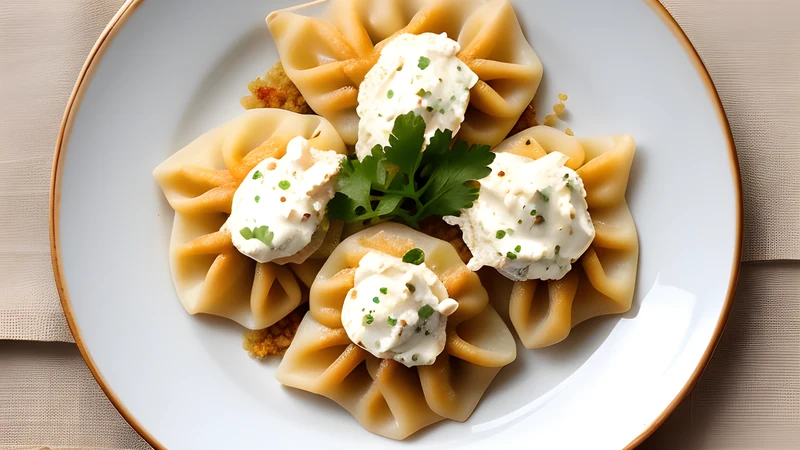
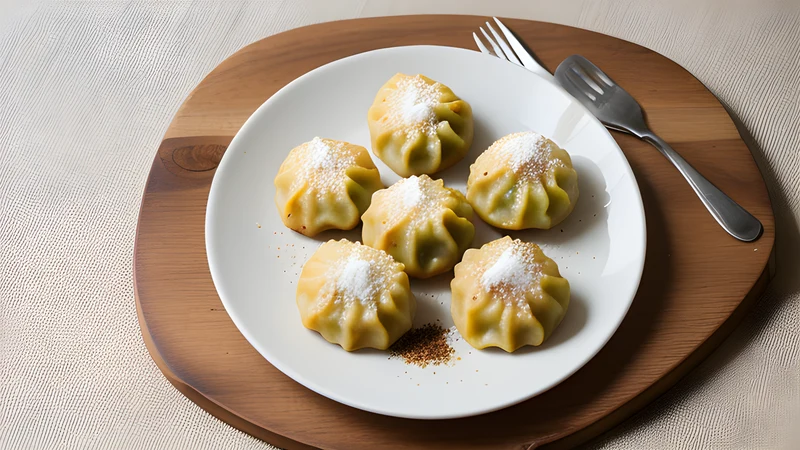
Marillenknödel: Apricot Dumplings in Buttered Crumbs
A whole Wachau apricot, a sugar cube where the stone was, and a quark dough that holds
Contents
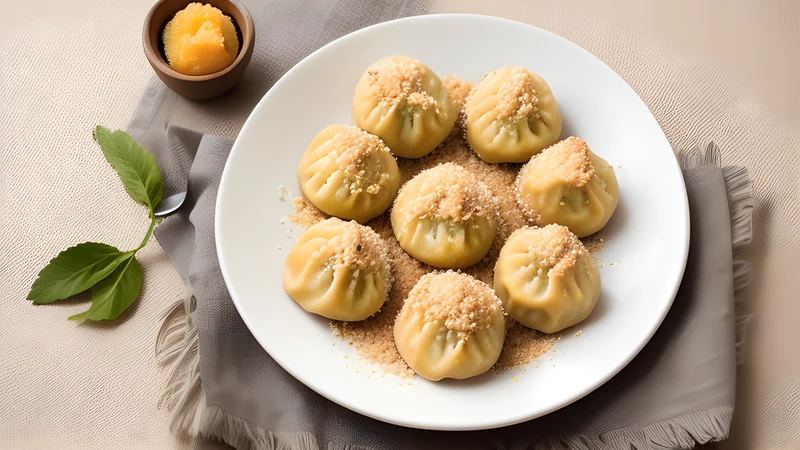
↓ Jump to recipeThere is a moment, cutting into a Marillenknödel, when the apricot gives up all the liquid it has been making for the last twelve minutes and it runs into the buttered crumbs. That is the dish. Everything else — the dough, the boiling, the crumbs — exists to deliver a whole hot apricot to a plate intact.
Austria takes them seriously enough to have a protected fruit for them. Wachauer Marille has EU protected designation of origin status, granted in 1996, covering apricots grown on the terraced Danube slopes between Melk and Krems. The variety is Klosterneuburger, and the geography does something specific: the Wachau sits at a climatic seam where Atlantic weather meets the Pannonian plain, so the trees get hot dry days and cold nights, which concentrates sugar and holds acid. A Wachau apricot in July is aromatic in a way that supermarket fruit trained on a Spanish greenhouse simply is not.
The season is about three weeks. Every village between Spitz and Dürnstein hangs out banners, sells apricot jam, apricot schnapps, apricot dumplings, and then it stops. Local restaurants put Marillenknödel on the menu for that window and take them off again, which is a discipline I admire.
Marillenknödel: Apricot Dumplings in Buttered Crumbs
Ingredients
- 8 small ripe apricots
- 8 sugar cubes
- 250g full-fat quark or Topfen, drained
- 150g plain flour, plus extra for dusting
- 60g fine semolina
- 1 large egg
- 40g unsalted butter, softened
- 1/2 tsp fine salt
- Finely grated zest of 1/2 lemon
- 100g unsalted butter, for the crumbs
- 120g dry white breadcrumbs
- 40g caster sugar, for the crumbs
- 1/2 tsp ground cinnamon
- Icing sugar, for dusting
Method
- Drain the quark in a sieve lined with muslin for 30 minutes if it looks wet, then beat it smooth with the softened butter, egg, salt and lemon zest.
- Fold in the flour and semolina until the dough just comes together. Do not knead. Wrap and rest in the fridge for 30 minutes.
- Cut a slit down one side of each apricot, prise out the stone with a teaspoon handle, and push a sugar cube into the cavity. Close the fruit.
- Divide the dough into 8 pieces. Flatten each on a floured surface into a 10cm disc about 5mm thick.
- Sit an apricot in the centre, bring the dough up around it, pinch the seam closed and roll gently between floured palms into a smooth ball with no visible seam.
- Bring a wide pan of water to a bare simmer with 1 tsp salt. The water must never boil hard.
- Lower the dumplings in and cook for 12-14 minutes, until they float and the dough is set. Test one at 12 minutes.
- Meanwhile melt 100g butter in a wide frying pan over a medium heat, add the breadcrumbs and fry for 5-6 minutes, stirring constantly, until evenly deep golden. Stir in the caster sugar and cinnamon off the heat.
- Lift the dumplings out with a slotted spoon, let them drain for 20 seconds, then roll each one in the warm crumbs until completely coated.
- Dust with icing sugar and serve immediately, two per person.
How the apricot got to the Danube
The apricot is not native to Austria and its route there is worth a paragraph. Prunus armeniaca came out of China, moved west through Central Asia and Persia, and reached Rome by the first century, where Pliny the Elder describes it as praecocium — the early-ripening one — which is the root of both “apricot” and “precocious”. It arrived in the Danube valley with the Romans, who planted along the limes, and then largely vanished with them.
What put apricots back in the Wachau was monastic. The Benedictines at Melk and the Augustinians at Klosterneuburg kept orchards through the medieval period, and the Klosterneuburger variety that dominates the Wachau today carries the abbey’s name for that reason. Serious commercial planting only began in the second half of the nineteenth century, when the railway reached Krems in 1870 and suddenly a fruit that bruises if you look at it could get to Vienna in a morning.
The dumpling probably predates the local apricot. Boiled fruit dumplings in a curd or potato dough are a Bohemian and Moravian idea of some antiquity, made with plums, and the Wachau simply substituted the better local fruit once there was enough of it. That is the usual direction of travel in Austrian food: a Czech technique, an Austrian ingredient, a Viennese name.
Today about 100,000 apricot trees grow on those terraces, farmed by roughly 200 growers, most of them on plots too small and too steep to mechanise. It is picked by hand into shallow trays because a Wachau apricot at full ripeness will not survive being stacked. That is why they cost what they cost, and why the season is three weeks rather than three months.
Two doughs, one argument
Before the recipe, the fight. There are two legitimate doughs for Marillenknödel and Austrians hold firm positions.
Topfenteig is quark dough — curd cheese, egg, butter, flour, semolina. It is faster, lighter, slightly tangy, and it is what most Viennese households make. It cooks in twelve minutes and it forgives you.
Erdäpfelteig is potato dough — riced floury potatoes, flour, egg, semolina, made the same way you would make Semmelknödel or gnocchi. It is more traditional in the Wachau itself, sturdier, and it tastes faintly of potato underneath the fruit, which some people love and others find baffling in a pudding.
I make the quark version, for three honest reasons: it is quicker, its sourness sets against the apricot properly, and potato dough goes gluey if you look at it wrong. If you want to try potato, use 500g floury potatoes boiled in their skins, riced hot, cooled completely, then bound with 150g flour, 50g semolina and one egg — and handle it as little as humanly possible.
The semolina in either version is doing something worth knowing. It absorbs water slowly, so it keeps swelling during the rest and during the boil, which gives the dough enough structure to survive being submerged for a quarter of an hour without turning to paste. A dough made with flour alone tends to either go tough or dissolve.
The sugar cube in the hole
Removing the stone and replacing it with a sugar cube is engineering.
An apricot with its stone removed has a cavity. Fruit heated inside a sealed dumpling releases juice; that juice needs somewhere to go, and if there is nothing in the cavity it simply pools, and when you cut the dumpling it floods. A sugar cube in the cavity dissolves into that juice and turns it into a thick syrup that stays roughly where it is put. It also sweetens the fruit directly, which matters because a dumpling’s dough is barely sweet at all and the crumbs only reach the outside.
The traditional variant is a cube soaked in apricot schnapps, or a cube with a clove pushed into it. The clove version comes from Bohemia and it is startling in a good way — half a clove, no more, or it takes over.
Use small apricots. A dumpling should be a two-bite object, and a large fruit needs so much dough around it that the ratio goes wrong. If your apricots are large, six is a portion for four rather than eight. And the fruit must be ripe but firm: a soft apricot collapses into pulp during the boil and the dumpling caves in on itself. Press one with your thumb — it should yield slightly and spring back.
Getting the stone out without destroying the fruit takes a knack. Cut a slit along the natural seam, deep enough to reach the stone, then push the handle of a teaspoon in beside the stone and lever. It pops out. Do not try to halve the apricot and reassemble it — the two halves never seal and it leaks.
Bröseln, and the thirty seconds that matter
The buttered breadcrumbs have a name — Bröseln — and they are half the dish. They appear all over Austrian and Czech cooking, on dumplings, on noodles, on Kaiserschmarrn if you are being unorthodox, and they come from the same instinct that produced panzanella and every other stale-bread dish in Europe: yesterday’s rolls are worth money.
Make them from dry white bread, grated or blitzed to a medium crumb — fine enough to coat, coarse enough to have texture. Fresh bread will not work; it turns to paste in the butter. Old Semmeln or a stale baguette, dried in a low oven for twenty minutes if necessary.
The technique is the same as browning butter, and it needs your full attention. Melt 100g butter in a wide pan, get it foaming, add the crumbs and stir continuously for five or six minutes. They go from pale to sandy to deep gold, and the last thirty seconds are where they either become perfect or become bitter. Take them off at gold — carryover heat in the pan will darken them another shade.
Add the sugar off the heat, always. Sugar added to a hot pan of crumbs caramelises and clumps into gravel. Off the heat it stays as sugar, and it dissolves against the wet dumpling as you roll it.
A wide pan matters as much as the temperature. The dumplings need room to move and they must not touch, because two dumplings resting against each other in simmering water will stick and tear apart when you separate them. A 28cm sauté pan holds four comfortably; cook in two batches rather than crowding, and keep the first batch warm on a plate over the pan while the second goes in.
Salt the water. A teaspoon in three litres is enough, and it seems perverse in a pudding, but unsalted dough boiled in unsalted water tastes of wet flour. The same logic applies to the half-teaspoon of salt in the dough itself.
Where it goes wrong
The dumplings burst. The water was boiling. This is the single most common failure and it is entirely avoidable — quark dough cannot survive a rolling boil. You want water at 90-95C, barely trembling, with the occasional lazy bubble. Get it there and hold it.
The seam opened. Not sealed properly, or too much flour on your hands when you sealed it. Pinch firmly, then roll the ball between dry-ish palms until the seam disappears entirely.
The dough is sticky and unworkable. Wet quark. Austrian Topfen is drier than most British quark. Drain it in muslin for half an hour and squeeze it gently — you may pull out 40ml of whey, and that 40ml is the difference between a dough and a batter.
The dough is tough. You kneaded it. Fold the flour in until it just coheres and stop. This dough gets worse with every second of handling.
The middle is raw. Twelve minutes is a guide for small apricots. Cut one open at twelve minutes — the dough should be uniformly set with no wet grey ring around the fruit. Large apricots want sixteen.
Timing, and what else fits in the dough
You can shape the dumplings up to four hours ahead and keep them on a floured tray in the fridge, uncovered, which dries the surface slightly and actually helps them hold. Any longer and the fruit’s juice starts to soften the dough from inside.
They do not reheat. A boiled quark dumpling that has gone cold and been warmed again is a sad object, and this is a dish you cook and serve within about ninety seconds. Accept it, and get everyone to the table before the dumplings go in the crumbs.
If you want to make them ahead properly, freeze them raw. Shape, freeze solid on a tray, bag them, and cook from frozen in simmering water for 18-20 minutes. That works far better than any attempt to reheat a cooked one, and it means a bag of July apricots can turn up on a plate in November.
The dough takes other fruit. Plums are the classic autumn version — Zwetschkenknödel, made with Zwetschke plums, a sugar cube and a clove, and they are arguably better than the apricot ones. Damsons work. Strawberries do not; too wet, no structure. A pitted cherry version exists but you need six cherries per dumpling and it is a great deal of work for a small return.
For a variation with more backbone, add 2 tablespoons of ground toasted hazelnuts to the crumbs and a tablespoon of dark rum to the butter as it foams. The rum burns off in seconds and leaves a molasses note that sits under the apricot rather than competing with it. Serve with nothing on the side. The dumpling brought its own sauce.
Related Content