Machanka: Belarusian Pork Gravy With Pancakes
A soured-cream pork gravy built for dipping, with buttermilk blini alongside
Contents
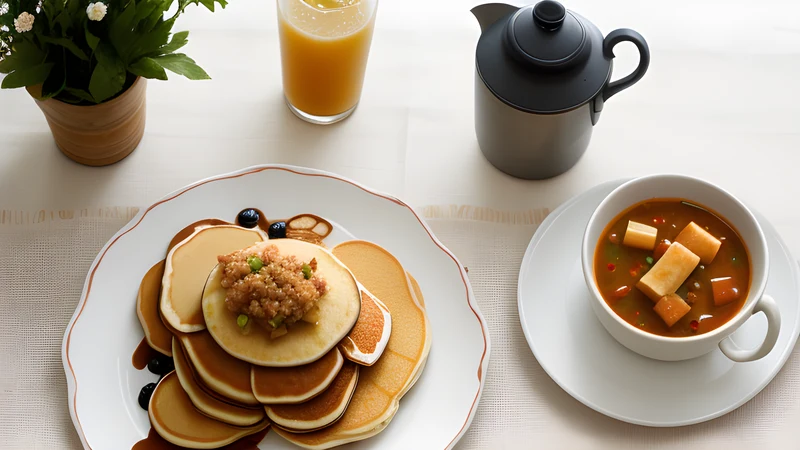
↓ Jump to recipeMachanka is a gravy that has been promoted to a main course, and Belarus is completely unapologetic about it. The name comes from machats — to dip — and that is the entire instruction set. A clay pot of pale, smoky, soured-cream pork gravy goes in the middle of the table with a stack of thick pancakes beside it. You tear, you dip, you keep going until either the pot or you is finished. There are no plates in the strict version. There are no forks either.
I love it for a specific reason: it is one of the few dishes where the sauce is deliberately the star and the meat is the seasoning. The ribs go in to give the gravy collagen and smoke and then get pulled apart into it. What you eat is the liquid.
Machanka: Belarusian Pork Gravy With Pancakes
Ingredients
- 600g pork ribs, cut into individual bones
- 200g smoked pork sausage (kielbasa), sliced 1cm thick
- 150g smoked streaky bacon, cut into 1cm lardons
- 2 medium onions, sliced 5mm thick
- 3 garlic cloves, sliced
- 2 tbsp plain flour
- 500ml chicken or pork stock, hot
- 300ml soured cream, at room temperature
- 2 bay leaves
- 6 allspice berries
- 1/2 tsp caraway seeds
- 1 tsp fine sea salt
- 1/2 tsp black pepper, freshly ground
- 10g dill, chopped
- For the pancakes: 250g plain flour
- For the pancakes: 1 tsp baking powder
- For the pancakes: 1/2 tsp bicarbonate of soda
- For the pancakes: 1/2 tsp fine salt
- For the pancakes: 400ml buttermilk
- For the pancakes: 2 large eggs
- For the pancakes: 30g butter, melted, plus more for the pan
Method
- Season the ribs with half the salt and the pepper. Brown them in a dry heavy casserole over medium-high heat for 8-10 minutes, turning, until well coloured on all sides. Remove to a plate.
- Lower the heat to medium and add the bacon lardons. Cook for 6 minutes until the fat runs and they crisp. Add the sausage slices and fry for 3 minutes until their edges catch. Remove both with a slotted spoon.
- Add the sliced onions to the fat and cook over medium-low heat for 12 minutes until soft and golden. Add the garlic, caraway and allspice and cook for 1 minute more.
- Stir in the flour and cook for 2 minutes, stirring constantly, until it smells toasted and coats the onions.
- Pour in the hot stock in three additions, stirring smooth after each. Return the ribs and bay leaves, bring to a simmer, cover and cook over the lowest heat for 75 minutes, until the meat pulls from the bone.
- Meanwhile make the pancake batter: whisk the flour, baking powder, bicarbonate and salt together. Beat the buttermilk, eggs and melted butter in a jug, pour into the dry mix and whisk until just combined, leaving a few lumps. Rest for 20 minutes.
- Return the bacon and sausage to the pot. Temper the soured cream by whisking 3 ladles of hot gravy into it, then stir the mixture back into the pot. Cook uncovered over low heat for 10 minutes without boiling. Taste and add the remaining salt if needed.
- Cook the pancakes: heat a knob of butter in a frying pan over medium heat. Ladle in 3 tbsp of batter per pancake and cook for 2-3 minutes until bubbles hold open on the surface, then flip and cook 90 seconds more. Keep warm in a low oven.
- Stir the dill through the gravy and pour it into a warm serving pot. Serve with the stack of pancakes, and let everyone tear and dip.
Where it comes from
Belarusian cooking has been under-documented in English for the obvious historical reasons, and machanka is the dish I would put forward as its clearest statement of intent. The template is old peasant cooking from the forested lands between the Baltic and the Pripet Marshes: pork, because every household kept a pig; soured cream, because every household kept a cow and had no refrigeration; rye or wheat flour, because that is what grew; and a clay pot in a masonry stove, because that was the technology.
The dish is documented in nineteenth-century accounts of the Belarusian and Lithuanian countryside as a Shrovetide food — the last big pork-and-dairy blowout before Lent, when both were forbidden. Vincent Dunin-Marcinkievič and later ethnographers record it under regional names, and the pancake element is common to the whole Slavic Maslenitsa complex, the same butter-week logic that produces Russian blini by the hundred.
What makes machanka specifically Belarusian is the combination of three pork forms in one pot: fresh (the ribs), cured (the bacon), and smoked (the sausage). Each contributes something the others cannot. The ribs give gelatine and body, the bacon gives rendered fat to cook the onions in, and the smoked sausage gives the aromatic top note that arrives late in the mouth. Drop any of them and the gravy loses a dimension.
The traditional partner is bliny or draniki, and there is a live regional argument about which. In the Minsk region and westwards it tends to be wheat-flour pancakes; in the Vitebsk direction you are more likely to be handed potato pancakes, which is a heavier proposition and, on a January evening, arguably the better one.
Choosing the three pork forms
The ribs. Ask for a rack cut into singles, and pick a meaty rack rather than a bare one — you want the fat and the connective tissue. Belly ribs, sold in Britain as spare ribs, carry more of both than loin back ribs and are cheaper. A pork hock, boned and cubed, is an excellent alternative and gives even more gelatine.
The bacon. Smoked streaky, in a piece if you can, cut into proper lardons rather than the thin rashers a supermarket packet gives you. Thin rashers turn to leather and disappear; a 1cm cube renders its fat and stays as something to bite.
The sausage. This wants a coarse, smoked, garlicky pork sausage — Polish kielbasa wiejska, Ukrainian kovbasa, or the Belarusian palendvitsa if a specialist shop has it. Frankfurters and hot dogs are useless here; they are emulsified, they release nothing, and they go rubbery. If your only option is a supermarket smoked sausage, buy the coarsest-textured one and slice it thick.
The order of cooking is deliberate. Ribs first, in a dry pan, because they carry enough fat to brown themselves and because the fond they leave on the base is the foundation of the gravy. Bacon second, to render the fat you will cook the onions in. Sausage third, briefly, only to catch its edges — cook it longer and the smoke turns harsh and dominates.
Serving it the Belarusian way
The pot goes in the middle. Everyone gets a pancake and a corner of the table. You tear a piece, you dip, you eat it over the pot because it will drip. There is a genuine communal logic to this: the last third of the gravy is the best part, thick with the shreds that have fallen off the bones, and eating from a shared pot means everybody gets to the good bit together.
If that horrifies your table, ladle the gravy into shallow bowls and hand out the pancakes on a board. It eats the same. But the pot version is more fun and it is the reason the dish exists in this form rather than as a rib stew.
The roux, and why it matters here
Most Eastern European soured-cream sauces are thickened by whisking flour into the cream and stirring it in cold. That works, and it also produces the characteristic slightly raw, pasty flour taste that people associate with cheap canteen versions of these dishes.
Making a roux in the pork fat first fixes it. Two minutes of cooking flour in fat over medium heat does two things: it toasts the starch, which produces nutty flavour compounds and kills the raw taste, and it coats each starch granule in fat so it disperses in the stock without clumping. Cook it until it smells like toasted bread and turns the colour of sand. Go further and it darkens, which tastes good but thickens less — browned flour loses roughly half its thickening power, and this gravy wants body.
Add the hot stock in stages, stirring each addition smooth before the next. Cold stock into a hot roux seizes into lumps that never fully break down.
Caraway and allspice are the two spices that make this taste Belarusian rather than generically Slavic. Allspice berries — six of them, whole, fished out or eaten around — give the warm, clove-and-pepper background that runs through the cooking of the whole region. Caraway is the assertive one, and half a teaspoon is deliberate restraint; a full teaspoon takes over. Toast both in the pork fat with the garlic for a minute before the flour goes in, which blooms their oils into the fat where they will disperse through the gravy rather than sitting in the pot as hard specks.
Tempering the soured cream
This is where machanka gets ruined. Soured cream dumped into a simmering pot curdles: the acid and the heat make the casein proteins clump, and you get white grit floating in thin liquid. The gravy still tastes fine and looks appalling, and there is no way back.
Two defences. First, temper — whisk several ladles of the hot gravy into the cream in the bowl, raising its temperature slowly, then return the warmed mixture to the pot. Second, once the cream is in, keep the pot below a simmer. You want lazy movement and no bubbles breaking.
The flour helps too, which is a genuinely useful piece of kitchen science: starch granules physically get between the casein micelles and stop them aggregating, which is why a floured cream sauce tolerates more heat than a plain one. The roux is doing double duty.
Room-temperature cream is easier to temper than fridge-cold. And fat content is your friend — 20% minimum, 30% better. Low-fat soured cream splits almost on sight.
The pancakes
These are thick, soft, slightly tangy pancakes with structural integrity, because a pancake that dissolves on contact with hot gravy is useless. Buttermilk and bicarbonate do the lifting: the acid in the buttermilk reacts with the bicarbonate immediately, and the baking powder gives a second lift in the pan. The result is an open, spongy crumb that holds gravy the way a good sponge holds water.
Do not beat the batter smooth. Lumps are fine and, in fact, desirable; overworking develops gluten and gives you rubbery discs. Whisk until the dry flour has just disappeared and stop. The 20-minute rest lets the flour hydrate fully and lets the bicarbonate get going.
Judge the flip by the bubbles. When the holes that open on the surface stay open rather than closing over, the underside is set and you can turn it. A pancake flipped early collapses and never regains its rise. Medium heat — these are thick and need the interior to cook through before the outside is mahogany.
The same batter, thinned with 100ml more buttermilk and cooked in a thin film, gives you proper blini for smoked salmon; the thickness here is a deliberate choice for dipping.
Failure modes
Watery gravy. Either the ribs were too lean or the braise was too short. Collagen needs 75 minutes at a bare simmer to turn to gelatine, and gelatine is what gives machanka its lip-sticking quality. Rushing it at a rolling boil tightens the meat and gives you tough ribs in thin liquid.
Greasy gravy. Pork ribs release a lot of fat. Skim the surface with a spoon before the cream goes in — you want some fat, since this is a fatty dish by design, but a 5mm slick on top is unpleasant. Better still, braise it the day before, chill it, and lift the set fat off.
Bitter, dark onions. Twelve minutes over medium-low is a soften, not a caramelise. Onions scorched in bacon fat turn acrid and the bitterness carries all the way through the finished pot.
The case against, and variations
Machanka is unrelenting. Three kinds of pork, soured cream, butter-fried pancakes, no vegetables to speak of. It was designed to fuel outdoor winter labour and it fuels a sofa less gracefully. Put a bowl of pickled cucumbers and a plate of sliced raw onion in vinegar on the table, and treat the dill as an ingredient rather than a garnish.
For a version with more shape, braise the ribs the day before, pull the meat off the bone and return it to the pot; it reheats better and it is easier to eat. Swapping half the stock for dark beer gives a maltier gravy that suits the smoked sausage well. Some Belarusian cooks add dried mushrooms, soaked and chopped, which pushes it towards the forest and is my preferred variation in autumn.
It keeps three days in the fridge and reheats gently over low heat, though the cream will thin slightly. It does not freeze; the sauce breaks on thawing. The pancakes are best fresh, and passable reheated in a dry pan for a minute a side.
Related Content