Mac and Cheese with a Crunchy Parmesan Crumb and English Mustard
Creamy within, crisp on top
Contents
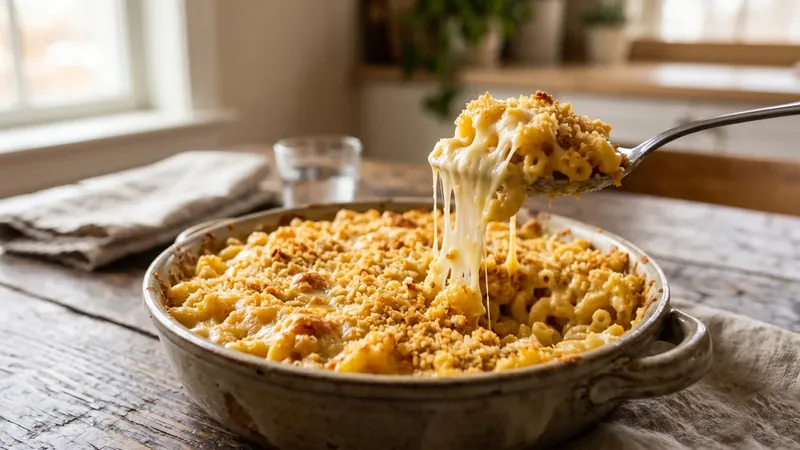
↓ Jump to recipeA great mac and cheese should be two textures at once: silky, molten pasta beneath a lid that crackles under the spoon. The twist here delivers both, a panko-and-Parmesan crumb baked to a deep crunch on top, and a spoonful of English mustard whisked into the sauce to cut the richness and make the cheese taste even more itself. It is a hearty supper with a bit of backbone, and it feeds a hungry table with ease.
Mac and Cheese with a Crunchy Parmesan Crumb and English Mustard
Ingredients
- 300 g macaroni
- 50 g unsalted butter
- 50 g plain flour
- 600 ml whole milk, warmed
- 1 tsp English mustard
- Pinch of grated nutmeg
- 200 g mature Cheddar, grated
- 75 g Gruyère, grated
- Sea salt and freshly ground black pepper
- 50 g panko breadcrumbs
- 30 g Parmesan, finely grated
- 1 tbsp olive oil
Method
- Heat the oven to 200°C (180°C fan). Cook the macaroni in salted boiling water for 2 minutes less than the packet says, then drain.
- Melt the butter in a large pan, stir in the flour and cook the roux for 2 minutes.
- Gradually whisk in the warm milk, a little at a time, until you have a smooth, glossy sauce.
- Simmer gently for 4-5 minutes until thickened, then whisk in the mustard and nutmeg.
- Take off the heat and stir in the Cheddar and Gruyère until melted. Season well.
- Fold the drained macaroni through the cheese sauce and tip into a baking dish.
- Mix the panko, Parmesan and olive oil with a little black pepper, then scatter evenly over the top.
- Bake for 20-25 minutes until bubbling at the edges and deeply golden and crisp on top.
- Rest for 5 minutes before serving.
Older than the boxed version
Pasta baked with cheese is far older than its modern American identity suggests. A recipe titled “de lasanis” appears in the fourteenth-century Neapolitan manuscript the Liber de Coquina, and Elizabeth Raffald’s 1769 English book The Experienced English Housekeeper gives a baked macaroni with a cream sauce, Cheddar and a browned top that is recognisably this dish. It reached America through the well-travelled table of Thomas Jefferson, who served a macaroni pie at a state dinner in 1802 and whose enslaved cook James Hemings helped bring the technique back from France. From there it became woven into American home cooking, and Kraft’s boxed version, launched in 1937, turned it into a pantry staple for millions of households. The roots, though, are unmistakably European: pasta bound in a rich, cheesy sauce and finished in the oven.
The technique: a proper béchamel
At the heart of the dish is one of the most useful techniques a home cook can learn: the béchamel, or white sauce. Built from a cooked paste of butter and flour, called a roux, then loosened with milk, it is the foundation for countless dishes far beyond this one. Melt 50g butter, stir in 50g flour and cook the roux for a full 2 minutes; that cooking drives off the raw, pasty taste of uncooked flour and toasts the starch just enough. Then add 600ml warm milk gradually while whisking hard. Adding it a little at a time keeps the starch granules dispersed and the sauce silky rather than lumpy, and warm milk incorporates far more smoothly than cold. Simmer for 4 to 5 minutes to thicken, then whisk in the mustard and a pinch of nutmeg. The single most important rule: stir the cheese in off the heat. Boiling melted Cheddar makes its proteins seize and squeeze out fat, which is what gives you that grainy, oily sauce nobody wants.
The béchamel is the same technique that underpins a good shepherd’s pie topping and countless other classics, which is why it is worth getting into your hands.
The cheese, and the mustard
The choice of cheese matters. Mature Cheddar provides the sharp, savoury punch, while 75g of Gruyère brings a smooth, nutty meltiness and, crucially, better emulsifying behaviour that keeps the sauce cohesive. Grate the cheese yourself; pre-grated cheese is dusted with anti-caking starch that can make the sauce chalky. The English mustard is the recipe’s quiet secret weapon. Used at just a teaspoon, it adds no obvious heat of its own; instead its sharpness lifts the dairy and deepens the perception of cheesiness. It is the same instinct that puts mustard in a Welsh rarebit or in the cheese pastry of a batch of gougères.
The crunchy crumb
The crisp topping is where the twist becomes most obvious. Panko, the light, shard-like Japanese breadcrumb, is made from crustless bread ground into flakes rather than crumbs, so it bakes to a far crunchier, longer-lasting crust than ordinary breadcrumbs. Toss 50g of it with 30g grated Parmesan, a tablespoon of olive oil and a little black pepper — the oil carries heat into each flake and helps it brown, while the Parmesan adds salt and a savoury, golden crust. Scatter it evenly and bake at 200C (180C fan) for 20 to 25 minutes until bubbling at the edges. The contrast of brittle crust giving way to molten pasta beneath is what turns a good bowl into one worth fighting over the corner pieces for.
What can go wrong
Two details save the dish. First, undercook the pasta in its initial boil by 2 minutes, because it keeps cooking in the oven and fully cooked macaroni turns soft and bloated by the time the crumb has browned. Second, make the sauce a shade looser than seems right: the pasta drinks in liquid as it bakes, and a sauce that looked perfect in the pan can turn stodgy in the dish. Rest the finished bake for 5 minutes so the sauce settles and holds together on the spoon rather than flooding the plate.
Substitutions, make-ahead and variations
No Gruyère? Comté, Emmental or a little grated mozzarella all bring meltiness. For a smokier version, swap a quarter of the Cheddar for smoked Cheddar, or fold through a spoonful of English mustard’s coarser wholegrain cousin. You can assemble the whole dish ahead, crumb and all, and keep it covered in the fridge for a day; add 5 to 10 minutes to the bake and start it from cold. Fold in fried leeks and a little crispy bacon, or roasted cauliflower, to turn it into a one-dish supper. Leftovers reheat well covered with a splash of milk stirred through to loosen the sauce.
Choosing the pasta
Elbow macaroni is the default for a reason: the curved tube traps sauce inside as well as coating the outside, and its short length means every forkful carries a good ratio of sauce to pasta. But the shape is not sacred. Anything with ridges or hollows holds a béchamel well, so cavatappi (the corkscrew macaroni), conchiglie (shells), rigatoni and penne all work, with the shells in particular scooping up little pockets of sauce. Avoid long, smooth shapes like spaghetti or linguine, which shed a cream sauce rather than holding it, and give delicate shapes a miss because they overcook too easily in the second, oven stage. Whatever you choose, salt the boiling water generously — it should taste of the sea — because it is the only chance to season the pasta itself from the inside, and no amount of salt in the sauce fully compensates for bland pasta.
To bake, or not to bake
There is a long-running divide between baked mac and cheese, with its crust and its set, sliceable body, and the stovetop version that stays loose and saucy and never sees the oven. This recipe is firmly in the baked camp because the crunchy crumb is the whole point, but the two are worth understanding as a spectrum. The more you bake it, the firmer and more custard-like the interior becomes as the eggless béchamel tightens and the pasta absorbs liquid; pull it earlier and it stays looser. If you prefer the American diner style with a genuinely custardy set, whisk an egg yolk into the finished sauce off the heat before folding in the pasta — the yolk sets gently in the oven and binds the whole thing so it holds a clean edge when cut. Leave the yolk out, as here, and you get a sauce that stays creamy and flowing under its crisp lid, which is how I prefer it. Either way, resist the urge to drench it in extra cheese on top before baking: a thick raw cheese layer bakes to a tough, oily skin, whereas the panko-and-Parmesan crumb browns into something far lighter and crunchier. That restraint, more than any single ingredient, is what separates a mac and cheese people remember from one they merely finish.
The physics of a smooth sauce
If there is one thing to understand about a cheese sauce, it is why it splits, because avoiding that is the difference between silky and greasy. Cheese is an emulsion of fat, water and protein held together while it is solid. Heat it gently and the fat softens and disperses smoothly; heat it too hard, and the protein network contracts and wrings out the fat as visible oil while the solids clump into rubbery strings. The béchamel is your insurance against this: the starch from the flour coats the melted cheese proteins and keeps them suspended, which is precisely why a roux-based sauce is so much more forgiving than melting cheese into plain milk. It is the same principle behind the sodium citrate that gives processed cheese slices their unnatural smoothness — a chemical crutch doing the job that a good roux does honestly.
This is also why the order and temperature of assembly are worth respecting. Warm the milk before it meets the roux so the sauce does not seize into lumps as cold liquid hits hot fat. Add the cheese only once the pan is off the heat and the sauce has stopped bubbling, and stir it through the residual warmth rather than forcing it over a flame. And loosen the finished sauce a shade more than looks right, because the pasta will drink liquid in the oven and a sauce that clings perfectly in the pan can bake into something claggy. Get the emulsion right and hold it there, and the dish stays creamy from the first spoonful to the corner-piece scrapings that everyone secretly wants.
Related Content