Louvi me Lahana: The Cypriot Black-Eyed Beans and Greens
Two ingredients, one lemon, an ocean of olive oil
Contents
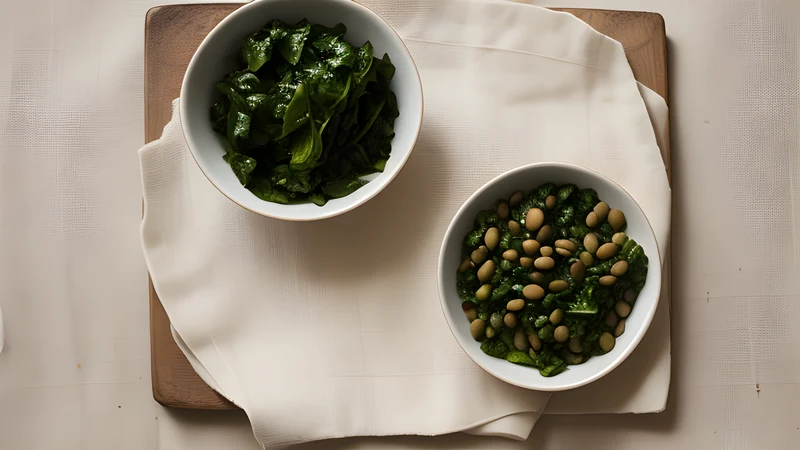
↓ Jump to recipeLouvi me lahana is what Cypriot households eat when nobody has planned anything. Beans from the cupboard, greens from the garden or the verge, a lemon off the tree, and enough olive oil that a British person seeing it made for the first time will assume a mistake has occurred. It has not. The oil is the sauce.
It is one of a very small number of dishes I can think of where the ingredient list is genuinely two things and the result is genuinely dinner. And the reason it works is that black-eyed beans and chard are both slightly earthy in the same register, so the lemon and the oil have a single target to hit rather than two competing ones.
Louvi me Lahana: The Cypriot Black-Eyed Beans and Greens
Ingredients
- 350 g dried black-eyed beans
- 400 g Swiss chard or spinach beet, leaves and stalks separated
- 2 lemons, halved
- 120 ml extra virgin olive oil, plus more to serve
- 1 1/2 tsp fine salt
- 1/2 tsp coarsely ground black pepper
- 1 small dried red chilli (optional)
- 1 tbsp olive oil, for the lemons
Method
- Rinse the black-eyed beans and put them in a large pan with 1.5 litres of cold water. Bring to the boil and cook uncovered for 3 minutes, then drain and discard the water.
- Return the beans to the pan with 1.5 litres of fresh cold water. Bring to a gentle simmer and cook uncovered for 25-30 minutes until tender but not collapsing. Add no salt yet.
- While the beans cook, cut the chard stalks into 3 cm lengths and shred the leaves coarsely.
- Brush the cut faces of the lemon halves with 1 tbsp olive oil. Place cut-side down in a dry, very hot frying pan and leave undisturbed for 4-5 minutes until the flesh is dark brown and blistered.
- Add the chard stalks to the beans and simmer for 5 minutes. Add the leaves and the chilli, if using, and simmer for 4 minutes more until the greens are silky.
- Add the salt and pepper and cook for 2 minutes. Drain, reserving 200 ml of the cooking liquid.
- Return the beans and greens to the pan off the heat. Pour over the 120 ml olive oil and squeeze in the juice of the charred lemon halves through a sieve.
- Stir hard for 30 seconds — the oil, lemon and starchy liquid should emulsify into a loose dressing. Add reserved liquid if it is tight. Serve warm or at room temperature with more oil.
The dish and the fast
Louvi is the Cypriot word for black-eyed beans; lahana here means leafy greens broadly, most often chard but also spinach beet, wild mustard greens, or whatever agria horta the person cooking has foraged. On Cyprus the foraging season runs roughly January to April, and the greens people bring back — strouthouthkia, mustard, sow thistle, wild fennel — are markedly more bitter than cultivated chard. If you can get proper bitter greens, use them and cut the lemon back slightly.
The dish sits at the centre of Cypriot Lenten cooking, which is severe. The Orthodox fast excludes meat, dairy, eggs, fish with backbones and, on the strictest days, olive oil itself. Louvi me lahana is what you make on the days oil is permitted, and it is the reason Cypriot vegetarian cooking is so much more developed than its neighbours’: roughly 180 days of the Orthodox calendar are fast days in the traditional reckoning, and a cuisine that spends half the year without meat gets very good at beans.
Black-eyed beans themselves came from West Africa, moved through Egypt and the Levant in antiquity, and have been growing on Cyprus long enough that the island treats them as native. They cook fast — no overnight soak required, which is unusual for a dried pulse and a large part of why this dish exists as weeknight food.
Which greens, and how bitter
The chard you buy in a British supermarket is a cultivated, sweetened version of something the Cypriots pick wild, and that gap is worth managing.
Swiss chard works and is what I use most weeks. The stalks are the interesting part — they are crunchy, faintly mineral, and they take eight or nine minutes to go tender, which is why they go in ahead of the leaves. Do not throw them away, as roughly every recipe written outside the Mediterranean instructs. Rainbow chard is the same plant with more colourful stalks and it bleeds pink into the beans, which some people mind.
Spinach beet, sometimes sold as perpetual spinach, is closer to what Cyprus uses: thinner-stalked, leafier, slightly more bitter. If your greengrocer has it, take it.
Real horta is a different proposition. Cypriots forage sow thistle, wild mustard, black mustard tops, wild fennel and something called strouthouthkia, and they are all noticeably bitter — bitter enough that first-timers assume something has gone wrong. That bitterness is load-bearing. It is what the olive oil is answering, and a dish made with sweet cultivated chard needs less lemon to stay balanced because there is less bitterness to frame. If you can get dandelion greens, which most Turkish and Greek grocers stock in spring, use 200 g of them alongside 200 g of chard and you will be much closer to the real thing.
What to avoid: kale, which is too tough and takes too long, and baby leaf spinach, which collapses to slime in ninety seconds and contributes nothing but water.
The twist: char the lemons
Raw lemon juice in this dish is correct and traditional and slightly one-dimensional. It arrives as a spike of acid, does its job, and leaves. My change is to halve the lemons and put them cut-side down in a dry, screaming-hot pan for four or five minutes until the flesh goes properly dark.
What happens in that pan: the fruit sugars caramelise and the juice partially cooks, which knocks the sharpest edge off the citric acid and builds a bitter-sweet backbone underneath it. The juice goes from bright to round. Squeezed into a bowl of beans and oil, charred lemon reads as depth rather than as an interruption. You still get the lift. You also get something almost like burnt marmalade sitting behind it.
Two practical points. Brush the cut faces with a film of oil first — dry lemon flesh in a dry pan tends to stick and tear rather than colour. And squeeze through a sieve, because charred lemon sheds bits of blackened membrane that taste genuinely acrid.
Getting the beans right
The three-minute purge. Boil the beans for three minutes in their first water, then throw that water away. This removes a large share of the oligosaccharides responsible for the digestive consequences of pulses, and it also takes with it a slightly dusty flavour that black-eyed beans carry. It costs you nothing.
No salt until the end. Salt in the cooking water toughens the skins of black-eyed beans specifically — they have a thinner seed coat than chickpeas or cannellini and behave differently. Salt them in the last two minutes and they season through perfectly.
Old beans will never soften. Dried pulses have a shelf life that nobody prints on the packet. Past about two years the seed coat undergoes changes that make it effectively impermeable, and no amount of simmering will rescue them — you can boil a four-year-old black-eyed bean for three hours and it will still be a pebble. Buy from a shop with turnover. A Turkish or Cypriot grocer sells more pulses in a week than a supermarket does in a season.
Cook uncovered at a bare simmer. A rolling boil breaks the skins and you end up with mush and floating jackets. You want the surface just trembling.
Stalks before leaves. Chard stalks need eight or nine minutes; the leaves need three. Put them in together and you get either raw stalks or grey leaves.
The emulsion
This is the step people skip and it is the whole dish. When you return the drained beans to the pan and pour on the oil and lemon, stir hard for a full thirty seconds. The starch clinging to the beans and the reserved cooking liquid act as an emulsifier, and the oil and juice come together into a loose, cloudy dressing that coats everything. Pour the oil on and stir twice and you get oil sitting on top of wet beans, which is a different and worse dish.
If it looks tight and claggy, splash in the reserved bean liquid a tablespoon at a time. If it looks broken and oily, add more liquid and stir harder.
Why the oil is the amount it is
A hundred and twenty millilitres of olive oil across four servings works out at roughly 30 ml a head, which is two tablespoons, and this is the number that alarms people.
Cyprus consumes somewhere around 15 to 18 litres of olive oil per person per year. That is simply how the cuisine is constructed. In a dish with no meat, no stock, no dairy and no fat of any other kind, the oil is supplying every single calorie of richness and every fat-soluble aromatic compound in the meal. Cut it to three tablespoons and you have not made a lighter version of louvi me lahana. You have made boiled beans with lemon on them, which is a different and sadder object.
The oil also does chemical work. The bitter compounds in chard — oxalates and various phenolics — are more perceptible in a watery medium and get muted in a fatty one. And the aromatic molecules in good olive oil, particularly the peppery oleocanthal that catches at the back of your throat, only register when the oil is present in quantity.
Which is why the bottle matters. Use a grassy, peppery extra virgin — Greek, Cypriot or a young Tuscan. A mild, buttery oil disappears. Refined olive oil, or the stuff labelled simply “olive oil”, has had the polyphenols stripped out and will contribute mouthfeel and nothing else. Keep 20 ml back to pour over each bowl at the table, uncooked and unheated, where you will taste it most clearly.
What to do with it
A note on tinned beans, since somebody will ask. They work, in the sense that dinner appears. Drain and rinse two 400 g tins, skip straight to the greens, and simmer them together for six minutes in 300 ml of water. What you lose is the starchy cooking liquid, which is the emulsifier — so keep 100 ml of the liquid from the tin, cloudy as it is, and use that instead. The result is about 80 per cent of the dish for about 15 per cent of the time. On a Tuesday that is a reasonable trade.
Serve warm or at room temperature — the second is arguably better, and it is how Cyprus eats it. It needs bread, a lump of salty cheese, and nothing else. Leftovers keep four days and thicken as the beans absorb the dressing; loosen with hot water and a splash of oil.
Variations worth trying: 200 g of diced ripe tomato added with the leaves turns it into a summer dish. A tin of tuna in oil, flaked through, makes it a proper meal for people who find beans insufficient. Two tablespoons of tahini whisked into the dressing sends it toward the Levant and is very good, on the logic laid out in tahini sauce: the ratio, the method, the variations.
For neighbours on the same shelf: ful medames is the Egyptian answer to the same question of beans plus acid plus oil, and tuscan white bean and cavolo nero soup is the Italian one. If you want the Cypriot table around it, afelia is what appears on the days the fast lifts.
One more thing about timing. This dish is at its best about forty minutes after you make it, once it has cooled to room temperature and the beans have drunk some of the dressing but before the fridge has firmed the oil into a paste. If you refrigerate it, take it out an hour before you plan to eat, because cold olive oil is waxy and mutes everything. Cypriot households leave the bowl on the counter under a plate and eat from it across the afternoon, which is the correct approach and also explains why the quantities are always more generous than the number of people present.
The olive oil is not a garnish. Use the good bottle.
Related Content