Lohikeitto: Finnish Salmon and Dill Soup
No roux, no browning, and a whole bunch of dill thrown in off the heat
Contents
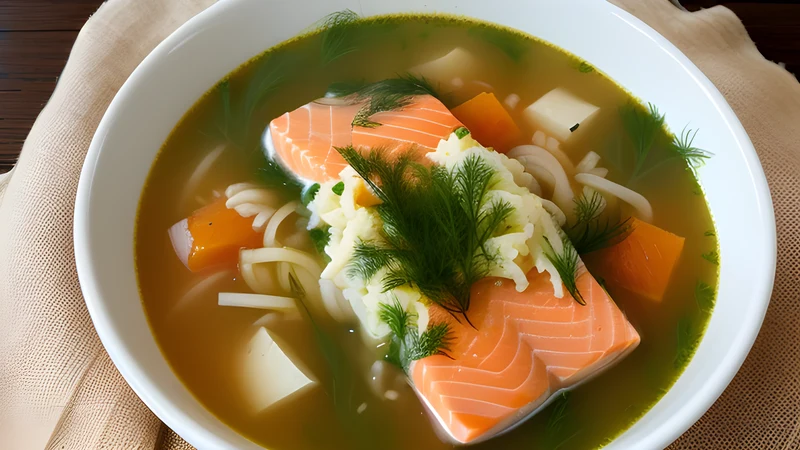
↓ Jump to recipeThe most common mistake with lohikeitto is treating it as a fish chowder. Chowder is built on a roux and thickened with flour, and it arrives opaque and heavy. Lohikeitto is thickened by potatoes simmered until their edges fall apart, and it arrives nearly translucent, with a body that comes from starch suspended in cream. You can taste the salmon through it, which is the entire point.
The other common mistake is the dill. Almost every recipe I have seen calls for a tablespoon or two, stirred in at the end and mostly invisible. Finnish households use a fistful — forty grams, two full supermarket packets, enough that the soup turns faintly green at the edges. That quantity is the recipe. Cut it in half and you have made a salmon soup that happens to contain dill.
Lohikeitto: Finnish Salmon and Dill Soup
Ingredients
- 700 g salmon fillet, skin on, pin-boned
- 1 litre cold water
- 1 leek, split lengthways and rinsed
- 10 whole allspice berries
- 8 white peppercorns
- 2 bay leaves
- 600 g floury potatoes (Maris Piper or King Edward), cut into 2 cm dice
- 2 medium carrots (about 200 g), cut into 5 mm coins
- 300 ml double cream
- 1.5 tsp fine sea salt, plus more to taste
- 50 g cold unsalted butter, cubed
- 40 g dill, fronds picked and roughly chopped (about 2 supermarket packets)
- 1 tsp white wine vinegar
Method
- Skin the salmon: lay it skin-side down, get a knife between flesh and skin at the tail end, grip the skin and run the blade along it at a shallow angle. Keep the skin.
- Put the salmon skin, the green half of the leek, allspice, peppercorns and bay leaves in a pan with the 1 litre cold water. Bring slowly to a bare simmer and hold it there for 15 minutes, skimming any foam. Strain and discard the solids.
- Return the strained broth to the pan. Add the potatoes and carrots and simmer for 12–14 minutes, until the potato is tender and its edges have started to fur.
- Slice the white half of the leek into 5 mm half-moons and add it with the double cream. Return to a bare simmer — never a boil.
- Season with the salt and the vinegar. Taste and adjust.
- Cut the salmon into 3 cm chunks. Turn the heat off. Slide the salmon in, put the lid on and leave for 5 minutes. The residual heat brings it to just-set.
- Take the lid off. Drop in the cold butter a few cubes at a time, swirling the pan rather than stirring, until it has melted into the soup and the surface turns glossy.
- Add all the dill at once. Stir once. Serve immediately, with dark rye bread.
The soup, and where it comes from
Salmon has been the currency of Finnish rivers for as long as anyone has kept records. The Tornio, on the Swedish border, and the Kymi, in the south, ran with Atlantic salmon in numbers that seem fictional now — medieval tax records list salmon as a payment in kind, and salmon weirs were valuable enough to be fought over in court. When the rivers were dammed for hydropower in the twentieth century, most of those runs collapsed. The Kymi’s wild salmon are essentially gone. Finland’s salmon soup is now made almost entirely from farmed Norwegian fish, which is an honest thing to know while you cook it.
Lohikeitto’s shape is old, though. A pot of water, whatever fish came out of the river, potatoes once they arrived in the eighteenth century, and dairy from whatever cow the household had. The allspice is the same colonial import that flavours karjalanpaisti and Swedish kalops, and it arrives in Finnish cooking through the same Baltic trade routes.
What is genuinely Finnish is the restraint. There is no wine here, no bay-and-thyme bouquet, no garlic, no browning of anything at all. The whole dish is fish, potato, cream, dill and allspice, and the flavour has to come from getting each of those exactly right. That is a harder discipline than it sounds. Every instinct you have will tell you to add something, and every addition makes it worse.
Salmon skin is the stock
This is the trick that separates a good lohikeitto from a beige one, and it costs you nothing.
Salmon skin is loaded with collagen and with the fat that sits in the layer just beneath it — the fattiest, most flavourful part of the fish, which most cooks throw away with the skin. Simmered for fifteen minutes in water with allspice and bay, it gives up enough gelatine to give the broth a soft, coating texture and enough salmon flavour to taste of the fish rather than of cream.
Fifteen minutes, and no longer. Salmon is an oily fish, and oily fish bones and skin go rancid-tasting fast in hot water. Twenty-five minutes is already too much; the broth develops a sharp, tinned quality that you cannot season out. Set a timer.
If you bought skinless fillets, buy 200 g of salmon trimmings or a tail piece instead and simmer that. Failing that, use plain water and accept a thinner soup — bottled fish stock made from white fish tastes wrong here, because it brings a cod-and-shellfish flavour that fights the salmon.
Do skim. Salmon throws a lot of grey albumen foam in the first five minutes, and left in, it clouds the broth and gives it a faint chalkiness. Two or three passes with a spoon are enough.
Potato as thickener
Choose floury varieties. Maris Piper, King Edward and Russet all have high dry-matter content — roughly 20–22% starch by weight against 16–18% for a waxy potato like Charlotte — and that starch is what suspends in the broth and gives the soup its body.
The mechanism is worth understanding. As the potato heats past about 65°C, its starch granules absorb water and swell; past 80°C, the swollen granules on the cut surfaces rupture and release amylose into the surrounding liquid, which is what thickens it. A waxy potato has fewer, smaller granules held in a firmer pectin matrix, so it stays in neat cubes and thickens nothing. Perfect cubes are a sign you bought the wrong potato.
You want the dice to be tender all the way through with their corners visibly gone fuzzy. Twelve to fourteen minutes at a simmer gets there for 2 cm dice. If you want a thicker soup, crush four or five of the cubes against the pan wall with a fork and stir — that is the entire technique, and it beats flour every time because it thickens without dulling the flavour.
The butter finish, and why cold
Finishing with cold butter — monter au beurre, if you want the French term for a technique Finnish grandmothers were doing anyway — is what gives lohikeitto its shine.
Cold butter is an emulsion: fat globules held in water by milk proteins. Added cold, in pieces, to a liquid below boiling, it disperses those globules through the soup and they stay dispersed. Added warm or melted, the emulsion has already broken and the fat separates into a slick on the surface within a minute. The pan wants swirling rather than whisking, and it wants to be off the heat. If your soup ends up with an oil slick, the butter went in too warm or the pan was too hot.
Fifty grams in a soup that already has 300 ml of double cream sounds like too much. It reads as gloss rather than richness, and it is the difference between a soup that looks like it came out of a Helsinki kitchen and one that looks like it came out of a tin.
What to leave out
A short list, because the omissions are the recipe.
No garlic. I say this as someone with strong opinions in the other direction on most things. Garlic’s sulphur compounds and salmon’s fat oils produce a specific, unpleasant metallic note together, and cream does nothing to hide it. Every time I have tried it — and I tried it three times, because I did not want to believe it — the soup got worse.
No flour. Flour coats the tongue and mutes the fish. The potato does the job better and adds flavour while it does it.
No wine. White wine’s acidity is fine in principle, but its own aromatics sit exactly where the dill wants to be, and the dill loses. If you want acid, use the vinegar.
No onion. Leek only. Onion cooked in cream turns sweet and sulphurous, and it flattens the allspice. The leek gives you allium without either problem, which is why every Finnish version I have eaten uses it.
No stock cube. A fish or vegetable cube brings monosodium glutamate, dried celery and yeast extract, and all three announce themselves loudly in a soup this plain. Salmon skin and water beat any cube on the shelf, and you already own the skin.
Timing the salmon, tips and variations
Off the heat, lid on, five minutes. Salmon sets at a lower temperature than cod — the muscle proteins denature from around 50°C, and the fish is at its best somewhere around 52–55°C, still faintly translucent in the middle of each chunk. A covered pan of 85°C soup delivers a 3 cm chunk to that point in about five minutes and then the whole thing cools together. Simmer it actively instead and you get 65°C salmon, which is dry, opaque and pushing out white albumen curds.
The dill goes in last, always. Dill’s aroma comes from volatile monoterpenes that boil off within seconds of hitting hot liquid. Add it at the start and you have paid for green confetti. Add it after the heat is off and the soup smells of dill from a metre away. Use the fronds; the stalks are tough, though they are excellent in the broth pot if you throw them in with the skin.
The vinegar is a teaspoon, and most Finnish recipes leave it out. I put it in because cream and salmon together are relentlessly soft, and a single teaspoon of acid gives the whole bowl an edge to stand on. Taste before and after and you will hear the difference.
Substitutions. Sea trout works beautifully and is often better value. Hot-smoked salmon, added at the very end and never simmered, makes a smokier version — use 400 g and drop the cream to 200 ml, because smoked fish is saltier and the balance shifts. Rainbow trout, farmed in Finnish lakes and sold as kirjolohi, is the everyday Finnish substitute.
Make-ahead. The broth keeps three days. The finished soup does not — reheating cooks the salmon a second time and turns it to sawdust. If you must, hold the soup back before the fish goes in, then reheat to 85°C and add raw salmon then.
Buying the salmon. Ask for a tail-end piece rather than a centre cut. It costs less, it has the same skin, and since you are dicing it anyway the even thickness of a centre cut buys you nothing. What matters more is that the flesh springs back when pressed and the cut face shows no gaping between the flakes — gaping means the fish has been frozen and thawed badly, and those chunks will fall apart in the pot.
Scaling up. The soup doubles cleanly except for the broth, which does not. Two litres of water and 1.4 kg of salmon skin still wants fifteen minutes, and it will be slightly weaker for the volume. Compensate by simmering the doubled broth uncovered for five minutes after straining, before the potatoes go in, rather than by extending the skin time.
Serve it with rye. Ruisleipä, buttered thickly, is what a Finn would put next to it, and the sourness of the bread does the same job as the vinegar. If you want a whiter fish version of the same idea with a roux behind it, Norwegian fiskesuppe is the neighbouring dish, and comparing the two teaches you more about Nordic soup than any amount of reading.
Related Content