Lobio: Georgian Red Bean Stew With Walnut
Kidney beans cooked soft, thickened with ground walnut, and sharpened at the last minute
Contents
↓ Jump to recipeLobio means beans. That is the whole name, and it covers a family of dishes rather than a single one: soupy lobio you eat with a spoon, mashed lobio the texture of hummus, lobio baked in a clay dish under a lid of cheese, and lobiani, the flatbread with the beans folded inside it. The version here is lobio nigvzit — beans with walnut — and it is the one that explains what Georgian cooking actually does with a legume, which is treat it as a canvas for spice and nuts rather than as filler.
Lobio: Georgian Red Bean Stew With Walnut
Ingredients
- 350g dried red kidney beans, soaked overnight in cold water
- 1 bay leaf
- 1 1/2 tsp fine salt, plus more to finish
- 3 tbsp sunflower oil
- 2 medium onions (about 300g), finely diced
- 6 garlic cloves, crushed
- 120g shelled walnut halves
- 1 tsp dried blue fenugreek (utskho suneli)
- 1 tsp dried marigold petals (Imeretian saffron), or 1/4 tsp turmeric
- 2 tsp ground coriander seed
- 1/2 tsp ground cinnamon
- 1/2 tsp dried chilli flakes
- 30g fresh coriander, chopped, plus extra to serve
- 2 tbsp red wine vinegar
- 1/2 tsp coarsely ground black pepper
- 1 small red onion, very finely sliced, to serve
Method
- Drain the soaked beans, cover with 1.5 litres of fresh cold water, add the bay leaf and 1 tsp of the salt, and bring to the boil. Boil hard for 10 minutes, then reduce to a steady simmer.
- Simmer, partly covered, for 60-80 minutes until the beans crush easily between finger and thumb with no chalkiness at the centre. Top up with boiling water if they emerge from the liquid.
- Drain, keeping 500ml of the cooking liquid. Set aside a third of the beans.
- Heat the oil in a wide pan over a medium heat. Fry the onions with 1/2 tsp salt for 12-14 minutes until soft and lightly golden. Add the garlic and cook 1 minute more.
- Stir in the blue fenugreek, marigold, ground coriander, cinnamon and chilli flakes. Cook for 45 seconds until fragrant.
- Blitz the walnuts in a food processor in short pulses until they are the texture of coarse breadcrumbs and just beginning to look oily. Stop before they turn to paste.
- Add the larger portion of beans to the pan with 400ml of the reserved cooking liquid. Crush about half of them against the side of the pan with a wooden spoon to thicken the stew.
- Stir in the ground walnuts and the reserved whole beans. Simmer gently, uncovered, for 12 minutes, stirring often. Add more cooking liquid if it tightens past a loose porridge.
- Take off the heat. Stir in the fresh coriander, the vinegar and the black pepper. Taste and add salt until the flavours sharpen, usually another 1/2 tsp.
- Rest for 10 minutes, then serve topped with sliced red onion and more fresh coriander.
The pot the dish is named for
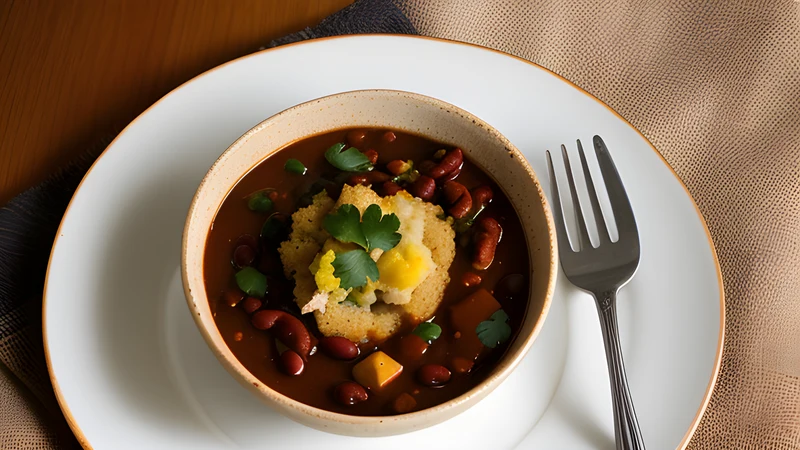
Go into a Tbilisi lobiani house and the stew arrives in a ketsi, a shallow, unglazed clay dish that has been fired to a dull terracotta and is scalding when it lands on the table. Clay is a bad conductor and a good store of heat, so the stew is still bubbling five minutes in, and the surface layer catches slightly against the walls. Alongside there will be mchadi — cornbread, flat rounds of white maize flour and water, cooked dry on a griddle, crisp outside and dense as a scone within — and a saucer of jonjoli, the pickled flower buds of the bladdernut tree, which taste like a caper crossed with a green bean.
That combination is peasant food in the honest sense. Maize arrived in Georgia from the Americas via the Ottoman world and settled hardest in the west, in Samegrelo and Guria, where it displaced millet and became the daily starch. Beans came the same way and by the same route. What Georgian cooks did with these New World imports was fold them into a spicing system that was already there, and it is that system, rather than the ingredients, that makes lobio taste like nowhere else.
Blue fenugreek and marigold petals
Two spices carry this dish, and both are worth a trip to a Georgian, Russian or Armenian grocer.
Blue fenugreek, utskho suneli, is the ground seed and pod of Trigonella caerulea, a small clover relative grown across the Caucasus. The name means “foreign spice”, which is a bit of Georgian dry humour given how thoroughly local it is. It tastes like fenugreek seed with the bitterness taken out: hay, maple, celery leaf, a sweet greenness. Ordinary ground fenugreek seed at half the quantity will stand in, though it brings a harder, more bitter edge.
Marigold petals, kartsakhura, sold as Imeretian saffron, are the dried and ground ray florets of Tagetes. They are used for colour first — a warm ochre-orange — and for a mild, resinous, slightly citrus scent second. Turmeric gives you the colour and none of the aroma, which is why the quantity drops when you swap.
Both are in khmeli suneli, the Georgian dried-herb blend, along with coriander seed, dill, bay, summer savory and marjoram. If you own a jar of khmeli suneli, 2 tsp of it can replace the fenugreek, marigold and ground coriander here. The same pair of spices show up in pkhali and in the cold walnut sauce of satsivi, and buying them once unlocks a whole shelf of Georgian cooking.
Walnuts do the work flour would
There is no roux in this stew, no cornflour, no reduction. The body comes from two places: beans crushed against the side of the pan, and ground walnut.
A walnut half is roughly 65% fat by weight. Grind it and you break the cell walls, releasing that oil into a suspension with the water in the pot. What you get is something close to a nut emulsion, and it thickens the stew while making it taste richer than the three tablespoons of oil in the ingredient list can account for. This is the single most Georgian technique in the repertoire. It builds the walnut sauces, it binds the vegetable pastes, and it thickens kharcho as well.
Pulse the walnuts, and stop early. There is a narrow window between coarse crumb and walnut butter, and past it the nuts release all their oil at once, seize into a paste, and go greasy in the pan rather than dissolving into the liquid. Coarse breadcrumb texture with a faint sheen is the target.
Georgian cooks use raw walnuts here, and I do too. Toasting them would give a deeper, rounder, more familiar flavour and would move the dish somewhere else entirely — raw walnut has a green, faintly bitter, tannic edge that reads as fresh, and the tannin plays against the vinegar at the end.
Which bean, and why red
Georgian cooks use a dark red bean they call lobio generically, closest in the British shops to the red kidney. It is a large, thick-skinned bean with a dense, almost mealy interior, and both of those properties matter. The thick skin survives 80 minutes of simmering and the subsequent crushing, so a third of the beans stay whole and give the stew texture. The mealy interior is high in starch, which is what actually thickens the pot when you press those beans against the pan wall.
Borlotti work well and are prettier, though they break down further and give a softer, less structured result. Pinto beans are good. Black beans taste wrong here — their earthy, almost mushroomy flavour argues with the walnut. Cannellini and other thin-skinned white beans disintegrate entirely and give you soup.
Soaking overnight is worth the forethought. It cuts the cooking time by roughly a third and, more usefully, gives you beans that cook evenly, because the water has had twelve hours to work its way to the centre rather than eight minutes. If you have forgotten, cover the beans with boiling water, leave them an hour, drain, and proceed with an extra 20 minutes on the simmer.
The onion, twice
There are two onions in this dish doing opposite jobs, and skipping either one shows.
The white onions on the base are cooked slowly, for a full 12 to 14 minutes with salt, until they are properly soft and just starting to take colour at the edges. This is not a three-minute softening. You want their harsh sulphur compounds gone and their sugars concentrated, because they are the sweet counterweight to two tablespoons of vinegar going in at the end. Rush them and the stew tastes thin and sharp.
The raw red onion on top is untouched, sliced as finely as you can manage, and it carries all the pungency the cooked onions gave up. A forkful of soft, spiced, walnut-thick beans with a few strands of raw onion through it is the whole dish in one mouthful. Slice it just before serving; red onion left sitting goes limp and loses its bite within about twenty minutes.
Salt early, acid late
Two rules about beans, one of them a myth.
The myth: salting the water toughens the skins. It does not. Salt actually helps — the sodium ions displace the calcium and magnesium in the pectin of the skin, which weakens it and lets the bean hydrate more evenly. Salted beans cook slightly faster and season all the way through instead of tasting like bland pellets in a savoury sauce. Salt from the start.
The rule that holds: acid does slow things down. Vinegar, tomato, lemon, wine — all of them keep the pectin in the cell walls intact and can leave beans chalky at the centre after two hours of simmering. This is why the vinegar in lobio goes in at the very end, off the heat. It is also why so many people’s first attempt at a bean stew stalls: they added the tomatoes at the beginning.
The ten-minute hard boil at the start is a separate matter and it is not optional. Red kidney beans contain phytohaemagglutinin, a lectin that causes serious gastric upset and is only destroyed by boiling — a low simmer or a slow cooker on low will concentrate it rather than destroy it. Boil hard for ten minutes, then drop to a simmer. Tinned beans have been through this already; if you use them, skip to the frying and use 3 x 400g tins, drained, with 400ml of vegetable stock in place of the bean liquor.
Judging when the beans are done
Squeeze one between finger and thumb. It should collapse into a smooth paste with no grit and no resistant core. Undercooked beans in lobio are a disaster, because half of them get crushed to thicken the stew and any chalkiness ends up distributed through the whole pot.
Age matters more than the packet suggests. Dried beans that have sat in a warehouse for three years may never soften properly, no matter how long you simmer. If yours are still hard at 90 minutes, they are old, and no technique will rescue them.
What can go wrong
Greasy, separated stew. The walnuts went past the crumb stage into butter. Grind in short pulses and stop early.
Chalky beans. Old beans, or acid added too soon.
Flat and muddy. Under-salted at the end, or the vinegar was left out. Georgian food runs sharp; 2 tbsp of red wine vinegar in a pot this size should make the beans taste more of themselves.
Claggy and stiff. Reserve that cooking liquid. Lobio tightens as it stands and always wants loosening.
Variations, storage and the table
Soupier. Add another 200ml of the bean liquor and crush fewer beans. Eat with a spoon.
Baked. Spread the finished stew in a shallow dish, top with 150g of grated sulguni or low-moisture mozzarella, and grill until blistered.
Pomegranate instead of vinegar. 3 tbsp of pomegranate molasses in place of the red wine vinegar, added at the same point. Sweeter, darker, deeply good.
Fresh green beans. In summer, mtsvane lobio uses green beans instead of dried, cooked for 15 minutes and dressed with the same walnut and spice.
It keeps five days in the fridge and improves for the first two, and it freezes for three months. Reheat with a splash of water and a fresh handful of coriander, since the herb fades fast. Serve it with cornbread if you have maize flour, and with sliced raw red onion on top — the crunch and the sulphurous bite are the point, and lobio without them tastes half-finished. A wedge of khachapuri on the same table is how a Georgian would do it. Anyone approaching from the Mediterranean side will find the logic familiar from a Tuscan white bean and cavolo nero soup, where crushed beans do the same structural job.
Related Content