Lo Mai Gai: Sticky Rice Parcels in Lotus Leaf
Glutinous rice, chicken and mushroom steamed in a fragrant leaf wrapper
Contents
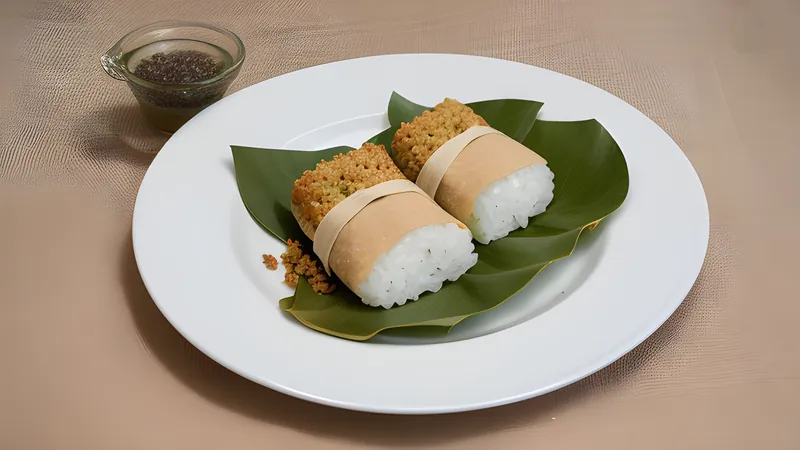
↓ Jump to recipeUnwrap a lo mai gai parcel and the first thing that hits you isn’t the chicken or the sausage, it’s the lotus leaf. That faint, grassy, almost tea-like perfume soaks into the rice during a half-hour steam and it’s not something you can replicate with any amount of seasoning added afterward — it has to come from the leaf itself, at exactly the moment the rice is hottest and most absorbent. It’s one of the few dim sum dishes where the wrapper is doing as much flavour work as the filling.
Lo Mai Gai: Sticky Rice Parcels in Lotus Leaf
Ingredients
- 300g glutinous rice, soaked overnight in cold water
- 4 dried lotus leaves, soaked in hot water for 1 hour until pliable
- 6 dried shiitake mushrooms, soaked in hot water for 30 minutes, then sliced
- 250g boneless chicken thigh, cut into 2cm pieces
- 1 Chinese sausage (lap cheong), sliced diagonally
- 2 tbsp light soy sauce, for the chicken marinade
- 1 tbsp oyster sauce, for the chicken marinade
- 1 tsp sugar, for the chicken marinade
- 1 tsp cornflour, for the chicken marinade
- 1 tsp sesame oil, for the chicken marinade
- 2 tbsp vegetable oil
- 3 garlic cloves, finely chopped
- 1 tbsp grated fresh ginger
- 2 tbsp light soy sauce, for the rice seasoning
- 1 tbsp dark soy sauce, for the rice seasoning
- 1 tbsp oyster sauce, for the rice seasoning
- 1 tsp sugar, for the rice seasoning
- 200ml reserved mushroom soaking liquid, strained
- 1 tbsp toasted sesame oil, to finish
Method
- Drain the soaked glutinous rice and steam it over boiling water, spread on a cloth-lined tray, for 20 minutes until just tender but still slightly firm, stirring once halfway through.
- While the rice steams, mix the chicken with the marinade ingredients (soy sauce, oyster sauce, sugar, cornflour, sesame oil) and set aside for 15 minutes.
- Heat the vegetable oil in a wok over high heat. Fry the garlic and ginger for 30 seconds, then add the sliced Chinese sausage and shiitake and stir-fry for 2 minutes.
- Add the marinated chicken and stir-fry until just cooked through, about 3-4 minutes.
- Add the steamed rice to the wok along with the soy sauces, oyster sauce, sugar and mushroom soaking liquid. Toss thoroughly over high heat for 2-3 minutes until the rice has absorbed the liquid and everything is evenly combined and glossy.
- Stir the toasted sesame oil through and remove from the heat.
- Lay each softened lotus leaf flat, shiny-side down. Spoon a quarter of the rice mixture into the centre of each.
- Fold the leaf over the filling like a parcel: sides in first, then roll or fold the top and bottom over to fully enclose the rice, leaving no gaps.
- Place the parcels seam-side down in a steamer lined with baking paper or extra leaf. Steam over rapidly boiling water for 25-30 minutes.
- Unwrap at the table, or partially unwrap and serve within the leaf, so the fragrance releases as you eat.
A dim sum trolley staple with a practical origin
Lo mai gai — literally “glutinous rice chicken” — belongs to the broad family of Cantonese dim sum built around sticky rice, and its lotus-leaf wrapping serves a purpose that predates dim sum trolleys and steamer baskets by a long way. Large lotus leaves, harvested and dried, have been used across southern China for centuries as a natural food wrapper, valued for being large, flexible once rehydrated, and — crucially — for imparting a specific fragrance to whatever’s steamed inside them. Before refrigeration was common, wrapping rice and meat in a large leaf and steaming the whole parcel was also simply a practical way to cook and transport a self-contained meal, the leaf sealing in moisture and heat far better than an open bowl would.
The dish’s move onto the dim sum trolley, alongside more delicate items like har gow and cheung fun, happened as Cantonese teahouse culture formalised through the twentieth century. Lo mai gai stood out on that trolley for being heartier and more filling than most other dim sum items — a genuine small meal in its own right rather than a two-bite snack — which is part of why it’s traditionally one of the later, more substantial dishes ordered towards the end of a long yum cha session, after lighter dumplings and buns.
Glutinous rice needs the long soak, no shortcuts
Glutinous rice — despite the name, containing no gluten, just an unusually high proportion of a starch called amylopectin that gives it its characteristic stickiness — behaves completely differently from regular long-grain rice and needs to be treated accordingly. An overnight soak, a genuine eight to twelve hours in cold water, hydrates the grains fully before they ever meet heat, which is what allows them to steam through evenly rather than staying hard and chalky at the centre while the outside turns mushy. Skipping or shortening the soak is the single most common reason home versions of this dish come out with an uneven, gritty texture rather than the uniform, pleasantly chewy stickiness a good lo mai gai should have.
Steaming the rice before it goes into the wok, rather than boiling it, is deliberate. Boiling glutinous rice tends to overhydrate the outer layer of each grain before the centre catches up, producing a gluey, waterlogged texture. Steaming heats more gently and evenly, and stopping the rice at “just tender but still slightly firm” — rather than fully cooked through — matters because the rice finishes cooking a second time inside the lotus leaf parcel, absorbing the seasoned mushroom liquid and finishing its texture during that final steam. Rice that’s fully cooked at the first stage turns to mush by the time the parcel is done.
Building flavour in stages, not all at once
Lo mai gai’s filling gets seasoned twice, and both stages matter. The chicken marinates separately first — soy sauce, oyster sauce, a little sugar, cornflour and sesame oil — which flavours the meat directly, while the cornflour gives it a very slight velvety coating that keeps it moist through the stir-fry and the long subsequent steam. Skipping this marinade and just seasoning everything together in the wok gives you drier, less deeply flavoured chicken, since the seasoning never gets a chance to actually penetrate the meat before it cooks.
The second seasoning stage happens when the steamed rice joins the stir-fried chicken, sausage and mushroom in the wok, along with the reserved mushroom soaking liquid. That liquid is not an ingredient to discard — it’s carrying concentrated umami from the rehydrated shiitake, and using it in place of plain water or stock to season the rice at this stage adds a depth that’s hard to replicate any other way. Toss everything together over genuinely high heat for a couple of minutes so the rice absorbs the seasoned liquid rather than just sitting wet on the surface; you’re looking for the rice to turn glossy and slightly translucent, with no pooled liquid left in the base of the wok.
Wrapping without leaks
Lotus leaves need a proper soak — a full hour in hot water — to go from brittle and papery to genuinely pliable enough to fold without cracking. A leaf that’s still stiff at the fold points will tear during wrapping, and any tear is a place steam and moisture can escape or, worse, where water from the steamer can get in and turn your carefully seasoned rice bland and waterlogged. Pat the softened leaves dry before you use them; excess surface water dilutes the seasoning on contact with the hot rice filling.
Fold the sides in first, then bring the top and bottom over to fully enclose the filling, aiming for a compact, tightly wrapped parcel with no visible gaps at the seams. A loosely wrapped parcel doesn’t just look untidy, it also cooks less evenly — steam needs to work through the whole parcel gently rather than blasting directly onto exposed rice through a gap. Place the finished parcels seam-side down in the steamer, which uses the weight of the parcel itself to help hold the fold closed through the cook.
Steaming time and what happens inside the leaf
A full 25 to 30 minutes of steaming, over water that’s genuinely at a rolling boil rather than a gentle simmer, is what finishes the rice’s texture and lets the lotus leaf’s fragrance properly permeate the filling. This is a slower process than steaming most dumplings, and it needs to be — the rice inside the parcel is essentially finishing its cook in a closed, humid environment, absorbing residual moisture and the last of that seasoned mushroom liquid while taking on the leaf’s aroma. Check your steamer water level partway through a batch this size; a pot that boils dry halfway through will scorch and ruins both the pot and the parcels’ bottoms.
Serve the parcels in their leaves, letting diners unwrap their own — part of the appeal is that first waft of fragrant steam escaping as the leaf opens, which is lost if you unwrap everything in the kitchen ahead of time. The leaf itself isn’t eaten, though it’s perfectly safe to have touched the food; treat it the way you would a banana leaf wrapper, as packaging rather than an ingredient.
Fillings beyond the classic
Chicken, Chinese sausage and shiitake is the standard filling, but it’s worth understanding why those three ingredients specifically work together before you start substituting. Chicken thigh, rather than breast, holds up to the long final steam without drying out, since its higher fat content protects it the way it protects the meat in a slow braise. Lap cheong sausage renders a little of its sweet, cured fat directly into the surrounding rice as it steams, which is a large part of what makes the finished parcel taste rich rather than merely savoury — a lean, unfatty protein swapped in without any sausage at all will leave the rice noticeably plainer. Dried shiitake contribute both texture and, through their soaking liquid, a concentrated umami note that fresh mushrooms simply don’t provide in the same way; if you only have fresh mushrooms to hand, a small amount of dried shrimp soaked alongside them can help close that flavour gap.
Salted egg yolk is a common addition in more elaborate versions, crumbled or halved into the centre of the rice filling before wrapping, adding a rich, faintly savoury creaminess that pairs well against the sweetness of the sausage. Dried scallop, torn into shreds and added alongside the shiitake, is another traditional upgrade, contributing a deep savoury sweetness that’s popular in more premium restaurant versions. None of these are necessary for a satisfying result, but they’re worth knowing about if you want to move beyond the base recipe once you’ve made it a few times.
Substituting the leaf
Dried lotus leaves are sold in most Chinese grocers, usually folded flat in packets, and they’re worth seeking out specifically rather than skipping — no other wrapper replicates their particular fragrance. If you genuinely can’t find them, banana leaf is the closest practical substitute in terms of size and flexibility, though the flavour it imparts is milder and slightly different, more purely grassy than the faintly tea-like note lotus leaf gives. In a real pinch, steaming the rice mixture in a heatproof bowl covered tightly with baking paper will still give you a good result texturally, but you lose the aromatic element entirely, which is enough of a loss that it’s worth waiting to source proper lotus leaf if you can rather than treating this as an equivalent shortcut.
Make-ahead and storage
Lo mai gai is an excellent make-ahead dish precisely because it’s designed to be reheated by steaming, which is a gentler process than most reheating methods and actually suits sticky rice better than a fresh cook in some ways — a well-wrapped parcel steamed a second time for ten to fifteen minutes comes back almost indistinguishable from fresh. Assemble and steam the parcels fully, then cool and refrigerate for up to three days, or freeze for up to two months, wrapped tightly. Reheat from chilled by steaming for 15 minutes, or from frozen by steaming for 25-30 minutes, rather than microwaving, which tends to leave patches of the rice hard while overheating others.
For more Cantonese dim sum, see har gow prawn and chive dumplings and xiao long bao Shanghai soup dumplings. Cheung fun steamed rice noodle rolls makes a good lighter counterpart on the same trolley, and building the two together gives you a genuine spread of textures — soft, silky rice noodle alongside dense, chewy sticky rice — without either dish competing for the same slot in the meal.
Related Content