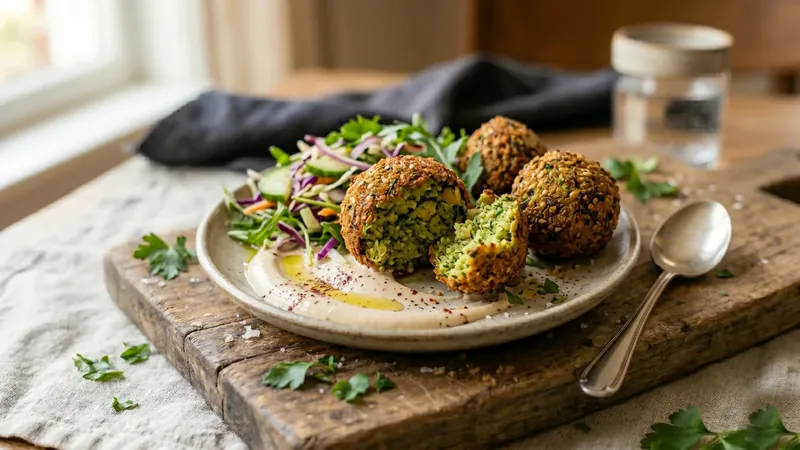
Litti Chokha: Roasted Sattu Balls with Smoked Mash
Wheat dough stuffed with spiced roasted gram flour, baked hard, then cracked open and dunked in ghee
Contents
↓ Jump to recipeLitti chokha is built from two separately cooked, separately assertive things that only make sense together: a hard-baked wheat ball stuffed with spiced roasted gram flour, and a smoky, garlicky mash of charred aubergine, tomato and potato. Neither is much without the other — the litti alone is dense and dry until it meets ghee and a spoonful of chokha; the chokha alone is a fine vegetable side but wants something more substantial to sit against. Together, cracked open at the table and doused in melted ghee, they make one of Bihar’s most recognisable dishes and one that has travelled surprisingly well outside the state, turning up on Indian railway platforms and street stalls far beyond Bihar’s own borders. Its rise to national prominence has run alongside a wider, ongoing appreciation of Bihari and eastern Indian cooking more generally, cuisines that spent decades under-represented on Indian restaurant menus dominated by Punjabi and Mughlai staples.
The dish’s roots are in Bihar’s Bhojpuri-speaking heartland, and litti in particular carries a strong association with rural, working-food traditions — traditionally buried directly in the embers of a cow-dung-cake fire or cooked over coals rather than baked in an oven, a method still used in villages across the region and one that gives the dough a genuinely different, smokier flavour than any oven can quite replicate. The name has become well known nationally in India partly through Bihar’s own political and cultural profile in recent decades, with litti chokha frequently cited as a symbol of Bihari food heritage in a way few other regional dishes from the state have achieved.
Litti Chokha: Roasted Sattu Balls with Smoked Mash
Ingredients
- 300 g wholewheat atta flour
- 1/2 tsp fine salt, for the dough
- 2 tbsp ghee, melted, for the dough
- 150-160 ml water, for the dough
- 250 g sattu (roasted gram flour)
- 2 tbsp mustard oil
- 2 tbsp mango pickle, chopped, plus 1 tbsp of its oil
- 3 garlic cloves, finely chopped
- 1 tbsp finely chopped fresh ginger
- 2 green chillies, finely chopped
- 3 tbsp finely chopped coriander
- 1 tsp ajwain (carom seeds)
- 1 tsp kalonji (nigella seeds)
- 1/2 tsp ground turmeric
- 1 tsp fine salt, for the filling
- 3-4 tbsp water, for the filling
- 2 large aubergines
- 4 medium tomatoes
- 3 medium potatoes, boiled and peeled
- 3 garlic cloves, crushed, for the chokha
- 2 green chillies, finely chopped, for the chokha
- 2 tbsp mustard oil, for the chokha
- 1 tsp fine salt, for the chokha, to taste
- Ghee, melted, for dunking
Method
- Make the dough: mix the atta, salt and melted ghee, then add water gradually and knead to a firm, smooth dough. Cover and rest for 20 minutes.
- Make the filling: mix the sattu, mustard oil, chopped pickle and its oil, garlic, ginger, chillies, coriander, ajwain, kalonji, turmeric and salt. Add water a tablespoon at a time until the mixture just holds together when pressed, like damp sand.
- Char the aubergines and tomatoes directly over a gas flame or under a hot grill, turning often, for 12-15 minutes until the skins are fully blackened and the flesh is soft. Cool, peel off the charred skin, and mash the flesh.
- Mash the boiled potatoes into the aubergine and tomato flesh. Stir in the garlic, green chillies, mustard oil and salt to make the chokha. Set aside.
- Heat the oven to 200C fan / 220C conventional. Divide the dough into 8 balls. Flatten each into a small disc, place a heaped tablespoon of filling in the centre, and gather the edges up to seal into a ball, pinching firmly to close.
- Place the sealed balls, seam-side down, on a wire rack over a baking tray. Bake for 35-40 minutes, turning once, until deeply browned and cracked in places.
- Crack each hot litti slightly and dip or drizzle generously with melted ghee. Serve immediately with the chokha.
Sattu, the ingredient that makes the filling work
Sattu is roasted gram flour — chickpeas (or sometimes a mix of chickpea and barley) dry-roasted until deeply toasted, then ground to a fine powder — and it is distinct from ordinary besan, which is made from raw, unroasted gram. The roasting is what gives sattu its nutty, almost smoky flavour and its dense, filling character, and it is eaten across Bihar and neighbouring Uttar Pradesh in forms well beyond litti: mixed with water and a little salt or sugar as a quick summer drink, or eaten as a simple spiced paste on its own, particularly during the hotter months when it is credited, rightly or not, with a cooling effect on the body.
For the litti filling specifically, sattu is mixed with mustard oil, chopped pickle, garlic, ginger, green chilli and a handful of whole spices into a mixture that should hold together loosely when pressed but never turn into a wet paste — think damp sand rather than dough. Add water in small increments and stop the moment it clumps, since too wet a filling will turn gummy inside the baked litti rather than staying pleasantly crumbly, which is the texture you actually want once you crack the shell open.
The mango pickle is not optional
Chopped mango pickle, oil and all, stirred into the sattu filling is doing more than adding a background tang — it is the primary souring agent in the filling, standing in for the lemon or tamarind other regional dishes might use, and it also contributes fat and moisture that help the dry sattu bind. Skip it and the filling tastes flat and one-dimensionally savoury rather than layered; a shop-bought Indian mango pickle, the kind sold in most South Asian grocers, works perfectly well here and is what most households actually reach for rather than making a fresh pickle specifically for this purpose.
Baking, and the shell that has to crack, not shatter
Getting the shell right is the technical heart of this recipe: it needs to bake hard enough to hold its shape and develop a genuine, slightly craggy crust, without turning so dry and tough that it becomes difficult to eat or, worse, cracks apart entirely and spills its filling onto the tray. A wire rack, rather than a flat tray, matters here more than it might seem to — it lets hot air circulate underneath the litti as well as around it, baking the base as evenly as the top and sides rather than leaving a pale, steamed patch where the dough sat directly on hot metal.
Turning the litti once partway through baking helps for the same reason, evening out browning across the whole surface. The dough itself should be firm rather than soft when first mixed — closer to a bread dough than a chapati dough — since a slack, soft dough will not hold its shape around the filling once baked and tends to split along the seam where it was pinched closed.
Charring the chokha vegetables properly
The chokha’s whole character depends on genuinely charring the aubergine and tomato rather than merely cooking them through, and this distinction is worth being precise about. Held directly over a gas flame or under a very hot grill, the skins should blacken and blister completely, not just brown at the edges, until the vegetables collapse and soften all the way through and the skin can be peeled away in large, easy pieces. That blackened skin carries a genuine smokiness into the flesh beneath it as it cooks, similar to the technique behind a good baba ganoush, and it is this smoke that gives chokha its name and its defining flavour — cooking the vegetables by boiling or roasting whole in a covered oven instead will produce a soft, edible mash, but not a proper chokha, since none of that charred flavour will develop.
If you have neither a gas hob nor a grill capable of real direct heat, a very hot dry cast-iron pan, with the vegetables turned every few minutes, gets closer than a conventional oven would, though it takes patience and a well-ventilated kitchen, since the process does produce a fair amount of smoke by design. A stovetop smoking box or a wok lined with foil and a smouldering piece of charcoal, the coal-in-a-bowl method used to smoke dals and biryanis, is another workable substitute if open-flame charring genuinely is not possible in your kitchen, though it adds an extra step most home cooks in Bihar would consider unnecessary given how directly the flame method usually works.
Mustard oil, used twice for two different reasons
Mustard oil appears in both halves of this dish, and it is doing a slightly different job each time. In the sattu filling, a small amount binds the dry roasted gram flour and contributes its own sharp, pungent flavour, which mellows considerably once the litti is baked. In the chokha, added raw and stirred through at the very end rather than heated, mustard oil keeps its full sharp, sinus-clearing pungency, which is very much the point — a good Bihari chokha should have a genuine kick from the raw oil, not a mellow, cooked one. If mustard oil is entirely unavailable, a neutral oil with a squeeze of extra lemon can stand in for the chokha, though the dish will be milder and noticeably less distinctive without it.
What can go wrong
A litti that splits open in the oven, spilling filling onto the tray, almost always means the dough was either too soft to hold its shape or the seam was not pinched firmly enough when sealing. Take an extra moment to properly pinch and smooth the closing seam, rolling the sealed ball gently between your palms afterward to even out the shape and reinforce the closure, rather than simply gathering the edges and hoping they hold.
A gummy, unpleasant filling texture means too much water went into the sattu mixture; there is no fixing this once baked, so err on the side of a slightly drier filling next time and add water more cautiously, since sattu continues to absorb moisture even after mixing and a batch that looks right can turn stickier by the time you actually fill the dough. If the dough itself cracks badly during shaping rather than at the seam, it is usually slightly too dry; work in an extra teaspoon of water at a time until it becomes pliable enough to gather smoothly around the filling without visible fissures.
Serving, substitutions and storage
Beyond Bihar
Litti chokha’s spread beyond its home state owes a good deal to migration — Bihari labourers and workers carried the dish with them to cities across northern and eastern India over decades, and it has since become a fixture of railway-platform food stalls and street vendors well outside Bihar’s own borders, sold in paper cones to travellers with little time and a need for something dense and portable. This is part of why the dish reads as sturdy, travel-friendly food in a way many regional Indian dishes do not: litti was built to survive being carried, wrapped, and eaten cold if it had to be, even though it is unquestionably better hot with fresh ghee.
Litti chokha is eaten hot, cracked open at the table and drizzled generously with melted ghee right before eating — this final step is genuinely part of the dish, softening the dense shell and carrying the spiced filling’s aroma through every bite. It pairs naturally with other roasted, roughly-worked dishes from the wider region; a plate of dal baati churma, Rajasthan’s three-part plate shares the same instinct for a baked wheat ball served alongside a separate, distinct accompaniment, while methi thepla, fenugreek flatbread for the road makes a good lighter counterpoint earlier in the same meal.
If sattu is unavailable, a reasonable approximation can be made by dry-roasting besan in a pan over a low heat for eight to ten minutes, stirring constantly, until it darkens several shades and smells distinctly nutty rather than raw — it will not be identical to properly roasted-and-ground chana, but it gets close enough for a first attempt. Litti keeps for up to two days at room temperature, wrapped, and reheats acceptably in a low oven for ten minutes, though it never quite regains the just-baked crackle of the first serving; the chokha keeps for three days chilled and is, if anything, better the next day once the garlic and chilli have had time to settle through the mash.
Related Content