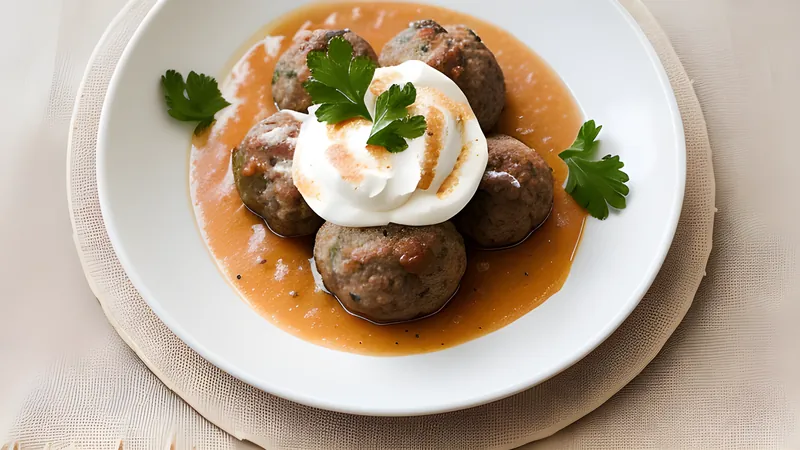
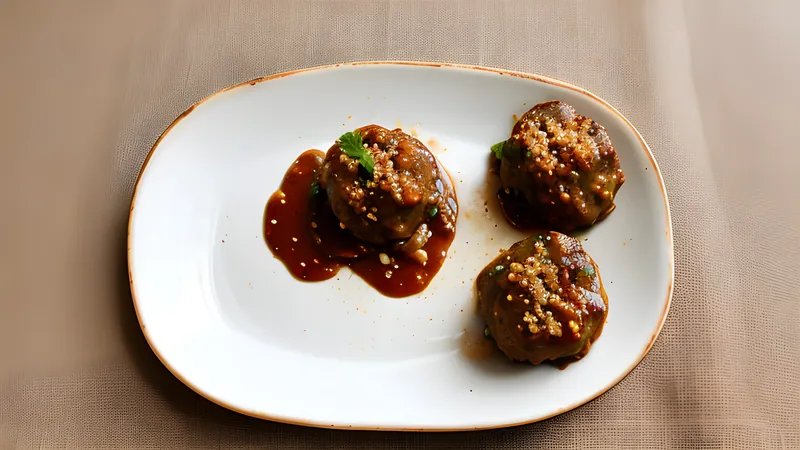
Lihapullat: Finnish Meatballs in Brown Sauce
Bigger than the Swedish ones, browner in the pan, and finished with a spoon of mustard
Contents
↓ Jump to recipeFinnish meatballs get overshadowed. Say “Nordic meatball” anywhere outside Finland and people think of the Swedish version — small, pale, swimming in a cream sauce the colour of parchment. Finland’s lihapullat sit next to their Swedish cousins and are noticeably different animals, and Finns are quietly annoyed about the confusion.
They are bigger, roughly 30 g against 20. They are browned harder. And the sauce is a brown sauce that takes a little cream at the end, built on a roux cooked past blond. That sounds like a technicality. It produces a completely different plate.
My twist is a longer roux. Three minutes takes it past blond and into the colour of milky coffee, which costs you some thickening power and buys a toasted, biscuity depth that stands up to the mustard.
Lihapullat: Finnish Meatballs in Brown Sauce
Ingredients
- 80 g dried breadcrumbs
- 180 ml single cream
- 1 large onion (about 150 g), finely chopped
- 30 g butter
- 500 g minced pork and beef, mixed 50:50
- 1 egg
- 1.5 tsp fine salt
- 0.5 tsp ground white pepper
- 0.5 tsp ground allspice
- 1 tbsp neutral oil
- 30 g butter, for frying
- 25 g plain flour
- 500 ml beef or veal stock, hot
- 1 tbsp dark soy sauce
- 2 tsp Dijon mustard
- 100 ml single cream, for the sauce
- 1 tsp cider vinegar
Method
- Stir the breadcrumbs into the 180 ml cream and leave for 15 minutes until they have swelled into a thick paste.
- Melt 30 g butter in a pan over medium-low heat and cook the onion for 10 minutes until soft with no colour. Cool completely.
- Combine the mince, soaked breadcrumbs, cooled onion, egg, salt, white pepper and allspice. Mix by hand for 60–90 seconds until tacky.
- Fry a small piece and taste. Adjust seasoning.
- Chill the mixture for 30 minutes, then roll into 24 balls of about 30 g each with wet hands.
- Heat the oil and 30 g butter in a wide frying pan over medium-high heat until foaming subsides.
- Fry the meatballs in two batches for 10–12 minutes each, shaking the pan every 2 minutes, until deeply browned all over and 70°C in the centre. Transfer to a warm plate.
- Pour off all but 2 tbsp of the fat. Add the flour to the pan and cook, stirring, for 3 minutes over medium heat until the roux turns the colour of milky coffee.
- Whisk in the hot stock a ladle at a time, scraping the base clean, until smooth.
- Add the soy sauce and mustard. Simmer for 8 minutes until glossy and thick enough to coat a spoon.
- Stir in the 100 ml cream and the vinegar. Taste and adjust the salt.
- Return the meatballs to the sauce and simmer gently for 5 minutes.
- Serve with boiled potatoes, lingonberry jam and pickled cucumber.
Two countries, one meatball, six hundred years of argument
The meatball came to Finland through Sweden, and the reason is straightforward: Finland was Sweden, administratively, from the thirteenth century until 1809. Swedish food, Swedish law, Swedish administration, a Swedish-speaking elite in Turku and Helsinki. When the Ottoman-derived meatball arrived in Stockholm in the early eighteenth century, it reached Finland shortly after by the same route everything else did.
Then, in 1809, Russia took Finland and made it a Grand Duchy, and for the next 108 years Finnish cooking drifted. Russian influence pushed in from the east — sour cream, mushrooms, rye, dill in quantity. The meatball stayed, and it changed.
The differences you can taste today track that divergence fairly well. The Finnish version’s brown sauce is closer to a Russian or German braune Soße than to Sweden’s cream gravy. The larger size reflects a Finnish habit of serving them as the substance of a meal rather than as one item among twenty on a smörgåsbord — Finland has never had a strong smörgåsbord culture, and a meatball that is going to be dinner needs to be worth putting a fork in.
The allspice survived both. Allspice is the pan-Nordic spice, in Swedish kalops and Finnish meat cooking alike, and it arrived through the same eighteenth-century Baltic trade that brought coffee and sugar. Half a teaspoon in 500 g of mince is under the threshold where anyone can name it and over the threshold where they notice its absence.
The other Nordic meatballs are worth knowing for contrast. Danish frikadeller are oval, pork-dominant and served without sauce. Norwegian kjøttkaker are flat patties in a brown gravy — the closest relative to the Finnish version, and Norway and Finland do not share a border culture at all, which suggests both borrowed from the same German source.
The panade, in cream
Sweden soaks bread in milk. Finland soaks dried breadcrumbs in cream, and I follow Finland here.
Dried crumbs behave differently from torn fresh bread. They absorb faster — fifteen minutes rather than the ten a soft slice needs — and they absorb more, because the drying has already collapsed the crumb structure and there is nothing holding the water out. You end up with a stiffer paste that distributes more evenly through the mince.
Cream rather than milk adds fat, and fat in the panade coats the meat proteins and physically interferes with them binding tightly. The effect is a meatball that stays tender at 70°C, which matters more here than in the Swedish version because a 30 g ball spends longer in the pan.
Use single cream. Double is thick enough that the crumbs cannot absorb it properly, and you get a greasy mixture that spits in the pan.
The meat, and the ratio
Fifty-fifty pork and beef is the Finnish standard, and it is a more pork-forward mix than Sweden’s usual three-to-two in favour of beef. That extra pork does two things. It raises the fat content, which a larger meatball needs because it spends longer over heat. And it softens the flavour — beef browns darker and tastes more mineral, and at fifty per cent it stops dominating.
Supermarkets in Finland sell a pre-mixed sika-nauta mince at exactly this ratio, which tells you how settled the question is there. In Britain you will buy the two separately and combine them, which is no hardship and lets you control the fat.
Aim for around 18 to 20 per cent fat overall. Standard 20% pork mince plus 15% beef mince gets you there. If your butcher will grind pork shoulder and beef chuck once through a coarse plate, take it — the texture is looser and the finished ball has visible grain rather than the paste you get from twice-ground supermarket mince.
One thing worth knowing about pre-minced meat: it has already been worked hard by the grinder, so the myosin is partly developed before you touch it. Mix it as long as freshly ground meat and you will overshoot into sausage territory. Watch the mixture rather than the clock — the moment it turns from crumbly to tacky and clings to your palm, stop.
Getting the fond right
The brown sauce lives or dies on what is stuck to the pan when the meatballs come out, so it is worth being deliberate about it.
Use a heavy stainless or carbon steel pan. Non-stick is a genuine handicap here: its entire purpose is to stop food adhering, and adhesion is what you are trying to produce. A non-stick pan will give you meatballs that brown reasonably and a pan with almost nothing left in it, and the sauce will taste of stock and flour.
Butter contributes to the fond as well as the browning. Its milk solids toast on the pan surface and stay there, and they are a meaningful part of what makes a Finnish brown sauce taste richer than the stock alone could account for.
If the fond looks like it is heading past dark brown towards black between batches, take the pan off the heat for thirty seconds and add a splash of water to stop it. Burnt fond is bitter and there is no fixing it downstream — you will taste it through the cream, the mustard and everything else.
Browning, and why bigger changes the maths
A 30 g meatball has a problem a 20 g one does not: its centre is further from its surface. Browning and doneness stop arriving at the same moment.
The answer is a hotter pan and a shorter total time than you would expect. Medium-high, oil plus butter for the smoke point, and ten to twelve minutes per batch. Shake the pan rather than turning them individually — a shaken meatball rolls onto a new patch of hot metal, and you build up an uneven, deeply browned surface across the whole sphere in a way that four deliberate turns cannot.
The target is genuinely dark. Finnish lihapullat are browner than Swedish köttbullar, and the whole sauce depends on the fond that browning leaves behind. Take them further than looks comfortable.
Two batches. This is the rule that is never worth breaking. A crowded pan drops below 140°C, the Maillard reaction slows to nothing, the meatballs release their water and poach.
The sauce
Everything is in the pan already. Pour off the excess fat, keep two tablespoons, keep every scrap of the brown residue.
The flour goes in dry and cooks for three full minutes. Watch the colour: it goes from white through blond to milky coffee. Blond roux thickens best; darker roux thickens less and tastes far more. At three minutes you have lost perhaps a fifth of the thickening power, which is why this recipe uses 500 ml of stock to 25 g of flour rather than the 400:30 you would use for a blond roux.
Hot stock, a ladle at a time, whisked smooth. Cold stock into hot roux gives lumps.
Then eight minutes of simmering, which is longer than most recipes suggest and is where the sauce goes from tasting of flour and stock to tasting of itself. The cream goes in at the end and only 100 ml of it — enough to round the edges and take the sauce from brown to bronze.
The teaspoon of cider vinegar at the very end is the ingredient nobody expects. A rich brown sauce sits heavy on the palate; a small hit of acid lifts it and makes everything else in the dish legible. Add it, taste, and notice.
Where it goes wrong
Grey, wet meatballs. Crowded pan.
They fall apart. Under-mixed, or the panade was too loose. Chill for the full 30 minutes.
Dense and springy. Over-mixed. Ninety seconds is the ceiling by hand and about twenty in a stand mixer.
Lumpy sauce. Cold stock, or the stock went in too fast.
Thin sauce. The roux went too dark. Simmer another five minutes, or slake a teaspoon of cornflour in cold water and whisk it in.
Bland sauce. Weak stock. A cube will not carry this dish; use a good liquid stock or add the soy sauce and an extra teaspoon of mustard.
Variations
Karjalanpaisti-style spicing. Add 6 whole allspice berries and 2 bay leaves to the sauce while it simmers and fish them out before serving. It pulls the dish towards the eastern Finnish braising tradition of Karelian hot pot.
Cream sauce version. Drop the flour to 20 g, use 350 ml stock and 250 ml cream, and skip the soy. This is the Finnish household variant closest to the Swedish original, and it is what most Finnish children were raised on.
Oven-finished. Brown the meatballs hard for 6 minutes, build the sauce, then bake everything together at 170°C for 20 minutes. Useful for a crowd; the browning suffers slightly.
The plate, and storage
Boiled potatoes. This is the Finnish convention and it is the right one, because a brown sauce wants something to run off, and mash absorbs it into a beige swamp within a minute. Lingonberry jam, raw-stirred; see lingonsylt. Pickled cucumber, or a spoonful of grated pickled beetroot.
Some Finnish households serve them with mashed potato and call it lihapullat ja perunamuusi, which is the school-dinner version and which every Finn under fifty has strong feelings about.
Raw rolled meatballs keep 24 hours in the fridge and freeze well on a tray. Cooked in sauce, they keep 3 days and reheat gently with a splash of stock. The sauce thickens overnight and loosens with heat.
They are also excellent cold, straight from the fridge, standing at the counter at eleven at night, which is how a great many of them are actually eaten.
Related Content