Lemon and Sugar Crepes
Thin, lacy and endlessly comforting
Contents
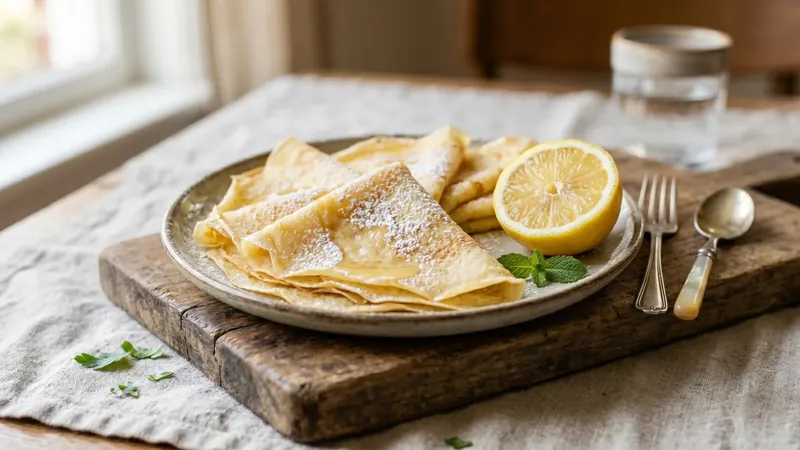
↓ Jump to recipeThere is little that beats a freshly made crepe, thin and lacy, sprinkled with sugar and a squeeze of lemon so the two dissolve into a sharp, sweet syrup. The twist is no twist at all but a quiet discipline: resting the batter properly before cooking, which relaxes the flour and yields crepes that are tender and delicate rather than rubbery. Simple, fast and endlessly comforting, this is a pudding, a breakfast or an afternoon treat in equal measure.
Lemon and Sugar Crepes
Ingredients
- 125g plain flour
- 1 tbsp caster sugar
- A pinch of salt
- 2 eggs
- 300ml whole milk
- 30g unsalted butter, melted, plus extra for the pan
- 2 lemons, cut into wedges
- 4 tbsp caster sugar, for sprinkling
Method
- Whisk the flour, sugar and salt together in a bowl.
- Make a well in the centre and crack in the eggs, then whisk in a little of the milk to form a smooth paste.
- Gradually whisk in the remaining milk and the melted butter until the batter is smooth and the consistency of single cream.
- Cover and leave the batter to rest at room temperature for at least 30 minutes.
- Heat a non-stick frying pan over a medium heat and wipe with a little butter.
- Pour in a small ladleful of batter, swirling the pan to coat the base in a thin, even layer.
- Cook for about a minute until the underside is golden and the edges lift, then flip and cook the other side for 30 seconds.
- Slide onto a warm plate and repeat with the remaining batter, stacking the crepes as you go.
- Sprinkle each crepe with caster sugar and a squeeze of lemon.
- Fold into quarters or roll up, and serve at once.
Brittany, Candlemas and Pancake Day
The crepe is one of France’s everyday staples, a paper-thin pancake whose spiritual home is Brittany, the windswept region in the north-west. There, crepes and their savoury buckwheat cousins, the galettes, are a defining part of the local table, sold from creperies and street stalls and made at home with practised ease. Buckwheat took hold in Brittany precisely because the region’s poor, acidic soil suited a crop that wheat could not tolerate, which is why the savoury galette de sarrasin belongs so specifically to that corner of France.
The tradition runs deep enough to have its own day in the calendar: Candlemas, on the second of February, is known in France as the Jour des Crêpes, when households cook them by the dozen. Folklore held that a good harvest depended on flipping the first crepe cleanly while holding a coin in the other hand. In Britain the same pancake instinct attaches to Shrove Tuesday, the day before the start of Lent, when eggs, butter and milk were traditionally used up before the fast — which is how a humble batter came to have a feast day at all.
The lemon-and-sugar topping is the one most associated with British pancakes, and its appeal lies in contrast. The sugar sweetens, the lemon sharpens, and when squeezed over a hot crepe the two dissolve together into a thin, bright syrup that soaks into the surface. It asks for nothing more than two pantry staples, yet feels like a small luxury. If you like that lemon-and-sugar pairing, it is exactly the finish on my Dutch baby pancake with lemon and powdered sugar, which takes the same flavours into a puffed, oven-baked format.
Why resting the batter matters
The twist here is patience rather than novelty, and it makes all the difference. Whisking flour into liquid develops gluten, the elastic protein network that makes bread chewy and is exactly what you do not want in a delicate crepe. Rest the batter for at least 30 minutes and two useful things happen: the flour granules fully hydrate, so the batter thins and spreads into a finer sheet, and the gluten you built by whisking relaxes, so the cooked crepe is tender rather than springy. Crepes cooked the instant the batter is mixed tend to turn out chewy and elastic; a rested batter cooks into something altogether more lacy. If you can rest it overnight in the fridge, better still — just whisk in a splash more milk the next day, as it will have thickened.
Making the crepes
Whisk 125g plain flour, 1 tbsp caster sugar and a pinch of salt in a bowl, make a well, crack in 2 eggs and whisk in a little of the 300ml whole milk to a smooth paste. Gradually whisk in the rest of the milk and 30g melted butter until the batter runs like single cream. That consistency is the target: too thick and it sets into a pancake, too thin and it tears. Cover and rest for at least 30 minutes.
Heat a non-stick frying pan over a medium heat and wipe it with a little butter on a folded piece of kitchen paper — you want the pan filmed, not pooled, or the first crepe fries greasily. Pour in a small ladleful and immediately swirl the pan to coat the base in a thin, even layer. Cook for about a minute, until the underside is golden and the edges lift and colour, then flip and cook the second side for 30 seconds; it will always be paler and more mottled, which is normal. Slide onto a warm plate and repeat, stacking as you go — stacked crepes steam gently and stay pliable. Sprinkle each with caster sugar and a squeeze of lemon, fold into quarters or roll up, and eat while warm.
What can go wrong
The pan temperature is the usual culprit. Too cool and the batter sits and steams into something pale and leathery; too hot and it sets before you can swirl it thin, giving thick, patchy rounds. The first crepe is traditionally the cook’s own — a slightly ragged practice run while the pan finds its rhythm — so don’t judge the batch by it. If crepes tear when you lift them, the batter is too thin or the pan too dry; if they come out tough, the batter was under-rested or over-whisked after resting.
Substitutions, storage and variations
Whole milk gives the richest result, but semi-skimmed works, and half milk, half water makes a lighter, more classically French crepe. For a dairy-free version, use oat milk and a neutral oil in place of the butter. Cooked crepes keep, stacked and wrapped, in the fridge for two days or in the freezer for a month with a square of baking paper between each; reheat briefly in a dry pan. Beyond lemon and sugar, try a smear of good chocolate-hazelnut spread, warmed jam, or lemon curd — the sharp, buttery curd from my lemon meringue pie with Italian meringue is a very good thing folded inside a warm crepe. For a savoury turn, leave out the sugar and fill with grated Gruyère and ham while the crepe is still in the pan.
Crepe, pancake, galette: what is the difference
It helps to be clear about what a crepe actually is, because English lumps several very different things under the word “pancake”. A crepe is defined by its thinness: a batter with a high proportion of liquid to flour, spread across the pan into a sheet barely a couple of millimetres thick, with no raising agent so it stays flat and lacy. A British or American breakfast pancake, by contrast, uses a thick batter leavened with baking powder or whisked egg white so it puffs into something fluffy and cakey. The Scotch pancake or drop scone sits between the two. Brittany’s savoury galette is a first cousin of the crepe, made with nutty buckwheat flour rather than wheat, and traditionally topped with ham, cheese and a runny egg folded into a square. Knowing that a crepe is meant to be thin tells you everything about the batter: single-cream consistency, well rested, cooked hot and fast.
The right pan and the right heat
You do not need a dedicated crepe pan, though the flat, low-sided ones do make swirling and flipping easier. A good non-stick frying pan of around 20 to 24cm works perfectly; anything bigger and you struggle to swirl the batter evenly before it sets. Cast iron is excellent once seasoned but takes practice to judge. The heat wants to sit at a steady medium to medium-high: hot enough that the batter starts to set the instant it hits the pan, cool enough that it takes a minute to colour rather than scorching in seconds. If your first crepe browns unevenly in blotches, the pan has hot spots and needs a moment to even out, or the heat is too high. Wipe the pan with butter only occasionally, every second or third crepe, because a well-behaved non-stick surface barely needs it and too much fat makes the edges lacy in a greasy rather than a delicate way. As for flipping: a thin palette knife or fish slice slid under the edge is far more reliable than tossing, at least until you have a stack of successes behind you and want to show off.
Getting the batter and the swirl right
The single trickiest moment is the swirl, and it rewards a little forethought. Take the pan off the heat for the two seconds it takes to pour in a small ladleful of batter into the centre, then immediately tilt and rotate the pan so the batter runs out to the edges in a thin, even film before it can set. Pouring while the pan sits still on a fierce heat is how you get a thick patch in the middle and a lacy, torn rim; lifting the pan buys you the moment you need to spread it. The right amount of batter is less than instinct suggests — roughly 60ml for a 24cm pan — because a crepe should be barely thicker than a sheet of paper. If you pour too much, don’t fight it; tip the excess back into the bowl and trim the tail of batter that leaves behind once the crepe is cooked.
Two batter faults account for most failures. Lumps mean the flour was not whisked smooth at the paste stage, before the bulk of the milk went in — always build a thick, lump-free paste with a little liquid first, then thin it. And a batter that has thickened on standing, especially after an overnight rest, needs loosening with a splash of milk back to that single-cream flow, or the crepes come out heavy. Once you have the feel of the swirl and the batter behaving, a stack of eight builds in barely fifteen minutes, and the rhythm of pour, swirl, wait, flip becomes quietly meditative.
Serving crepes to a crowd
The one awkwardness of crepes is that they cook one at a time while everyone wants to eat at once. The cook’s-own tradition of eating the ragged first crepe standing at the stove solves the smallest version of this problem, but for a table of people, keep the finished crepes warm in a low oven at around 90C, stacked on a plate and loosely covered with foil so they steam gently and stay soft rather than drying at the edges. They hold happily like that for half an hour. Then bring the stack to the table with a bowl of caster sugar and a plate of lemon wedges and let everyone dress and fold their own — the sugar-and-lemon syrup is best made at the last second on a hot crepe, and there is something companionable about the assembly line of it. Serve strong coffee alongside, and you have turned a two-ingredient topping into an occasion.
Related Content