Lemon Meringue Pie with Italian Meringue
Sharp lemon curd under a glossy, stable cloud
Contents
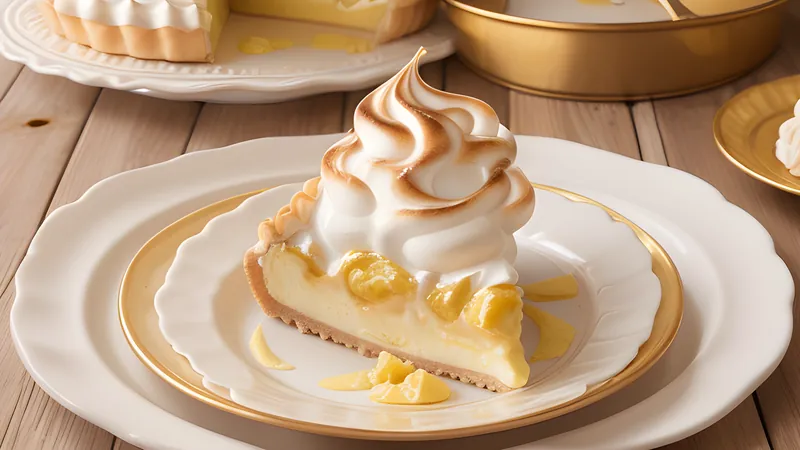
↓ Jump to recipeThere is a particular kind of person who claims to dislike lemon meringue pie, and almost always it turns out they have only ever met the bad version: a wedge of luminous yellow jelly under a weeping, beige slick that slides off the moment a knife touches it. That pie deserves its reputation. This one does not. This is the pie that converts the doubters, and the secret is not in the lemon at all. It is in the meringue.
Lemon Meringue Pie with Italian Meringue
Ingredients
- 200g plain flour, plus extra for dusting
- 100g cold unsalted butter, cubed
- 1 tbsp caster sugar
- 0.25 tsp fine salt
- 1 egg yolk
- 2 to 3 tbsp ice-cold water
- 6 large lemons, zest and juice (about 200ml juice)
- 200g caster sugar (for the curd)
- 50g cornflour
- 6 egg yolks
- 75g unsalted butter, cubed
- 4 egg whites (for the meringue)
- 220g caster sugar (for the meringue)
- 60ml water
- 0.25 tsp cream of tartar
Method
- Rub the cold butter into the flour, sugar and salt until it resembles breadcrumbs, then bind with the yolk and just enough ice water to form a dough. Chill 30 minutes.
- Roll out and line a 23cm tart tin, prick the base, chill again, then blind bake at 180C fan for 20 minutes with beans, and 8 to 10 minutes more uncovered until pale gold.
- For the curd, whisk the lemon zest, juice, sugar and cornflour in a pan until smooth, then add 150ml water and the yolks.
- Cook over medium heat, whisking constantly, until very thick and glossy, then beat in the butter and pour into the baked case.
- For the Italian meringue, heat the meringue sugar with the water to 118C while you whisk the whites with cream of tartar to soft peaks.
- Pour the hot syrup down the side of the bowl in a thin stream, whisking, then keep whisking until the meringue is stiff, glossy and cool to the touch.
- Pile the meringue over the warm curd, sealing it to the pastry edge, and swirl into peaks.
- Scorch the top with a blowtorch or under a hot grill until golden, then cool before slicing.
Where the pie comes from
Lemon meringue pie is younger than it looks. Elizabeth Goodwell, a Philadelphia baker, is often credited with an early version in the 1800s, but the dish as we know it owes far more to the American pie boom of the late nineteenth century, when cheap refined sugar, reliable ovens and the arrival of cornflour (cornstarch) as a thickener made a stable citrus custard achievable in a home kitchen. The meringue crown was borrowed from French pastry, where whipped, sweetened egg white had been used since at least the seventeenth century; the pâtissier François Massialot recorded a recipe for meringue around 1692.
The version that spread through British and American cookbooks in the twentieth century almost always used what the French call meringue française, or French meringue: raw whites beaten with dry sugar and set with a brief spell in the oven. It is the simplest of the three classic meringues, and it is the one responsible for every disappointing, tearful slice you have ever been served. The technique I use here, Italian meringue, is the professional’s answer to that problem, and it is worth understanding why.
Why Italian meringue changes everything
French meringue works, after a fashion, but it is temperamental. It weeps. It beads with sugary tears as the undissolved sugar draws moisture out of the foam. It deflates if you so much as look at it sideways, and the underside often stays raw and slippery where it meets the warm curd.
Italian meringue solves all of this by cooking the whites with a hot sugar syrup as you whisk. The syrup, brought to 118C (the firm-ball stage), does two jobs at once. It dissolves completely, so there is no stray sugar left to sweat, and at that temperature it pasteurises the whites, taking the eggs safely past the point where salmonella is a concern. The heat also partially sets the egg proteins as they whip, which is why the finished foam is glossy, marshmallow-firm and close to bombproof. It holds its peaks for days. It does not weep. You can slice through it cleanly and the slice stands up on the plate like it means it. The small extra faff of a sugar thermometer buys you a result that genuinely behaves like the pastry-shop version.
The clever twist: a properly fierce curd
The other place pies go wrong is timidity with the lemon. Six lemons sounds like a lot. It is not. The meringue is sweet and rich enough to swallow any amount of sharpness, so the curd needs to be aggressively, mouth-watering sour to cut through it. I cook the curd with 50g cornflour as well as six yolks, which gives it the backbone to slice neatly without setting to rubber, and I finish with 75g of butter for shine and a silky texture. The cornflour matters technically as well as texturally: its starch granules coat the egg proteins and raise the temperature at which they curdle, which is what lets you cook the curd hard enough to set without it splitting.
Use unwaxed lemons if you can, because you want all that zest, and roll them hard on the worktop before juicing to wring out every drop. Aim for about 200ml of juice. Taste the curd before it goes in. It should make you wince slightly and then immediately want another spoonful. If you like the sharp-preserved-lemon end of the spectrum, the same instinct drives my chicken thighs with preserved lemon and olives and the chicken, preserved lemon and olive tagine, where salt-cured lemon does the same job of cutting through fat.
Building the pie
Start with the pastry, because everything else hangs on it. Rub 100g cold cubed butter into 200g plain flour with a tablespoon of sugar and a quarter-teaspoon of salt until it looks like breadcrumbs, bind with a yolk and 2 to 3 tablespoons of ice water, and chill for 30 minutes. A proper blind bake is non-negotiable here; a soggy base under wet curd is a sad thing. Line a 23cm tin, prick the base, chill again, then blind bake at 180C fan for 20 minutes with baking beans and 8 to 10 minutes more uncovered until pale gold. Bake it until it is genuinely dry, not just set, then leave it in its tin.
I like to add the curd while it is still warm and the meringue while the curd is warm too, because the two layers fuse slightly at the join and you avoid the gap that lets meringue slide off. When you pile the meringue on, take it right to the edge of the pastry. That seal is what stops shrinkage and weeping. Swirl it into dramatic peaks with the back of a spoon, then torch it. A blowtorch gives you the most control, but a very hot grill works if you watch it closely; meringue goes from beautifully bronzed to charcoal in about ten seconds of inattention.
Tips and small mercies
Room temperature matters more than people admit. Cold whites take longer to whisk and a cold curd will skin over before the meringue is ready. Get everything organised, mise en place style, before you boil the syrup, because once that sugar hits temperature it waits for no one. A pinch of cream of tartar in the whites (about a quarter-teaspoon) helps stabilise the foam by lowering its pH, which makes the proteins knit into a tighter, more forgiving network.
If you do not own a sugar thermometer, the firm-ball test works: a drop of syrup dropped into a glass of cold water should form a firm but still pliable ball you can pick up. Pour the hot syrup down the side of the bowl in a thin steady stream while the mixer runs, not onto the whisk, or it flings molten sugar up the sides and sets there in useless threads. And if the whole project feels like a lot for a weeknight, the pastry case and the curd can both be made a day ahead and chilled; only the meringue needs to be same-day.
Storage and make-ahead
The finished pie is best eaten the day it is made, while the pastry is still crisp, but Italian meringue is unusually forgiving and the pie will keep, loosely covered, in the fridge for two days without weeping. The base softens a little over time, which is the only real cost. Do not freeze it: the curd survives freezing but the meringue collapses to a wet sponge on thawing. If you want to get ahead, freeze the blind-baked pastry case unfilled for up to a month and make the curd and meringue fresh.
Variations worth trying
Swap a third of the lemon juice for lime to nudge it towards a key lime profile, or fold a little finely grated ginger into the curd for warmth. A scrape of vanilla seeds through the meringue is quietly lovely. For a grown-up version, a tablespoon of limoncello stirred into the cooling curd does no harm at all. If you want the same bright lemon hit in a faster format, my Dutch baby pancake with lemon and powdered sugar scratches a similar itch in twenty minutes. Whatever you do, do not skimp on the sour. A polite lemon meringue pie is a contradiction in terms.
The three meringues, and why the choice matters
It is worth knowing the family this pie belongs to, because the same egg white and sugar can behave in three quite different ways. French meringue, the simplest, is raw whites beaten with dry caster sugar; it is airy and quick but unstable, and it is what most disappointing home pies use. Swiss meringue heats the whites and sugar together over a bain-marie to about 60C, whisking until the sugar dissolves before whipping to a dense, silky foam — the one you see on baked Alaska. Italian meringue, used here, is the most stable of the three because the sugar arrives as a syrup already cooked to 118C, which both dissolves completely and partly cooks the whites as it hits them. That stability is precisely why pâtissiers reach for it on anything that has to sit in a display case: it will not weep, slump or shed sugar for days. The trade-off is the sugar thermometer and a little coordination, whisking whites and boiling syrup at once, but the payoff is a meringue you can slice through cleanly and serve the next day.
Getting the curd to set without splitting
The curd deserves a closer look, because it is where most of the anxiety lives. You are cooking egg yolks, and egg yolks curdle into sweet scrambled egg if they get too hot too fast. Three things protect you here. The cornflour, as noted, raises the curdling temperature and thickens the mixture so it can reach a proper set without scrambling. Whisking constantly keeps any single spot from overheating. And cooking over a medium rather than a fierce heat gives you the time to feel the change: the curd will suddenly thicken and turn glossy, and a spoon drawn across the base of the pan will leave a clean channel that holds for a second before closing. That is your cue to pull it off and beat in the butter, which both enriches the curd and cools it slightly, arresting the cooking. If, despite everything, it does catch and go faintly lumpy, pass it through a fine sieve while hot and nobody will ever know.
Serving
Cool the finished pie for at least an hour before slicing so the curd firms enough to hold a clean edge; a warm pie slumps on the plate. A knife dipped in hot water and wiped between cuts gives the tidiest slices through the meringue. Serve it as it is — it needs nothing — though a little unsweetened whipped cream on the side is welcome for anyone who finds the curd as bracingly sharp as I like it. This is a pudding to make when you want to impress without pretending; every component is straightforward, and the only real skill is the willingness to take the lemon further than feels sensible.
Related Content