Lefse: Norwegian Potato Flatbread With Butter and Sugar
Cold potato, hot griddle, and the one rule nobody tells you
Contents
↓ Jump to recipeEvery Norwegian family that makes lefse has a rule, and the rule is always presented as an eccentric family superstition rather than as food science. Mine came from a woman in Trondheim who told me, with total seriousness, that the potato had to sleep. She meant overnight in the fridge. She was completely right and she had no idea why.
Lefse: Norwegian Potato Flatbread With Butter and Sugar
Ingredients
- 1.5 kg mealy potatoes such as Maris Piper or King Edward, peeled and halved
- 100 g butter
- 150 ml double cream
- 2 tsp fine sea salt
- 1 tbsp caster sugar
- 300 g plain flour, plus 150 g more for rolling
- 80 g softened butter, to serve
- 80 g caster sugar, to serve
- 2 tsp ground cinnamon, to serve
Method
- Boil the potatoes in salted water for 20 to 25 minutes, until a knife meets no resistance. Drain thoroughly and return them to the dry pan over low heat for 2 minutes to steam off surface moisture.
- Meanwhile, melt the 100 g butter in a small pan over medium heat and cook for 4 to 5 minutes, swirling, until it foams, subsides, and the milk solids at the base turn hazelnut brown and smell nutty. Pour it into a bowl at once, scrapings included.
- Pass the hot potatoes through a ricer into a large bowl. Do not mash and never use a food processor.
- Stir in the brown butter, the cream, the salt and the 1 tbsp sugar while the potato is still hot. Spread the mixture out on a tray to cool.
- Cover and refrigerate for at least 8 hours, ideally overnight. This step is not optional.
- Next day, tip the cold potato into a bowl and work in the 300 g flour with your hands, just until it comes together into a soft, slightly tacky dough — about 40 seconds. Overworking makes it tough.
- Divide into 16 pieces of about 90 g and roll each into a ball. Keep them covered and refrigerated while you work.
- Heat a dry griddle or heavy flat pan to 260°C. A pinch of flour dropped on it should brown in about 5 seconds.
- Flour a pastry cloth generously. Roll one ball out to a 30 cm round, about 2 mm thick, turning it a quarter turn between passes and reflouring as needed.
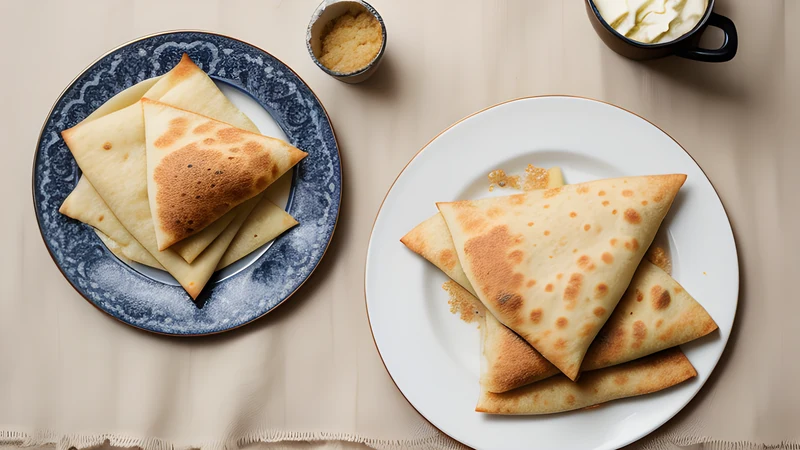
- Slide a long flat stick or a thin palette knife under the centre of the round, lift, and lay it on the griddle. Cook for 30 to 45 seconds, until dry-looking and freckled with brown spots, then flip and cook 30 seconds more.
- Stack the cooked lefse between two damp tea towels as you go. They must steam and soften or they will crack.
- To serve, spread each with softened butter, scatter with sugar and cinnamon, and roll up tightly. Cut into 5 cm lengths.
The bread that emigrated
Lefse is a soft flatbread cooked on a takke — a flat round griddle, originally iron, set over a fire — and it is old. Flatbreads on hot stones predate almost everything else in the Norwegian kitchen, and the unleavened, griddled, rolled-thin form is what you get in a country with no ovens to speak of outside the towns and a climate that made wheat a luxury. What went into it depended entirely on where you were: barley, oats, rye, and in the lean years, bark.
The potato changed it. Potatoes reached Norway seriously in the late 1700s, pushed hard by clergymen — the potetprestene, potato priests, who preached the tuber from the pulpit as famine insurance — and within a century potetlefse had displaced most of the grain versions. It remains one of the more successful public health campaigns in European history, conducted entirely by vicars.
Then it left. Between 1825 and 1925, something in the order of 800,000 Norwegians emigrated to North America — a staggering figure against a population that was under two million for most of that period, and the highest per-capita emigration in Europe after Ireland’s. They went to Minnesota, the Dakotas, Wisconsin and Iowa, and they took the takke.
Which is why lefse is now, oddly, more visible in the American Midwest than in much of Norway. Norwegian-American Christmas runs on it. There are lefse griddles sold in North Dakota hardware shops, lefse-making as a multi-generational December ritual, church-basement lefse production lines, and an entire vocabulary of specialist equipment — grooved rolling pins, turning sticks, pastry cloths — that most Norwegians in Norway have never owned. Norway kept a dozen regional lefse, ate them all year, and thought nothing of it. America kept one and made it sacred.
Norway’s lefse are a family of breads
Worth knowing what else is out there, because “lefse” on its own is close to meaningless:
Potetlefse is this one — soft, potato-based, thin, eaten fresh or the next day.
Tynnlefse, from Valdres and Hallingdal, is rolled paper-thin, dried hard for storage, then revived by brushing with water and stacking under a cloth. Filled with butter, sugar and cinnamon and rolled, it becomes lefsekling.
Møsbrømlefse, from Nordland, is dressed with a warm sauce of brunost — the caramelised whey cheese — plus butter and syrup, then folded. It is sweet, savoury, faintly caramel and completely bewildering the first time.
Hardangerlefse is thicker, closer to a soft flatbread, and gets treated more like bread than pastry.
The rule: the potato must go cold
Here is the science behind the Trondheim superstition, and it is the whole recipe.
When you boil a potato, its starch granules absorb water and gelatinise — they swell, burst, and release amylose and amylopectin into a loose, water-holding network. A hot riced potato is therefore holding a great deal of free-ish moisture in a very open structure.
Add flour to that and the flour drinks. You will find yourself adding more, and more, because the dough stays sticky, and each addition builds more gluten. By the time it handles nicely you have put in twice what you needed and made a tough, chewy, bready thing that tears on the roll and goes leathery on the griddle.
Chill it overnight and the starch retrogrades: the amylose chains recrystallise into an ordered structure and lock the water in. Cold, retrograded potato is drier to the touch, firmer, and it needs perhaps half the flour to reach the same handling consistency. Less flour means less gluten, and less gluten is the entire point of a bread you want to roll to 2 mm and keep soft.
Eight hours minimum. Overnight is better. There is no shortcut, and warm potato is the reason most first attempts at lefse fail.
The other half of the rule: rice, never mash, and never process. A ricer extrudes the cooked potato in strands, keeping the gelatinised granules largely intact. A masher ruptures them and a food processor’s blade shears them apart, dumping free starch into a sticky, gluey mess that behaves like wallpaper paste and cooks like it too.
Equipment, and what you can get away with
Lefse has more specialist kit attached to it than any other flatbread I know, and about half of it is genuinely useful.
The takke. A flat, round, unlipped griddle. The lack of a lip is the point: you need to slide a 30 cm disc of raw dough on and off without a rim in the way. An electric lefse griddle is a thermostatted takke and costs about what a decent frying pan does. A large cast-iron plancha works. A heavy flat-bottomed frying pan works if you accept 24 cm rounds and a hotter, less even surface.
The lefse stick. A thin, flat wooden paddle about 60 cm long with a tapered edge. You slide it under the centre of the rolled round, lift, and the dough drapes over it; then you unroll it onto the griddle. This is the tool that decides whether your lefse arrives round or arrives as a crumpled fist. A long thin palette knife or a metal ruler wrapped in baking paper will do the same job with less dignity.
The grooved pin. Reduces surface contact so the dough releases. Helpful, replaceable by flour and confidence.
The pastry cloth. Genuinely worth buying. A floured cotton cloth holds a reservoir of flour in its nap that a bare worktop cannot, so the dough gets a continuous dusting without you ever pressing more flour into it. This is the piece that most improves a beginner’s lefse, and it costs almost nothing.
The twist: brown the butter
The 100 g of butter that goes into the hot potato is normally melted. Brown it instead.
Four minutes over medium heat: it foams, the foam subsides, the milk solids at the bottom go from pale to hazelnut, and the smell shifts from dairy to toasted nuts. That is the Maillard reaction working on butter’s roughly 2% milk protein and its trace lactose, and it generates a set of aromatics — diacetyl, furans, pyrazines — that plain butter simply does not have.
Poured into hot riced potato and stirred through, it distributes into every strand. The finished lefse tastes faintly of toast and caramel before you have put anything on it, which matters, because a lefse’s flavour otherwise consists of potato, salt and whatever you smear on afterwards. Scrape the brown solids in; they are the flavour, and leaving them in the pan is throwing away the reason you did it.
Rolling, and the 260°C question
Two millimetres. That is thinner than you think — you should be able to see the pattern of the cloth through it in places.
Flour the pastry cloth heavily and reflour between passes. A grooved lefse pin genuinely helps, because the grooves stop the dough gripping the pin’s full surface, but a normal pin and enough flour will get there. Turn the round a quarter turn every couple of passes to keep it circular and to stop it sticking. If it tears, the dough is too warm or too wet — back to the fridge for twenty minutes.
The griddle wants 260°C, which is far hotter than any bread instinct suggests. The reason is contact time. At 260°C a 2 mm round sets and freckles in 30 to 45 seconds, which is short enough that the interior never fully dries out. At 200°C you need two or three minutes a side, and in that time the moisture leaves, and you have made a cracker. Norwegian lefse griddles are sold with thermostats set to precisely this temperature and it is not an accident.
Brown freckles, distributed across the surface, are the target. A uniformly brown lefse has been on too long.
Then the damp towels. Straight off the griddle, a lefse is stiff and dry-feeling and looks like a failure. Stacked between two damp tea towels, the residual heat drives moisture out of the cloth and back into the bread, and within twenty minutes the whole stack is soft, pliable and foldable. Skip this and you will have a pile of edible frisbees.
What goes wrong
Dough tears on the roll. Too warm, or too much cream. Chill and reflour.
Tough and chewy. Too much flour, which means the potato was warm, or you kneaded it. Forty seconds of mixing, no more.
Gluey. You mashed or processed. Unrecoverable.
Cracks when you fold it. No damp towel stage, or the griddle was too cool and cooked it dry.
Sticks to the griddle. Not enough flour on the surface, or the griddle is under temperature. A dry, properly hot griddle needs no fat at all.
Variations
Sour cream lefse. Replace half the cream with full-fat soured cream. The lactic acid tenderises the little gluten there is, and the finished bread has a faint tang that stands up to savoury fillings. This is closer to the western Norwegian style.
Tynnlefse for storage. Roll to 1 mm, cook slightly longer, and stack them dry without the damp towel. They go hard and keep for months in a tin. To revive, brush each side with water, stack under a cloth for 45 minutes, and they come back soft. This is how the bread was actually used before refrigeration — baked twice a year, in quantity, and rehydrated as needed.
Møsbrømlefse. Melt 200 g of brunost with 150 ml cream and 1 tbsp golden syrup over low heat until smooth, spread it on a warm lefse with butter, and fold into quarters. Nordland’s contribution, and a genuinely strange and excellent thing.
Savoury. Cut the sugar from the dough entirely, add 1 tsp of caraway seed, and serve with cured salmon and dill. Sacrilege in Minnesota, unremarkable in Bergen.
Eating them
The default is butter, sugar and cinnamon, spread on the warm side, rolled tight, cut into lengths. It is very plain and very good, and it is what December in a Norwegian-American house smells like.
Beyond that: brunost and butter; cured meats and soured cream; a smear of raw-stirred lingonberry and nothing else. Around Christmas, a rolled lefse next to a plate of krumkake cones and a bowl of cloudberry cream is the complete Norwegian dessert table, and the three of them between them use one griddle, one iron and no oven at all — which tells you most of what you need to know about how Norwegians baked before 1900.
They keep three days wrapped in a cloth in a tin, or three months in the freezer, interleaved with baking paper. Thaw at room temperature under a damp towel. If you have gone to the trouble of a 260°C griddle and an overnight fridge shift, make thirty and freeze twenty.
Related Content