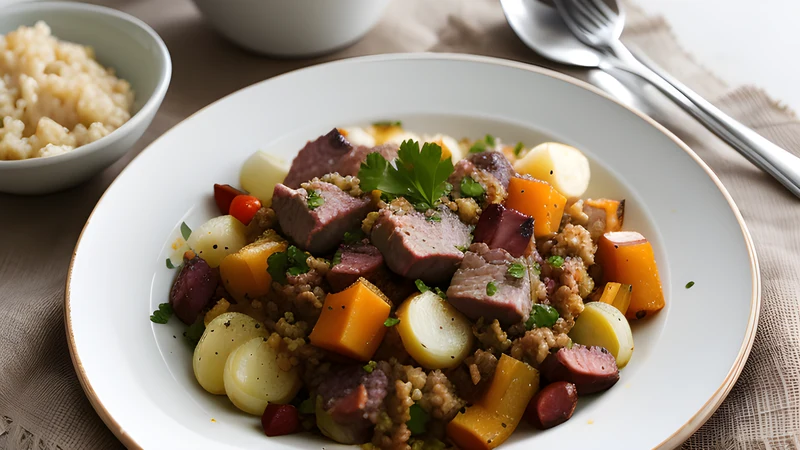
Lapskaus: Norwegian Meat and Root Vegetable Hash
The sailors' pot that gave Liverpool its nickname
Contents
↓ Jump to recipeThere is a word that made it from a Baltic galley to a football chant, and lapskaus is the Norwegian branch of it.
The English form is lobscouse, in print by 1706 in a sailor’s account of naval life, describing a mess of salt meat and biscuit boiled together. Liverpool ate so much of it that the city shortened the word to scouse, and then the word jumped from the food to the people who ate it, which is why a Liverpudlian is a Scouser and a Norwegian dinner in December is a distant relative of Merseyside. Hamburg has Labskaus, the version that turned pink with beetroot. Denmark has skipperlabskovs. Norway has lapskaus, and Norway kept it as dinner rather than as a curiosity.
Lapskaus: Norwegian Meat and Root Vegetable Hash
Ingredients
- 600 g beef chuck or shin, cut into 2 cm cubes
- 400 g pork shoulder, cut into 2 cm cubes
- 40 g butter
- 1 large onion, about 200 g, diced
- 1.2 litres beef or vegetable stock, hot
- 2 bay leaves
- 1 tbsp whole black peppercorns
- 500 g mealy potatoes such as Maris Piper or King Edward, peeled and cut into 2 cm cubes
- 500 g waxy potatoes such as Charlotte, peeled and cut into 2 cm cubes
- 300 g swede, peeled and cut into 1.5 cm cubes
- 2 medium carrots, about 200 g, cut into 1.5 cm coins
- 1 leek, white and pale green only, sliced 1 cm thick
- 2 tbsp brine from a jar of pickled beetroot
- 1.5 tsp fine sea salt, plus more to taste
- 3 tbsp chopped flat-leaf parsley
Method
- Pat the beef and pork thoroughly dry. Melt half the butter in a heavy casserole over high heat and brown the meat in three batches, 4 minutes per batch, until deeply coloured. Crowding the pan will steam the meat instead. Set the browned meat aside.
- Lower the heat to medium, add the remaining butter and the onion, and cook for 8 minutes until softened and lightly golden, scraping the browned residue off the base.
- Return the meat and any juices to the pot. Add the hot stock, bay leaves and peppercorns. Bring to a bare simmer, cover, and cook for 60 minutes.
- Add the swede and the mealy potatoes. Simmer, uncovered now, for 25 minutes.
- Add the carrots, the waxy potatoes and the leek. Simmer for a further 25 minutes, stirring every 5 minutes and pressing some of the mealy potato against the side of the pot as you go.
- The pot is ready when the mealy potatoes have dissolved into the liquid and thickened it enough to hold a spoon upright for a second, while the waxy cubes still have edges.
- Stir in the beetroot brine and the salt. Taste and adjust — it should be savoury with a distinct sour lift at the back.
- Remove the bay leaves. Rest off the heat for 10 minutes, stir through the parsley, and serve in deep bowls with flatbread and butter.
The pot that was designed for a rolling sea
The genius of the original was that nothing in it needed teeth or balance.
A ship’s cook working out of Hamburg or Bergen in the eighteenth century had salt beef, salt pork, root vegetables that survived months in a hold, and hard biscuit. He had a fire he could not always keep lit and a deck that would not always stay flat. So he boiled everything into one dense, spoonable mass, thick enough not to slosh out of a bowl when the ship rolled, soft enough for men whose teeth were in the state that a life of salt meat and no vitamin C tends to produce.
Every characteristic of lapskaus that a modern cook might read as a failure is that constraint showing through. It is deliberately overcooked. The potatoes are supposed to break. The vegetables are supposed to lose their definition. A tidy lapskaus, with each cube distinct in a clear broth, is a stew — and a stew is a different, later, richer idea.
Ashore, the dish changed jobs. It became the Norwegian answer to the question of what to do with Sunday’s boiled meat on Tuesday, which is why it turns up in every Norwegian institutional kitchen, every school canteen, every hospital, and why a great many Norwegians have complicated feelings about it. It is also why the recipe below is a template rather than a law. Real lapskaus is made from whatever is in the fridge.
Where the word came from, as far as anyone can tell
The etymology is a genuine unsolved problem, and the fact that it is unsolved tells you something about how the dish travelled.
The English lobscouse appears first, in the early 1700s, in the mouths of sailors. Norwegian lapskaus, German Labskaus, Danish labskovs and Dutch lapskous all show up in the same century, in the same ports, among the same men. No language can convincingly claim to have lent it to the others, which is exactly what you would expect from a word that lived on ships rather than in kitchens — it circulated in the North Sea trade the way a shanty did, picking up local spelling at every quay.
The guesses are various and none of them holds. Some point at Latvian labs kausis, a good bowl. Some at English lob, meaning to boil or bubble, plus course. Some at a Norwegian dialect lapp, a scrap or patch, plus skaus. The Oxford English Dictionary declines to commit, which is the correct scholarly response and an unsatisfying one.
What is not in doubt is the route the food took. It went where salt-meat shipping went, which in the eighteenth and nineteenth centuries meant Hamburg, Bergen, Copenhagen, Liverpool and every port between. Each of them kept the pot and changed one thing. Hamburg added beetroot and turned it pink. Liverpool dropped the biscuit and eventually the sea. Norway kept it brown and put swede in it.
Brown or light: the national split
Norway makes two.
Lys lapskaus — light lapskaus — browns nothing. Meat and vegetables go into the pot raw or already boiled, cover with water, and cook until it collapses. It is pale, mild, thick and faintly sweet from the swede, and it is what most Norwegians over sixty mean by the word. It is also, if I am honest, a hard sell to anyone who did not grow up on it.
Brun lapskaus — brown lapskaus — browns the meat hard first, builds on that fond, and produces something deeper, darker and more argumentative. It is the version below, because it is the version that survives contact with people who did not have a Norwegian grandmother.
The split runs roughly north-south and rich-poor: browning costs butter and attention, and light lapskaus was what you made when the point was calories. Both are correct. Only one of them is worth cooking for guests.
The potato arithmetic
This is the part that separates a good lapskaus from a bad one, and almost no recipe explains it.
Use two kinds of potato, in equal weight, added at different times.
Mealy potatoes — Maris Piper, King Edward, Russet — have low cell adhesion and high starch. Boiled hard, the cells separate and the granules gelatinise into the surrounding liquid. These are your thickener. They go in early, get abused, and disappear entirely. That is their job, and they are the reason lapskaus needs neither flour nor a roux.
Waxy potatoes — Charlotte, Anya, Nicola — hold together because their cell walls carry more of the calcium and magnesium that cross-link pectin. They go in late and they survive. These are the texture: the moments in a spoonful where you meet an actual edge.
Half and half gives you a pot that is simultaneously a purée and a stew. Use only mealy and you get wallpaper paste. Use only waxy and you get a thin, sad broth with cubes floating in it, and you will find yourself reaching for cornflour, which is the point at which the dish stops being lapskaus.
Swede is doing something similar in a minor key. It softens without ever fully dissolving and it brings a sweetness that reads as depth after two hours. Do not substitute turnip; it is sharper and more watery and it does not have the sugar.
The twist: two tablespoons of beetroot brine
Hamburg serves its Labskaus with pickled beetroot and gherkins on the side, and Danish skipperlabskovs comes with pickled beetroot on top. The sourness exists in every branch of this family except the Norwegian one, where it got lost somewhere in the nineteenth century.
Put it back — inside the pot rather than beside it. Two tablespoons of brine straight from a jar of pickled beetroot, stirred in at the end, off the heat.
The reason is straightforward. Lapskaus is two hours of fat, starch and long-cooked root sugar, with no acid anywhere. That is why the third spoonful tastes duller than the first: your palate has nothing to reset against. The brine gives you roughly 1% acidity in the finished pot — barely detectable as sourness, plainly detectable as the dish suddenly having a back end. Add it off the heat, because simmering vinegar off leaves you the flavour of vinegar without the acid, which is the worst of both.
If you have no beetroot jar, 1 tbsp of cider vinegar and a pinch of sugar will get you most of the way there.
What goes wrong
Thin, watery pot. Not enough mealy potato, or you kept the lid on. The last fifty minutes are uncovered for a reason — you are reducing.
Uniform mush. You added all the potato at once, or you stirred too enthusiastically. Stir every five minutes with a wooden spoon, and only in the last half hour.
Grey and flat. The meat was not dry when it hit the pan, so it steamed. Nothing recovers a lapskaus that never had a fond. Pat the meat dry, use high heat, and brown in three batches even though it is boring.
Peppercorns everywhere. Fish them out with the bay leaves if it bothers you, or leave them, as most Norwegians do. Unlike the four teaspoons that go into fårikål, a tablespoon across six portions is background rather than event.
Burnt bottom. Mealy potato starch settles and catches. Once the potatoes go in, the heat comes down and the spoon comes out regularly.
Leftovers, which is the whole point
Lapskaus is itself a leftovers dish, and it makes more leftovers, and that is a feature. Yesterday’s Norwegian meat cakes in brown gravy, quartered and dropped in at the last twenty minutes, are better here than they were the first time. Cold roast pork, boiled ham, leftover sausage, the last of a joint — all of it goes in. Skip the browning step if the meat is already cooked and simply build the pot on stock and onion.
The one rule for a leftovers lapskaus is that something must be fatty. Lean leftovers plus potato plus stock makes a pot with no body, and butter added at the end is a poor substitute for fat that spent two hours in the liquid.
It reheats better than it cooks. Day two, the starch has retrograded slightly, the pot has firmed up, and you can fry a slab of it in butter until it crusts — which is where lapskaus meets the Icelandic habit of frying yesterday’s fish and potato mash, and where I genuinely prefer it.
Variations
Lapskaus with salt meat. The closest thing to the original. Substitute 500 g of salt-cured beef brisket for the chuck, soak it in cold water for 8 hours with two changes, and skip the salt entirely at the end. The pot comes out saltier, denser and more clearly a sailor’s dinner.
Sausage lapskaus. Norwegian households use up medisterpølse or any coarse pork sausage this way. Slice into 2 cm rounds, brown them, and add at the halfway mark. Sausage added early turns to sawdust.
Fish lapskaus. Rarer, and better than it sounds. Skip the meat, build on fish stock and browned leek, and fold 500 g of poached cod through in the final five minutes with a good handful of dill.
Lamb lapskaus. Uses up the mutton from an autumn slaughter, and the flavour is stronger than the pot wants. Cut the lamb with an equal weight of pork to keep it civil.
At the table
Deep bowls. Flatbread or rye, and cold butter. A glass of something dark. Pickled beetroot on the side even though you put the brine in — the sweet, earthy chunks are good against the meat, and the visual argument for a bowl of brown food needing something red in it is unanswerable.
Then leave the pot on the hob and pick at it standing up, later, which is a tradition of sorts.
Related Content