Lángos: The Hungarian Fried Bread With Garlic and Soured Cream
A potato-slacked dough, stretched thin, fried fast, and rubbed with raw garlic while it burns your fingers
Contents
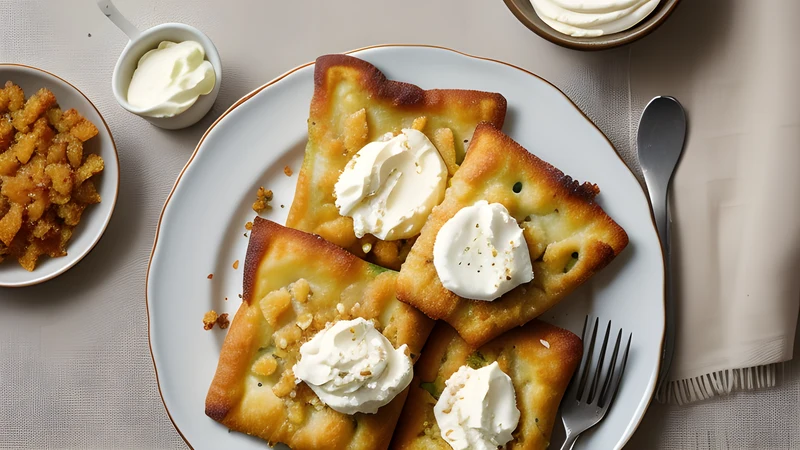
↓ Jump to recipeThe correct way to eat lángos is standing next to the fryer, at a lake, in July, at about eleven in the morning, holding it in a folded square of greaseproof that is already translucent with oil, burning the roof of your mouth. Everything about the dish is calibrated for that moment. It is the worst possible food to make in advance and one of the best things you can put in a mouth within ninety seconds of it leaving the pan.
At Lake Balaton every third stall sells them. The queue moves slowly because each one is stretched and fried to order, and the smell of hot oil and raw garlic carries about forty metres. In Budapest they turn up at Christmas markets and in the covered halls. Everywhere they are unapologetically the same thing: a disc of yeasted dough, deep-fried, hit with garlic, and buried under soured cream and cheese.
Lángos: The Hungarian Fried Bread With Garlic and Soured Cream
Ingredients
- 150 g floury potato (about 1 medium), peeled and cut into chunks
- 400 g strong white bread flour
- 7 g fast-action dried yeast
- 1.5 tsp fine salt
- 1 tsp caster sugar
- 220 ml lukewarm milk (about 35°C)
- 2 tbsp sunflower oil, plus 1.5 litres for frying
- 4 fat garlic cloves
- 100 ml warm water
- 0.5 tsp fine salt, for the garlic water
- 250 ml soured cream, to serve
- 200 g Trappista or mild Gouda, coarsely grated, to serve
Method
- Boil the potato in salted water for 15 minutes until completely soft. Drain very well, return to the dry pan over a low heat for 30 seconds to steam off, then rice or mash it smooth and leave to cool to lukewarm.
- Combine the flour, yeast, 1.5 tsp salt and sugar in a large bowl, keeping the salt and yeast apart until the flour is between them.
- Add the mashed potato, the lukewarm milk and 2 tbsp oil. Mix to a shaggy mass, then knead for 8–10 minutes until smooth and elastic. The dough should be noticeably softer and stickier than a sandwich loaf — resist adding flour.
- Cover and prove in a warm place for 60–75 minutes, until doubled and domed.
- Crush the garlic to a paste with the 0.5 tsp salt using the flat of a knife. Stir into the 100 ml warm water and leave to steep.
- Knock the dough back gently and divide into 6 pieces of about 130 g. Roll each into a ball, cover, and rest 15 minutes.
- Heat the frying oil in a deep, wide pan to 180°C. Use a thermometer.
- Take one ball and stretch it with oiled hands into a rough disc 18–20 cm across, thinner in the middle than at the rim. Poke a hole through the centre with your finger if you like — it stops the middle ballooning.
- Lower the disc into the oil away from you. Fry 60–75 seconds until deep gold, then flip and fry 45–60 seconds more. It should puff within the first 20 seconds.
- Lift onto a wire rack. While it is still too hot to touch comfortably, brush both sides generously with the garlic water.
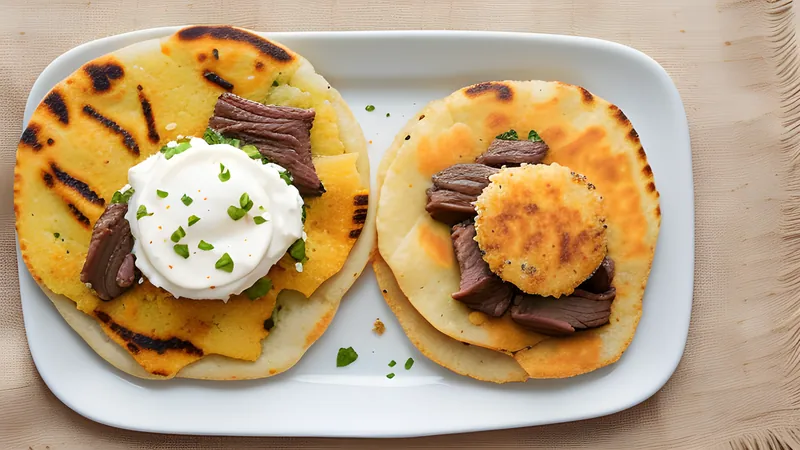
- Top immediately with soured cream and grated cheese and eat standing up. Fry the next one while the last is being eaten.
Where lángos actually comes from
The name comes from láng, Hungarian for flame, and it tells you the dish’s original technique. Lángos began as bread-oven cookery: when a household lit its wood-fired oven for the week’s baking, a scrap of the bread dough went in first, close to the flame at the mouth of the oven, and cooked in a couple of minutes while the oven came to temperature. It was the baker’s snack — a test of the heat and a reward for the fire-tending.
That version was baked. The frying came later and came from somewhere else. As wood ovens disappeared from Hungarian homes in the twentieth century, the dish had nowhere to live, and it migrated into a pan of hot fat, which delivers the same fast, high-heat blistering by a different route. Purists occasionally point out that a fried lángos is a compromise. They are correct, historically, and I have never met anyone who wanted the baked one instead.
The garlic-and-soured-cream-and-cheese topping — tejfölös-sajtos — is the modern default and is not especially old either. The oldest treatment is simply garlic, rubbed on with a cut clove. A stall at Balaton today will offer you a dozen variants including one with sausage and one with Nutella, and Hungarians have opinions about which of these constitute crimes.
Lángos sits in a broad family of fried doughs that runs across the Balkans and central Europe: the Serbian and Croatian mekike, the Romanian langoși, the Slovak posúch. It also rhymes structurally with the Polish zapiekanka — cheap carbohydrate, melted cheese, sold from a hatch, eaten walking.
The potato, and why it belongs in the dough
Plenty of lángos recipes skip the potato. Those recipes make an adequate fried bread, and they miss the thing that makes lángos worth the oil.
Cooked potato brings two assets. First, gelatinised starch, which holds water far more tightly than flour starch does. A dough with 150 g of mashed potato in it stays moist and tender in the crumb after frying, where a straight flour dough goes dry and biscuity within four minutes. That extra window matters when you are frying six of them in sequence.
Second, the potato interferes with gluten development in a useful way. It dilutes the protein network, which is why the finished lángos tears softly under your teeth rather than pulling like a bagel. You want yield here. A chewy lángos is a failed lángos.
Rice or mash the potato while it is hot and let it cool to lukewarm before it meets the yeast — hot potato at 70°C will kill your yeast on contact. Drain it very thoroughly and steam it dry in the pan for thirty seconds, because any retained water goes into your hydration calculation uninvited and you end up with a batter.
Frying: the temperature is the recipe
180°C. Buy a thermometer if you do not have one; a probe thermometer costs less than the oil you will waste getting this wrong.
Below about 165°C, the dough absorbs oil faster than the surface can set. Steam pressure inside is too low to push outward, oil flows inward, and you get a heavy, greasy, pale disc that sits in your stomach like a paperweight. This is what happens to everyone’s first attempt.
Above about 195°C, the outside colours to deep brown in forty seconds while the interior is still raw dough. You pull it out, it looks perfect, and the middle is wet.
At 180°C the water in the dough flashes to steam fast enough to force its way outward, keeping oil at bay, and puffs the disc within the first twenty seconds. Sixty to seventy-five seconds a side gives you a deep gold crust and a cooked interior. If your lángos does not visibly inflate almost immediately, the oil is too cold — pull it out, wait, try again.
The oil temperature drops around 15°C every time a disc goes in. Let it recover between pieces. Frying six lángos properly takes twenty minutes because of this, and rushing it is how you produce five greasy ones.
The oil, and what happens to it
Sunflower oil is what Hungary uses and it is the right choice: neutral, cheap, and stable to around 225°C. Rapeseed works. Olive oil is wrong on both flavour and smoke point. Lard is historically accurate for some rural versions and produces a lángos with a distinctly heavier, savoury edge that I like once a year.
Depth matters more than people expect. You want at least 5 cm of oil in a wide, heavy pan — enough that the disc floats without touching the base. A shallow pan means the underside sits on hot metal and scorches while the top steams, and it also means the temperature crashes further with each addition, because there is less thermal mass to buffer it. A litre and a half in a deep casserole is the minimum for a comfortable session.
The oil is reusable two or three times if you strain it through a coffee filter once it has cooled and keep it somewhere dark. Watch for the signs it has gone: it darkens, it starts to smell fishy or acrid, it foams more than it should, and it smokes at a lower temperature than it used to. Each of those is polymerisation and free fatty acids building up, and past that point the oil imparts a stale taste to everything.
Never pour hot oil anywhere. Let it cool completely in the pan.
Proving, timing and doing this for a crowd
The prove is 60–75 minutes at normal room temperature, and the dough should double and dome. An under-proved lángos comes out dense and refuses to puff, because there is not enough gas structure for the steam to inflate.
You can slow the whole thing down usefully. Make the dough the night before, knead it, and put it straight in the fridge for a cold prove of 12–18 hours. The yeast works slowly, the flavour deepens noticeably, and you get a dough with more character than the 75-minute version. Bring it back to room temperature for an hour before you divide it, or the cold centre will not fry through.
The 15-minute rest after balling is doing real work — it relaxes the gluten so the dough stretches to 20 cm without springing back. Skip it and you will fight every disc.
For a crowd, the only honest answer is that someone stands at the pan for the duration. Divide and ball everything in advance, set up the garlic water and toppings on a tray, and accept that you are the fryer for twenty minutes. Trying to fry six and serve them together produces one good lángos and five cold ones.
Stretching, and the hole in the middle
Do not use a rolling pin. A pin compresses the dough and drives out the gas the prove has built, and you lose the irregular blistering that is half the appeal.
Stretch by hand with oiled palms, from the centre outwards, letting gravity help. You want a disc 18–20 cm across, thin in the middle — almost translucent — and thicker at the rim, so you end up with a crisp centre and a soft puffed edge to hold. The thinness is deliberate; a thick lángos is a doughnut.
The finger-hole through the centre is optional and pragmatic. Without it the thin middle balloons into a dome that has to be popped before you can put soured cream on it. With it, the disc stays flat and fries evenly. Balaton stalls do it both ways.
The garlic water
This is where most home versions go wrong, by being timid.
Crush four cloves to a paste with salt — the salt provides abrasion and draws water out of the garlic — and steep them in 100 ml of warm water. Brush it on while the lángos is still ferociously hot. The heat drives the garlic water into the surface and volatilises the allicin so it hits your nose before you take a bite.
Applied cold, or after the bread has cooled, it just makes the surface damp and tastes raw. Applied instantly, it perfumes the whole thing. This is the single largest flavour decision in the recipe and it takes four seconds.
Some stalls rub the lángos with a cut clove instead. It works and it is more traditional; it also uses much more garlic and I find the coverage uneven.
What goes wrong
Greasy and heavy. Oil too cold. Almost always this.
Raw in the middle. Oil too hot, or the disc was too thick in the centre.
Chewy and tough. Over-kneaded, or too much flour added during kneading because the dough felt sticky. It is meant to feel sticky.
Dense, no puff. Under-proved, or the yeast died. Check the milk was lukewarm and the potato had cooled.
Delicious for ninety seconds, then leathery. That is the dish. Lángos does not keep, does not reheat, and does not travel. Fry them one at a time and hand each one over as it is done.
Toppings, honestly assessed
Soured cream and grated Trappista is the standard and it is very good — the cream’s acidity is the only thing cutting the oil, and it needs to be full-fat. Mild Gouda is the best supermarket substitute for Trappista.
Garlic alone, with salt, is the oldest version and the one I make most often. It is cleaner and lets you taste the bread.
Grated cheese with no cream produces a dry mouthful. Nutella is sold at Balaton and I will say only that the garlic water makes it a strange experience.
If you want to build a Hungarian afternoon around it, lángos before a bowl of gulyásleves is how a lot of people spend a Saturday, and the caraway in the soup and the garlic in the bread get on better than they should. For a related dough worth knowing, puffy charred pita uses the same steam-inflation physics in a hot oven instead of oil.
Related Content