Moroccan Lamb Tagine with Apricots and Preserved Lemon
Slow-cooked, sweet and savoury
Contents
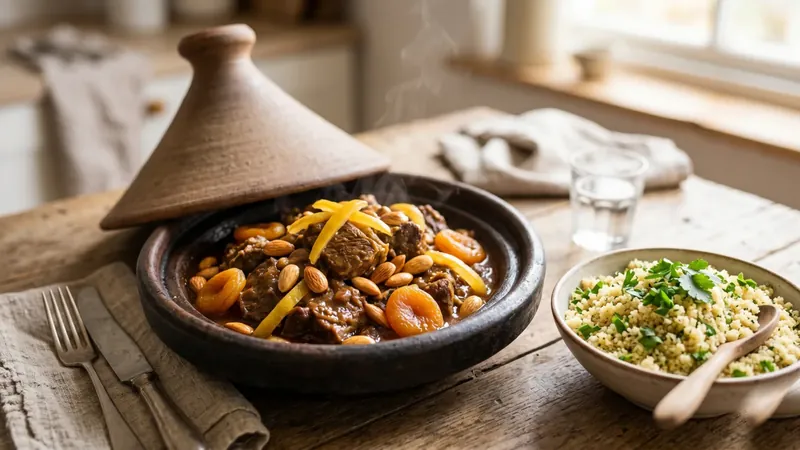
↓ Jump to recipeA good tagine balances sweet against savoury, and this one leans into both ends. Dried apricots, plumped in the sauce and lifted with honey, give a gentle, jammy sweetness, while the salty, citrus tang of preserved lemon cuts straight through the richness of slow-cooked lamb. Warmly spiced and meltingly tender, it is the kind of dish that fills the kitchen with the scent of cinnamon and saffron long before it reaches the table.
Moroccan Lamb Tagine with Apricots and Preserved Lemon
Ingredients
- 1.2kg lamb shoulder, cut into large chunks
- 3 tbsp olive oil
- 2 onions, finely sliced
- 4 garlic cloves, crushed
- 1 thumb of fresh ginger, grated
- 2 tsp ground cumin
- 2 tsp ground coriander
- 1 tsp ground cinnamon
- 1 tsp ground turmeric
- Pinch of saffron threads
- 2 tbsp tomato purée
- 700ml lamb or chicken stock
- 150g dried apricots
- 2 tbsp clear honey
- 1 preserved lemon, flesh discarded, rind finely chopped
- Salt and black pepper, to taste
- Toasted flaked almonds and coriander, to serve
Method
- Season the lamb. Heat 2 tbsp oil in a large casserole and brown the lamb in batches until well coloured, then set aside.
- Add the remaining oil and cook the onions over a low heat for 10 minutes until soft and golden.
- Stir in the garlic and ginger for 1 minute, then add the cumin, coriander, cinnamon, turmeric and saffron and cook for 1 minute until fragrant.
- Stir in the tomato purée, then return the lamb to the pot with the stock. Bring to a gentle simmer.
- Cover and cook over a very low heat, or in a 160C (140C fan) oven, for 1 hour and 30 minutes.
- Stir in the dried apricots and honey, then cook uncovered for a further 30 minutes until the lamb is meltingly tender and the sauce has thickened.
- Stir through the chopped preserved lemon rind and season to taste.
- Rest for 10 minutes, then scatter with toasted almonds and coriander. Serve with couscous or flatbread.
The Story
A tagine is two things at once: the conical earthenware pot, and the slow-cooked stew prepared inside it. The pot, with its distinctive pointed lid, is the traditional cooking vessel of Morocco and the wider Maghreb. The shape is cleverly designed for cooking over low heat or coals, the tall lid trapping rising steam so it condenses and trickles back down, keeping the contents moist and gently braising the meat with very little liquid. A heavy casserole with a tight lid does the same job perfectly well at home.
What defines the food is the layering of warm spices with a savoury and often sweet character. Cumin, coriander, cinnamon, ginger, turmeric and saffron form the backbone, sometimes blended into the famous spice mix ras el hanout, whose name loosely translates as “top of the shop”, a blend of the merchant’s finest spices. The combination of meat with dried fruit is a hallmark of this cooking, an inheritance from the wider Arab and Persian culinary world where sweet and savoury have long shared a plate.
The two ingredients highlighted here are pillars of the Moroccan kitchen rather than novelties. Apricots, prunes and dates all appear in classic tagines, where their concentrated sweetness softens into the sauce and balances the spice. Preserved lemons are perhaps the most characteristic Moroccan ingredient of all: whole lemons packed in salt and their own juice and left to mature for weeks, mellowing into something intensely fragrant and savoury. Only the rind is used, the soft flesh usually discarded, and it brings a salty, almost floral citrus note that no fresh lemon can replicate.
The two ingredients highlighted here reflect a long history of trade. Morocco sits at the meeting point of Berber, Arab, Andalusian and sub-Saharan cooking, and the caravans that crossed the Sahara and the ships that crossed the Mediterranean brought spices, dried fruit and preserving techniques from far beyond its borders. Saffron arrived with Arab traders; cinnamon and ginger travelled the spice routes from further east; the habit of preserving lemons in salt is shared across the Middle East and North Africa. What Moroccan cooks did was fold all of this into a single, coherent style built around the tagine pot.
Why the technique works
Patience is the real secret. Lamb shoulder is a tough, well-marbled cut laced with collagen, and collagen only becomes tender gelatine when it is held at a gentle heat for a long time. Rush it over a high flame and the muscle fibres simply seize and toughen; keep the pot at a bare simmer for two hours and the same cut turns silky, with the melted collagen thickening the sauce into something glossy. This is why the recipe insists on a very low heat, whether on the hob or in a 160C oven.
Browning the meat first matters just as much. When you colour the lamb in a hot pan you are triggering the Maillard reaction, the browning that creates hundreds of new savoury, roasted flavour compounds on the surface of the meat. Skip it and the finished tagine tastes thin and grey; do it properly, in batches so the pan stays hot and the meat sears rather than stews, and you build a deep base note that carries the whole dish. Cook the onions slowly afterwards until soft and golden, which coaxes out their natural sugars and gives the sauce its body.
Timing the apricots and preserved lemon is the last piece. Add the apricots too early and they dissolve entirely into the sauce; add them in the final half hour and they plump and soften while keeping their shape, giving you pockets of jammy sweetness. The preserved lemon rind goes in right at the end, off the heat, so its salty, floral citrus edge stays bright and distinct rather than cooking away into the background.
What can go wrong
The most common problem is a watery sauce. If yours is thin after the cooking time, lift out the lamb and boil the sauce hard for a few minutes to reduce it, then return the meat. The opposite problem, a sauce that catches and scorches, means your heat is too high or your pot too thin; use a heavy-based casserole and check that the liquid is barely trembling, not boiling. If the lamb is still chewy after two hours, it simply needs longer, so give it another 20 to 30 minutes rather than turning up the heat.
Watch the salt at the end. Preserved lemon is heavily salted, so add it before your final seasoning and taste carefully; you may need very little extra salt, if any.
If the sauce tastes flat despite the long cook, it usually needs one of three things: a pinch more salt, a squeeze of the preserved lemon’s juice for acidity, or a final drizzle of honey to bring the sweet and savoury back into balance. A tagine is a dish you correct at the end by tasting, not one you set and forget. The saffron is easy to under-use; a proper pinch of threads, steeped for a few minutes in a little warm stock before it goes in, gives a far deeper colour and honeyed aroma than tossing the dry strands straight into the pot.
Substitutions and variations
Lamb shoulder is ideal, but diced lamb leg or even beef shin work with the same slow method. For a version closer to the Persian end of this tradition, swap half the apricots for pitted prunes and add a handful of raisins. A teaspoon of ras el hanout in place of some of the individual spices deepens the flavour if you have a good jar to hand. Chickpeas, drained and stirred in for the last 20 minutes, stretch the dish and add texture, while a scatter of pomegranate seeds at the table brings a fresh, tart pop against the richness.
If you enjoy the salt-and-citrus lift of preserved lemon, it is worth keeping a jar on hand: it does the same clever work in this chicken and preserved lemon tagine and in braised chicken thighs with preserved lemon and olives. For a different but equally slow-cooked, spice-led braise, try a lamb rogan josh.
Make ahead and storage
Like most braises, this tagine is better the next day, once the flavours have settled and the sauce has thickened further in the fridge. It will keep, covered, for up to three days, and reheats gently on the hob with a splash of water or stock to loosen the sauce. It also freezes well for up to three months; cool it fully, freeze in portions, and defrost overnight before reheating slowly until piping hot throughout. Add the toasted almonds and fresh coriander only when you serve, so they stay crisp and vivid.
Serve with fluffy couscous or warm flatbread to soak up every drop, and offer a spoonful of harissa on the side for anyone who wants a little heat against all that gentle sweetness.
Related Content