Lahmacun: The Turkish Flatbread You Roll and Eat
Paper-thin dough under a smear of spiced lamb, blasted in a scorching oven, rolled around parsley
Contents
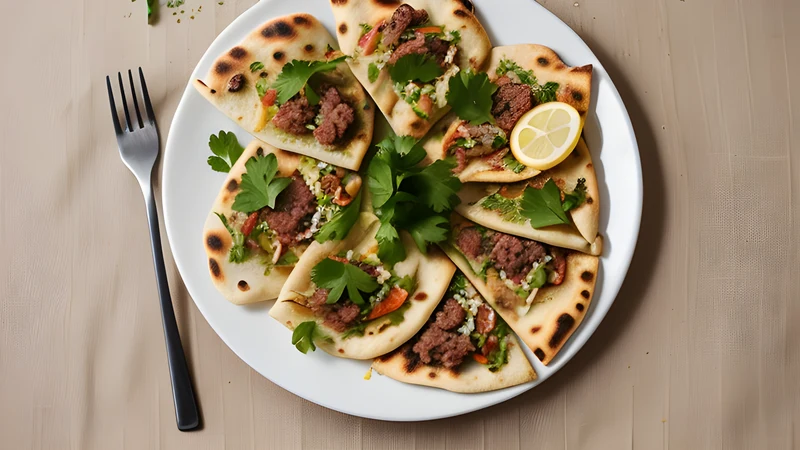
↓ Jump to recipeThe word is Arabic, more or less: lahm bi’ajin, meat with dough. In southeastern Turkey they say lahmacun and they eat it in quantity, folded around a fistful of parsley, with a glass of ayran and a wedge of lemon squeezed over first. The bread is thinner than a pancake, the meat is spread so sparingly you can see through it, and the whole thing spends four minutes in an oven hot enough to strip paint. Getting it right at home is a question of temperature and dryness, and both are solvable.
Lahmacun: The Turkish Flatbread You Roll and Eat
Ingredients
- 400g plain flour, plus extra for dusting
- 1 tsp fast-action dried yeast
- 1 tsp fine salt
- 1 tsp caster sugar
- 250ml lukewarm water
- 1 tbsp olive oil
- 300g minced lamb (about 20% fat)
- 1 medium onion (about 150g)
- 1 red pepper, deseeded and roughly chopped
- 4 garlic cloves
- 40g flat-leaf parsley, plus a large handful to serve
- 2 tbsp biber salçası (Turkish red pepper paste), hot or mild
- 1 tbsp tomato purée
- 2 tsp isot (Urfa) pepper flakes, or 1 tsp pul biber
- 1 tsp ground cumin
- 1/2 tsp ground cinnamon
- 1 1/4 tsp fine salt, for the topping
- 1/2 tsp coarsely ground black pepper
- 1 tbsp pomegranate molasses
- 1 lemon, cut into wedges, to serve
- 1 small red onion, finely sliced and tossed with 1 tsp sumac, to serve
Method
- Mix the flour, yeast, 1 tsp salt and sugar in a bowl. Add the lukewarm water and olive oil, bring together, and knead for 8 minutes until smooth. Cover and prove for 60-90 minutes until doubled.
- Put a baking steel or heavy baking stone on the highest oven shelf and heat the oven to its maximum, at least 250C fan, for a full 45 minutes.
- Grate the onion on the coarse side of a box grater. Squeeze it hard in a clean tea towel over the sink and discard the juice. This step is what keeps the base crisp.
- Put the red pepper, garlic and 40g parsley in a food processor and blitz to a fine, damp rubble. Tip into a sieve and press out the liquid for 1 minute.
- Combine the lamb, squeezed onion, drained pepper mixture, biber salçası, tomato purée, isot, cumin, cinnamon, 1 1/4 tsp salt, black pepper and pomegranate molasses. Mix with your hand for 2 minutes to a smooth, spreadable paste with no loose liquid.
- Knock back the dough and divide into 8 pieces of about 82g. Roll each into a ball, cover, and rest 10 minutes.
- On a lightly floured surface, roll one ball out to a 24cm round about 1mm thick, as thin as you can get it without tearing.
- Transfer to a floured peel or the back of a baking tray. Spread 60g of the topping over the round in a thin, even layer right to the edge, using the back of a spoon. It should be barely 2mm deep and you should half see the dough through it.
- Slide onto the hot steel and bake for 4-6 minutes, until the edges are blistered and browned and the meat has lost its raw colour and caught at the rim.
- Slide onto a wire rack for 30 seconds, then stack the finished ones under a clean tea towel so they stay pliable. Repeat with the rest.
- Serve with a squeeze of lemon, a heap of parsley leaves and sumac onions laid down the middle. Roll into a tight cigar and eat with your hands.
Gaziantep, Urfa, and a bread built for a stone oven
Lahmacun’s home ground is the southeast: Gaziantep and Şanlıurfa above all, running down towards the Syrian border where the food shades into Aleppan. Antep is the food capital by common consent — it is on the UNESCO Creative Cities list for gastronomy, granted in 2015 — and it is where the pistachios, the pepper paste and the baklava come from. The same dish exists in Armenian kitchens as lahmajoun, and in Syria and Lebanon as sfiha or lahm bi’ajin, with local variation in the spicing and thickness.
It is street food and lunch food, made by a lahmacuncu who has a stone oven going all day and turns them out in three or four minutes each for the price of a coffee. Ordering is done by the number, and one is never enough.
The two ingredients that make it taste like Turkey rather than a thin pizza:
Biber salçası, red pepper paste. Sweet red peppers are minced, salted and left in shallow trays in the sun for days until they reduce to a dense, brick-red paste. It is made across Anatolia every autumn, domestically and industrially, and it comes in tatlı (mild) and acı (hot). It carries a deep, sweet, sun-cooked capsicum flavour that no amount of tomato purée and paprika will reproduce. Every Turkish grocer has it, and a jar keeps months in the fridge under a film of oil.
Isot pepper, also called Urfa pepper, from around Şanlıurfa. The pods are sun-dried by day and wrapped tightly by night, so they sweat and ferment slightly rather than drying out. The result is dark purple-black, oily to the touch, moderately hot, and tasting of raisin, tobacco and chocolate. It is one of the great chilli flakes. Pul biber — the ordinary bright red Turkish flakes, often labelled Aleppo pepper — is hotter, brighter and fruitier, and works at half the quantity.
Heat is the whole problem
A lahmacuncu’s oven runs somewhere north of 400C. Yours does not. What you can do is store heat in something dense and put the bread directly on it.
Get a baking steel if you make flatbreads with any regularity — it is a slab of mild steel, 6mm or so, and it conducts heat into a dough base roughly twenty times faster than a stone does because steel’s thermal conductivity is in a completely different league. A stone works and takes longer. A heavy upturned baking tray is the last resort and will give you a paler base.
Preheat for a full 45 minutes at maximum. The oven’s thermostat will say it is up to temperature after twelve, and the steel will still be cold in the middle. This is the single most common reason home lahmacun comes out pale and floppy: the oven was ready and the steel was not.
Top shelf, close to the roof. You want radiant heat cooking the meat from above at the same time as the steel is cooking the dough from below, and four to six minutes to do both. That is why the topping is spread so thin — it has to be cooked through in the time it takes a 1mm dough to bake.
The dough, which asks very little
There is no sourdough here, no long ferment, no baker’s-percentage anxiety. Lahmacun dough is flour, water, a little yeast, salt, sugar and a spoon of oil, at about 62% hydration, proved once for an hour. Plain flour is correct — strong bread flour develops more gluten, which sounds like an improvement and means the round fights you when you try to roll it to a millimetre. You want a dough that goes thin and stays thin.
The single prove is enough. A long, cold, flavour-building ferment would be wasted: the dough spends five minutes in the oven under a layer of spiced lamb, and nobody has ever tasted the difference. Lahmacun is a vehicle, and it is meant to be a slightly soft, chewy, mildly bready one.
The ten-minute rest after dividing into balls is the step people skip and then regret. Rolling a ball straight after shaping means fighting a taut gluten network that snaps back the moment you lift the pin. Ten minutes of relaxation and the same dough rolls out to a 24cm round in about twenty seconds with no argument.
Roll on a lightly floured surface and rotate the round a quarter turn every couple of passes, which keeps it circular and stops it sticking. If it starts to shrink back, walk away for three minutes and come back to it.
Why the lamb has to be mixed hard
Two full minutes of mixing with your bare hand, until the topping stops behaving like mince with things in it and turns into a smooth, cohesive paste that holds the marks of your fingers.
Salt dissolving into the meat draws out myosin, the muscle protein, and that protein cross-links into a mesh as it is worked. That mesh does two useful jobs here. It binds the topping so it can be spread in a 2mm layer without falling into clumps or sliding off the dough on the way into the oven. And it holds onto the lamb’s own moisture and fat during the bake instead of letting it run out and puddle.
An under-mixed topping breaks up as you spread it, leaves bald patches, and browns unevenly — some parts scorched, some raw. It also renders its fat straight into the dough. Mix it until it clings to your palm, then chill it while the oven finishes preheating; a cold topping spreads more cleanly than a warm one.
The onion, squeezed
Here is the technique that separates a good home lahmacun from a soggy one.
An onion is around 89% water. A red pepper is around 92%. Put them into a topping raw and chopped, and that water has nowhere to go except down into the dough, where it turns the base to steamed paste in the first ninety seconds — before the steel has had a chance to set the crust. You get a lahmacun that flops, tears when you roll it, and tastes of boiled lamb.
So: grate the onion coarsely, wrap it in a tea towel and wring it out over the sink until the pulp is genuinely dry. You will be surprised how much comes out — usually 60ml or more from a medium onion. Then blitz the pepper, garlic and parsley and press that through a sieve too.
You are throwing away flavour, and it is worth it. What remains is concentrated, and it does not sabotage the base. This is the mirror image of the khinkali filling, where you keep the onion juice deliberately because the dumpling wants the liquid.
Grating rather than dicing matters too. Dice leaves crunchy fragments that never soften in five minutes of baking; grated shreds disappear into the paste.
Spreading, and the discipline of not enough
Sixty grams of topping on a 24cm round. Spread with the back of a spoon, right out to the edge, in a layer around 2mm deep — thin enough that the dough shows through in patches. Every instinct says this is mean. Every instinct is wrong.
Thicker topping cannot cook through in five minutes. What happens instead is that the surface dries and the underside stays raw and grey, sitting in its own rendered fat, and the moisture it releases waterlogs the dough beneath it. Thin topping goes brown and slightly crisp at the edges, and the fat renders into the bread rather than pooling on it.
Right to the edge is Turkish practice. There is no crust, no rim, no border. The whole round gets covered and the outer few millimetres crisp up hardest.
What can go wrong
Floppy, pale base. Under-preheated steel, or a wet topping, or both.
Grey, wet meat. Too thick. 60g, spread out.
Tears when you roll it. Overbaked, so the dough went brittle. Stack the finished ones under a tea towel; the trapped steam softens them back to pliable within a minute.
Bland. Under-salted, or no biber salçası. Paprika does not substitute.
The dough springs back and will not roll thin. It needs the 10-minute rest after balling. Give it another five and it will go.
Storing, and the table
Lahmacun is best thirty seconds out of the oven and perfectly good an hour later. Stack them under a tea towel as they come out. To reheat, 90 seconds on a dry pan over a medium heat, or two minutes back on the steel. They freeze well, interleaved with baking paper, and go straight from the freezer onto the hot steel for three minutes.
The assembly at the table matters as much as the baking. Lemon over the top — a proper squeeze, so the acid cuts the lamb fat. Then parsley leaves, a lot of them, whole. Then sumac onions: red onion sliced thin and tossed with sumac, which is the ground dried berry of Rhus coriaria and gives a sour, faintly fruity astringency. Roll it tight and eat it in your hands over a plate.
A vegetarian version made with 300g of finely chopped mushrooms, fried dry, and 100g of walnuts is a real thing in Turkish home cooking and holds up better than it has any right to.
If you like this and want the rest of the meal, İskender kebab is the Bursa dish that treats bread as the base of the plate rather than the wrapper, and kısır is the bulgur salad that would be sitting alongside, doing the same job the parsley does — sour, herbal, cutting through the lamb. For a flatbread lesson with no topping at all, lavash blistered in a hot oven teaches the same thing about preheating that lahmacun does, with less at stake.
Related Content