Kvass: The Russian Fermented Rye Drink
Stale black bread, a little yeast, and three days of patience
Contents
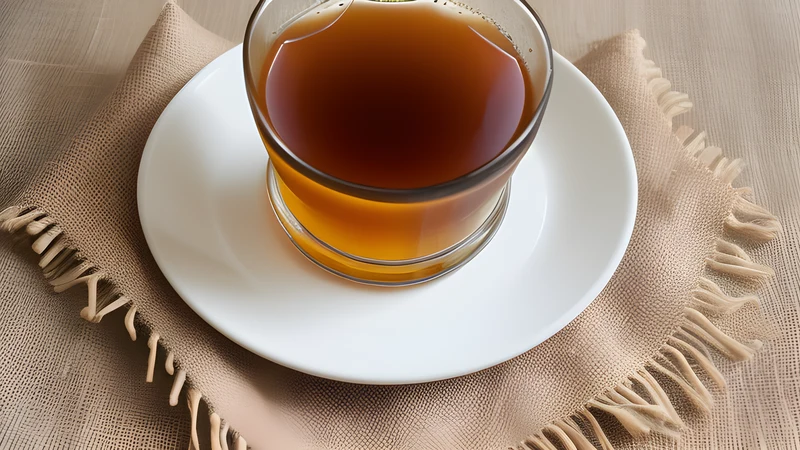
↓ Jump to recipeThere is a particular kind of thirst that only shows up in August, and in Moscow it used to be answered by a woman with a yellow tanker on wheels parked at the kerb, dispensing kvass into whatever glass you handed her. The tankers were state-issue, the glasses were communal and rinsed in a spinning jet of cold water, and the drink inside was dark, sour, faintly fizzy, and made from bread that would otherwise have gone in the bin.
I make it because it is the most direct answer I know to the question of what to do with the heel of a rye loaf. You toast it, you steep it, you let wild-ish yeast have its way for a day, and you end up with something that tastes like a savoury cola brewed by someone who does not much care for sugar.
Kvass: The Russian Fermented Rye Drink
Ingredients
- 400g stale dark rye bread (borodinsky or a similar sour rye), cut into 2cm slices
- 2.5 litres water
- 120g caster sugar
- 3g dried instant yeast (about 1 level teaspoon)
- 20 raisins, unwashed if possible
- 1 tbsp runny honey
- 2 strips lemon zest, pared with a peeler
- 5g fresh mint leaves (optional)
Method
- Heat the oven to 180C fan. Spread the rye slices on a baking tray and toast for 18–20 minutes, turning once, until the edges are dark brown and the surface is dry and brittle. You want deep colour without acrid black patches — taste a corner, and if it is bitter rather than roasted, start again with a shorter bake.
- Bring the water to the boil in a large pan, then take it off the heat. Add the toasted bread, push it under with a spoon, cover, and leave for 6 hours or overnight at room temperature. The liquid should turn the colour of strong tea.
- Strain through a sieve lined with muslin into a clean bowl or jug. Press the bread gently with the back of a ladle to release the liquid, then stop — squeezing hard forces starch through and makes the finished kvass cloudy and gluey. Discard the bread.
- Stir the sugar and honey into the warm infusion until fully dissolved. Let the liquid cool to 30C — hotter than that will kill the yeast, cooler and the ferment takes an extra day.
- Sprinkle the yeast over the surface, leave for 5 minutes, then whisk in. Add the lemon zest and mint if using.
- Pour into a wide jar or bowl, cover with a cloth (not a lid — the gas needs to escape), and leave at 20–22C for 24–36 hours. It is ready when the surface carries a fine foam and the taste has turned distinctly sour with only a trace of sweetness left.
- Strain again through muslin. Divide between two 1-litre plastic bottles, dropping 10 raisins into each. Leave 4cm of headspace and screw the caps on tightly.
- Leave at room temperature for 8–12 hours until the bottles feel rock hard when squeezed, then refrigerate for at least 12 hours before drinking. Open over a sink for the first pour.
- Serve very cold. Drink within 5 days, burping the bottles once a day.
What kvass actually is
Kvass is a lightly fermented drink, usually between 0.5% and 1.2% alcohol by volume, made by fermenting a sugared infusion of toasted rye bread. That alcohol figure matters: it is low enough that in Russia it has always been sold as a soft drink, and low enough that children drink it, but it is not zero. If you leave a bottle in a warm kitchen for three days rather than one, you will find yourself with something closer to a weak beer, and a cap that fires across the room.
The written record goes back to the Primary Chronicle, where Vladimir the Great’s mass baptism of Kyiv in 988 is marked by distributing food, honey and kvass to the crowd. By the nineteenth century it was infrastructure. Russian households brewed it in wooden tubs; monasteries brewed it in volume; the army issued it. There is a nineteenth-century figure I like, quoted often enough that I distrust it slightly but not enough to leave it out — that a Russian peasant household got a meaningful share of its daily calories from kvass and black bread together.
What I find genuinely interesting is the class inversion. Kvass was the drink of people who could not afford much else, and the phrase kvasnoy patriotizm — “kvass patriotism” — was coined in the 1820s by Prince Vyazemsky as a sneer at nobles who performed peasant Russianness for effect. The drink was so humble it became a rhetorical weapon. Then Coca-Cola and Pepsi arrived in the 1990s and kvass nearly vanished from Russian shops, before coming back in the 2000s as a branded, pasteurised, sweetened bottle sold explicitly on the fact that it was not American. Same drink, opposite politics, eighty years apart.
Ukraine, Poland, Lithuania and Latvia all have their own versions and their own claims. Ukrainian kvass tends drier; the Baltic versions often lean harder on the caramel. The cold Russian kvass soup uses it as a broth rather than a drink, which tells you how far it sits from lemonade in the Russian mind.
The honest case against making it
Before the method: kvass is not for everyone, and the bottled stuff has taught a lot of people to expect the wrong thing. Commercial kvass in a supermarket is pasteurised, sweetened to roughly the sugar level of a cola, and often carbonated by injection rather than by ferment. It tastes like a soft drink with a bready aftertaste. Homemade kvass tastes sour first, sweet a distant second, and has a faint yeasty savouriness that some people read as “off”. If you make this expecting root beer, you will pour it away.
It also asks for three days of calendar and about forty minutes of actual attention, which is a poor ratio if what you want is a cold drink this afternoon. What it repays is the sourness, which no shop-bought version gets right, and the fact that the raw material was going to be thrown away.
The bread does all the work
Everything about the finished flavour is decided by what you toast and how far you toast it.
Use a genuinely dark, genuinely sour rye. A borodinsky loaf with coriander is the ideal — its molasses and coriander come straight through into the glass — but any dense sour rye works. What will not work is a soft supermarket “rye” that is 80% wheat flour with a spoon of rye for colour. There is nothing in it to extract.
Toasting is a Maillard operation and a caramelisation operation at once, and the window between the two useful outcomes and the useless third is narrower than people expect. At 180C fan for 18–20 minutes the crust goes from brown to dark brown, the sugars in the crumb caramelise, and the melanoidins that give kvass its colour and its faint cocoa note develop. Push to 25 minutes and the crust starts producing genuinely bitter pyrolysis compounds, which the fermentation only concentrates. My rule is to break a slice in half at 18 minutes and chew a corner. Roasted and slightly sweet, carry on. Ashy, stop.
Steeping in water off the boil rather than at the boil is deliberate. Water at 100C gelatinises rye starch aggressively and pulls the pentosans — the gums that make rye dough sticky — straight into your infusion. The result is a kvass with a slippery body that never clears. Just-boiled water, cooled for a minute in the pan, extracts colour and flavour and leaves most of the gum behind.
The ferment, and the second one
You are running two fermentations, and they do different jobs.
The first, in an open bowl for 24–36 hours, is where the sourness comes from. Yeast eats sugar and makes ethanol and CO2, which all escapes; meanwhile lactic acid bacteria — carried in on the bread crust, on the raisins, from your kitchen air — get to work producing lactic acid. That acid is the whole point. A kvass that has fermented for only 12 hours tastes like sweet bread water, which is the most common failure I see and the reason people conclude they don’t like kvass.
The second fermentation, in sealed bottles with raisins, is purely about carbonation. The residual sugar left in the liquid feeds one last burst of yeast activity, and with the cap on, the CO2 has nowhere to go except into solution. The raisins add a little fructose and a little tannin, and they also give you a visual cue — when they rise and hover, the ferment is active.
Use plastic bottles for this, always. A squeezed plastic bottle tells you the pressure by feel, and it fails by deforming. A swing-top glass bottle left too long fails by exploding, and I have swept up that particular mess. Once the bottle is hard to dent with a thumb, get it in the fridge; cold slows fermentation to a crawl.
Where it goes wrong
Cloudy and slimy. You either boiled the bread or wrung it out through the muslin. Press gently, accept a slightly lower yield.
Bitter, harsh finish. The toast went too far. There is no rescue.
Flat. You left too little residual sugar before bottling, or the room was too cold. Add a teaspoon of sugar per bottle and give it another 6 hours at 22C.
Tastes of bread and nothing else. Under-fermented. Give it another 12 hours in the open bowl and taste again — you are waiting for a sourness that makes the back of your jaw tighten slightly.
A white bloom on the surface during the open ferment. Kahm yeast, harmless, skim it. Fuzzy, coloured, or hairy growth is mould, and that batch goes down the sink.
Yeasty, bready, faintly of raw dough. Too much yeast for the volume. Three grams in two and a half litres is genuinely enough; a whole 7g sachet gives you a fast ferment that tastes of the yeast itself rather than of the acid it should have produced on the way.
A sediment layer at the bottom of the bottle. Entirely normal, and a sign it is alive. Pour gently and leave the last centimetre behind, or swirl it in if you like the extra body.
The twist, and variations
The honey is my small deviation from orthodoxy. A tablespoon in two and a half litres stays below the threshold where anyone would name it as honey. What it leaves is a rounder finish behind the acidity — the sugars in honey are not all fermentable, so a little survives to soften the edge. The lemon zest does the same job from the other direction, lifting the whole thing so it reads as refreshing rather than merely sour.
For a fruit kvass, add 200g of chopped rhubarb or 150g of raspberries at the start of the open ferment. Beetroot kvass is a different animal entirely — no bread at all, just raw beetroot, salt and water, fermented for a week, and used as a souring agent rather than drunk for pleasure.
Mint goes in at the yeast stage, never at the toasting stage, and comes out at the first strain. A stalk left in the bottle turns medicinal within a day.
Timing it around your week
The rhythm is easier than the total elapsed time suggests, because almost all of it is waiting. Toast the bread on a Thursday evening and start the steep before bed. Strain, sugar and pitch the yeast on Friday morning — that is a ten-minute job before work. The open ferment runs all day Friday and through Friday night. Bottle on Saturday morning, leave the bottles on the worktop while you get on with the day, and refrigerate on Saturday evening. You are drinking it on Sunday.
The one variable that will not obey your calendar is temperature. A kitchen at 18C in February will take 48 hours to reach the sourness a kitchen at 24C reaches in 24. Taste rather than clock-watch: dip a teaspoon, and if the sweetness still dominates, walk away for another six hours. An airing cupboard or the top of the fridge buys you several degrees in winter.
Serving and keeping
Cold, in a tall glass, with the bottle opened slowly over a sink. It will keep five days in the fridge and improves for the first two, after which the sourness sharpens past the point most people enjoy.
Beyond drinking, it earns its space. It makes the base for okroshka. It braises pork beautifully — the acid and the residual sugar do together what cider does, with more depth. And a splash in the pan when you are making red cabbage gives you exactly the sour-sweet balance that German rotkohl chases with vinegar and apple.
Two and a half litres of drink from a stale loaf and a spoon of yeast. The economics are hard to argue with, and the yellow tanker on the kerb had it right.
Related Content