Künefe: The Cheese Dessert Under Shredded Pastry
molten cheese, crisp kadayıf, hot syrup, cold pistachio
Contents
↓ Jump to recipeKünefe is a dessert that only works hot. The moment it leaves the heat the clock starts, because the whole point is the pull: cut into it while it is molten and the cheese stretches up in long ropes, the pastry underneath still crackling. Let it sit ten minutes and the cheese firms, the magic collapses, and you have a decent sweet pastry instead of the thing people cross cities for. This is a dessert made to order, eaten standing at a counter in Gaziantep or Hatay with a small fork and a glass of tea, and everything about making it at home should respect that it wants to be eaten immediately.
The dish belongs to southern Turkey, above all to Hatay and to Gaziantep, the pistachio capital where the best versions are finished with a snowfall of finely ground Antep fıstığı. Its cousins run right across the region under related names, künāfah in the Arabic-speaking Levant, where Nablus in Palestine makes a famous orange-tinted version with a soft white cheese. The Turkish künefe is defined by two things: the shredded pastry called kadayıf, and an unsalted stretchy cheese that melts without turning greasy or splitting. Get those two right and the rest is technique.
Künefe: The Cheese Dessert Under Shredded Pastry
Ingredients
- 250g kadayıf (shredded filo pastry), fresh or thawed
- 120g unsalted butter, melted (clarified if you can)
- 250g unsalted mozzarella or fresh unsalted cheese (see note), coarsely grated
- For the syrup: 300g caster sugar
- For the syrup: 250ml water
- For the syrup: 1 tbsp lemon juice
- For the syrup: 1 tsp orange blossom water (optional)
- 50g shelled unsalted pistachios, finely chopped
- A pinch of ground mastic (optional, traditional)
Method
- Make the syrup first: boil the sugar, water and lemon juice, simmer 8 minutes to a light syrup, stir in orange blossom water off the heat, then chill completely.
- Thaw the kadayıf fully, pull the strands apart with your fingers and chop into short 2cm pieces. Toss thoroughly with the melted (ideally clarified) butter until every strand glistens.
- Grate the unsalted cheese and, if salty, soak in cold water then pat very dry.
- Butter a 20cm ovenproof pan. Press half the buttered kadayıf firmly into the base, spread the cheese over leaving a small border, cover with the rest and press down into a firm disc.
- Cook on medium-low heat 8-10 minutes until the base is deep gold and crisp, then finish the top under a hot grill or invert and crisp the second side.
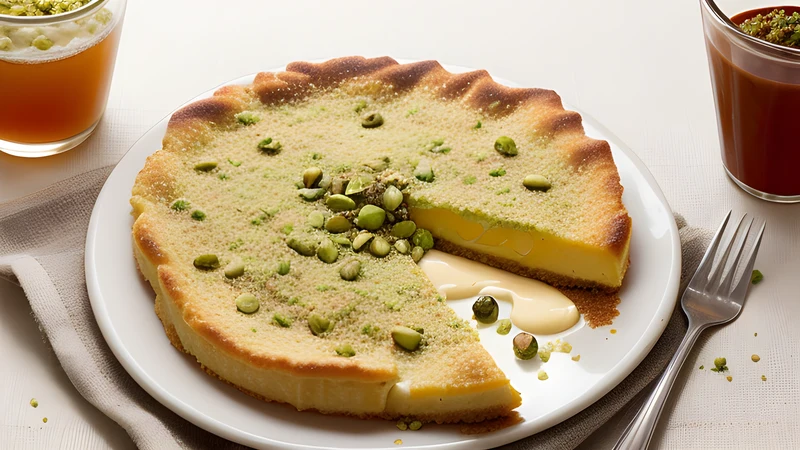
- Off the heat, immediately pour over about two-thirds of the cold syrup, starting at the edges. Scatter thickly with chopped pistachios and serve at once, cut into wedges, while it still stretches.
A dessert that crosses borders and starts arguments
Künefe is claimed with real feeling by several places at once, and the arguments are half the pleasure. Gaziantep, Turkey’s pistachio and baklava capital, considers its künefe the gold standard, built on unsalted local cheese and finished with a thick green drift of Antep fıstığı. Hatay, on the Syrian border, makes a famously good version and treats the dish as a point of civic pride. Across the frontier in the Levant, the same idea appears as knafeh, and Nablus in the West Bank is so bound up with it that Nabulsi knafeh is a category of its own. In 2009 the city cooked a knafeh over seventy metres long to claim a world record, which tells you how seriously the dessert is taken as an emblem of place.
What travels across all these borders is the structure: a fine, crisp, buttery carbohydrate cradling a molten unsalted cheese, drowned in fragrant syrup and eaten hot. What changes is the detail, the type of cheese, whether the top is shredded kadayıf or a fine semolina crumb, how much orange blossom or rosewater scents the syrup, whether the pastry is tinted. Making it at home, you get to choose your allegiance, and once you understand why each choice is made you can build the version you actually like.
Kadayıf, the pastry that looks like shredded wheat
Kadayıf (also spelled kadaif or kataifi) is filo batter piped through a fine comb onto a hot plate, producing long thin strands that look uncannily like shredded wheat. You buy it in nests from Turkish, Greek and Middle Eastern shops, fresh in the chiller or frozen. Thaw frozen kadayıf fully and let it come to room temperature, or it stays clumped and refuses to crisp. Then comes the fiddly, meditative part: pull the strands apart with your fingers and roughly chop them so no piece is longer than a couple of centimetres. Long unbroken strands cook unevenly and are awkward to cut later.
The butter matters more than you would guess. Künefe is generously buttered, and clarified butter or ghee gives the cleanest crunch because the milk solids that would otherwise burn have been removed. If you only have regular butter, melt it gently and spoon the golden liquid off the white sediment at the bottom. Toss the chopped kadayıf with the melted butter using your hands until every strand is coated and glistening. Underbuttered kadayıf bakes pale and dry; properly buttered kadayıf turns a deep, even gold and shatters when you cut it.
The cheese, and the great substitution question
Traditional künefe uses a fresh, unsalted, springy cheese, often called künefelik peyniri, or Antep peyniri soaked to remove salt, or in the Levant a mild white cheese like Nabulsi that has been de-salted. The two things it must do are melt into a smooth stretch and stay unsalted, because the sweetness comes entirely from the syrup and a salty cheese fights it.
Outside Turkey the reliable stand-in is low-moisture unsalted mozzarella. If you can only find salted fresh mozzarella, slice it and soak it in several changes of cold water for a couple of hours to draw the salt out, then pat it very dry, because excess water makes the finished künefe soggy. Some home cooks blend mozzarella with a little unsalted ricotta or a mild fresh cheese for a softer pull. Avoid anything aged or sharp; cheddar, halloumi and feta will not give you the clean stretch this dessert lives or dies on.
Syrup first, and why it must be cold
Make the syrup before anything else, because it needs to be cold when it meets the hot pastry, and that temperature contrast is a real technique rather than a fussy detail. Combine the sugar, water and lemon juice in a pan, bring to a boil, then simmer for about 8 minutes until it thickens very slightly to a loose syrup that coats the back of a spoon. The lemon juice keeps it from crystallising. Stir in the orange blossom water off the heat if you are using it; add it earlier and the perfume cooks away. Then let the syrup cool completely, ideally to fridge-cold.
The rule that traders in Antep repeat is simple: hot künefe, cold syrup, or cold künefe, hot syrup. Pour cold syrup over the sizzling pastry and it soaks in fast while the outside stays crisp. Pour hot syrup over hot pastry and it goes limp and greasy. This single piece of timing is the difference between crisp and soggy, and it is the thing most home versions get wrong.
Building and cooking it
Butter a shallow metal pan or ovenproof skillet, ideally the traditional round copper künefe pan but any 20cm ovenproof frying pan works. Press half the buttered kadayıf firmly into the base in an even layer, pushing it up the sides a little. Spread the grated cheese over it, leaving a small border. Cover with the remaining kadayıf and press down firmly with the back of a spatula so it holds together as a single disc.
Cook it on the hob first over medium-low heat for 8-10 minutes. You are toasting the bottom to a deep gold, so lift an edge with a knife to check the colour. When the base is bronzed and crisp, run the pan under a hot grill or into a very hot oven for a few minutes to set and colour the top, or, if you are brave and the pan is sturdy, invert it onto a plate and slide it back to crisp the second side. The moment both sides are golden and you can see the cheese bubbling at the edges, it is ready.
Take it off the heat and immediately pour over the cold syrup, starting at the edges and working in, using about two-thirds and keeping the rest for the table. It will hiss. Scatter the finely chopped pistachios thickly over the top and serve at once, cut into wedges, with extra syrup for anyone who wants it. The first cut should stretch.
Where it goes wrong, and how to fix it
Soggy künefe usually means hot syrup on hot pastry, too much syrup, or a wet cheese; drain the cheese harder and respect the cold-syrup rule. Pale, dry pastry means too little butter or too gentle a heat, so butter generously and let the base properly colour. A greasy, oily result comes from unclarified butter burning its milk solids, so clarify if you can. Cheese that will not stretch is usually the wrong cheese, aged or salted; the unsalted low-moisture mozzarella route is the dependable fix. And if it firms up before you serve it, there is no rescue but a quick blast of heat, which is why you make this last and eat it first.
Variations and the wider table
In Nablus the version called knafeh is tinted deep orange with a little food colouring and often built with a fine semolina-dough top rather than shredded pastry; it is softer and less crisp. A pistachio-heavy Antep style leans into the nuts. Some cooks add a pinch of ground mastic to the cheese for a faint resinous perfume that is very traditional and very good. You can also make individual künefe in small pans for a dinner party, which solves the serve-immediately problem by letting each person get their own hot portion.
Getting ahead without losing the magic
Because künefe must be eaten hot and fresh, it resists making in advance, though you can do most of the work early. Prepare and butter the kadayıf, grate and drain the cheese, and make the syrup and chill it, all hours ahead. Then the assembly and cooking take only about fifteen minutes when you want to serve. For a dinner party this is the sensible way: clear the savoury plates, build the künefe while the kettle boils for tea, and bring it out at the peak of its stretch. Leftover künefe can be revived the next day with a short blast in a hot oven to re-crisp the pastry and re-melt the cheese, though it never quite recaptures the first-day pull. Store any leftovers loosely covered rather than sealed, so the pastry does not steam itself soft.
Künefe is the natural sweet ending to a Turkish spread. Start the day at the other end of the same table with menemen, the soft eggs with peppers and tomato, and you have bracketed a long lazy weekend of eating from savoury morning to sticky afternoon. If you are drawn to the wider world of syrup-soaked, nut-strewn pastries, the baked doughs of Central Asia scratch a related itch; the tandoor-baked samsa shows how far the shared pastry logic of the old Silk Road stretches, even when the filling turns savoury.
Make it once and the technique clicks. After that, künefe becomes a fifteen-minute showpiece: butter, press, sizzle, syrup, pistachio, pull.
Related Content