Krumkake: Norwegian Cone Wafers
Ten seconds to roll it, or you have made a broken biscuit
Contents
↓ Jump to recipeYou get about ten seconds. That is the whole difficulty of krumkake, and every Norwegian who makes them at Christmas has the fingertips to prove it.
Krumkake: Norwegian Cone Wafers
Ingredients
- 12 green cardamom pods, or 1.5 tsp ready-ground cardamom
- 3 large eggs, at room temperature
- 150 g caster sugar
- 100 g butter, melted and cooled to lukewarm
- 150 ml double cream
- 150 g plain flour
- 30 g potato flour (potetmel)
- 0.25 tsp fine sea salt
- Butter or neutral oil, for greasing the iron
Method
- Toast the cardamom pods in a dry frying pan over medium heat for 60 seconds, shaking constantly, until they smell sharply floral. Cool, split the pods, discard the husks, and grind the black seeds to a powder in a mortar. You should have about 1.5 tsp.
- Whisk the eggs and sugar together for 3 minutes, until pale, thickened and roughly doubled in volume.
- Whisk in the lukewarm melted butter, then the cream. Melted butter that is hot will scramble the eggs; butter that is cold will seize.
- Sift the plain flour, potato flour, ground cardamom and salt over the bowl and fold in with a spatula until just smooth. The batter should be the consistency of double cream.
- Rest the batter, covered, at room temperature for 30 minutes.
- Heat the krumkake iron over medium heat, or plug in an electric one and let it come to temperature — about 200°C. Grease it lightly the first time only.
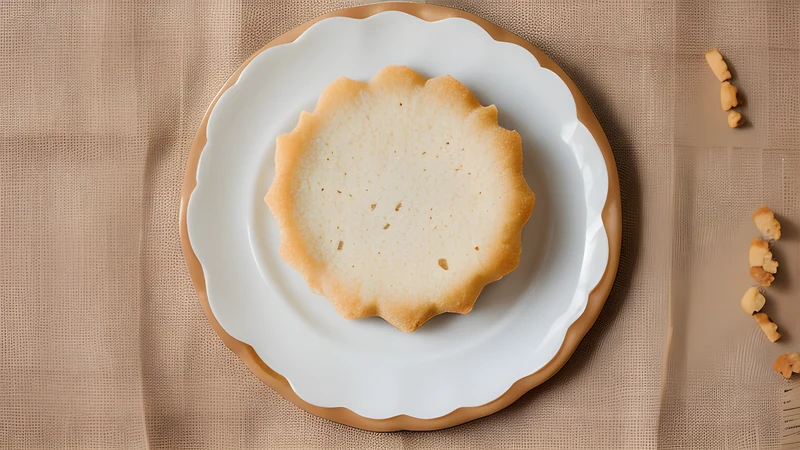
- Drop 1 tablespoon of batter onto the centre of the lower plate, close the iron, and press firmly. Cook for 30 seconds, turn the iron over if using a hob model, and cook 30 seconds more, until the wafer is pale gold with darker patches at the pattern's high points.
- Open the iron and lift the wafer out with a palette knife. Working immediately, wrap it around the cone form, seam side down, and hold for 5 seconds.
- Slide the cone off and stand it upright to cool completely, about 2 minutes. Repeat with the remaining batter.
- Store in an airtight tin, cones nested, for up to 2 weeks. Fill with whipped cream or cloudberry cream at the moment of serving, never before.
The iron came from the church
Krumkake means, straightforwardly, “curved cake”, and it belongs to one of the oldest continuous traditions in European baking: the engraved wafer iron.
The ancestor is the oblat iron — the tool for pressing communion wafers, in use across medieval Europe, two hinged iron plates engraved with crosses, monograms and scenes from the Passion, heated in the fire. Making the host was skilled work, and the irons were beautiful objects. What happened next is the sort of thing that happens repeatedly in food history: the technology escaped the church. By the late Middle Ages secular wafer irons were being engraved with coats of arms, family monograms, hunting scenes and wedding dates, and the batter had picked up sugar, butter and eggs.
Every country with an iron ended up with a wafer. Italy has pizzelle and ferratelle, engraved in Abruzzo with patterns that families kept for generations. The Netherlands has kniepertjes, eaten on New Year’s Eve and — crucially — rolled while hot, so that the flat one becomes the curled rolletje. Belgium industrialised the whole idea into the gaufre. Germany has Waffeln. Iceland, Sweden and Norway all got there.
Norway’s contribution was to roll it into a cone and put cardamom in it, and to make the iron a dowry item. Old Norwegian krumkakejern carry initials and dates, and they were made by the local smith to order. The pattern on your krumkake was, quite literally, your family’s.
Seven sorts, and why
Norwegian and Swedish Christmas baking runs on a number: seven. Sju slag — seven kinds of biscuit — is the traditional minimum a household should produce before Christmas, and the count is taken seriously enough that people will list theirs to you. Krumkake is on almost every list. So are sandkaker, serinakaker, goro, fattigmann, berlinerkranser and pepperkaker, in shifting regional combinations.
The number has no documented origin worth trusting, and the effect of it is entirely real: it commits a household to a week of baking every December, and it is why a Norwegian kitchen in the third week of Advent contains four tins, a pile of irons and someone who has stopped being polite.
Buying an iron, and living with it
There is no way to make krumkake without a krumkake iron. A waffle iron produces something else entirely — the deep pockets trap batter, the wafer comes out thick, and it will never roll. A pizzelle iron is the one honest substitute, being the same tool with an Italian pattern on it.
Two kinds exist.
Hob irons are two hinged cast-iron or cast-aluminium plates on long handles, used over a gas flame or an electric ring. You cook one side, flip the whole thing over, cook the other. They take practice, because you are managing the temperature yourself, and they make better krumkake than the electric ones once you have the feel: cast iron holds heat, so the plate temperature does not sag when cold batter lands on it. An old Norwegian one turns up on Scandinavian auction sites for the price of a takeaway.
Electric irons are thermostatted, cook both sides at once, and remove most of the skill and some of the quality. If you are making krumkake once a year with children, buy the electric one and do not feel bad.
Seasoning: treat a cast-iron krumkake iron exactly like a pan. Wipe with a thin film of neutral oil, heat it empty for ten minutes, let it cool, repeat three times. Never wash it with detergent. Wipe it out with a dry cloth while warm and put it away. A well-seasoned iron needs greasing once at the start of a batch and then never again, because the butter in the batter maintains it.
The cone form — krumkakepinne — is a tapered wooden cone about 12 cm long. Buy two. You will understand why within four wafers.
Batter: thin, rested, and 20% potato flour
The recipe is close to a rich pancake batter, and two details make it a wafer instead.
Potato flour, 30 g of the 180 g total. Potato starch is nearly pure amylopectin-rich starch with no protein at all, so replacing a sixth of the wheat flour dilutes the gluten and adds starch that gelatinises early and dries hard. The result is a wafer with a glassier, cleaner snap — the difference between biting something that shatters and biting something that yields first. Cornflour will do at a pinch and is slightly less effective.
Thirty minutes’ rest. This lets the flour hydrate fully and lets the gluten that mixing developed relax. Unrested batter spreads unevenly under the iron and gives you a wafer that is thick in the middle and lacy at the edge, which then tears when you roll it.
The butter must be lukewarm when it goes in. Hot butter into whisked egg gives you sweet scrambled egg; cold butter seizes into flecks that never disperse and show up as greasy spots on the finished wafer.
The twist: crack your own cardamom
Ground cardamom in a jar is, after about three months, brown dust that tastes of nothing much. Cardamom’s aroma is carried almost entirely by volatile terpenes — 1,8-cineole and alpha-terpinyl acetate chiefly — and they begin evaporating the moment the seed is broken.
So buy pods. Toast them whole in a dry pan for sixty seconds, until they smell sharply floral and slightly medicinal. Split them, throw away the papery husks, and grind the sticky black seeds in a mortar. Twelve pods gives you roughly a teaspoon and a half.
The toasting matters as much as the freshness. Sixty seconds of dry heat drives the aromatics out of the seed’s oil cells and makes them available; the same pods ground raw give perhaps half the intensity. In a wafer this thin, with this little else going on, cardamom is the entire flavour, and the gap between jar-dust and freshly toasted seed is the gap between a nice biscuit and the thing people remember.
Cardamom’s presence in Norwegian baking is a Hanseatic inheritance, incidentally — the same trade route that put ginger into kjøttkaker and cardamom into every sweet dough from Swedish cinnamon buns to semlor. Northern Europe took delivery of the spice cabinet in the fourteenth century and has been baking with it ever since.
The ten seconds, explained
This is the part worth understanding, because understanding it makes the panic stop.
A krumkake straight off the iron is roughly 30% sugar and it is hot — somewhere around 150°C at the surface. At that temperature the sugar in it is in an amorphous, rubbery state, above its glass transition temperature. Amorphous sugar above its Tg is pliable. It bends. It will wrap around a cone form without a complaint.
As the wafer cools, it passes below the glass transition — for a mixture like this, somewhere in the region of 60 to 70°C — and the amorphous sugar goes rigid and glassy. That is the crispness you want, and it is also the reason a wafer that has sat on the counter for fifteen seconds will crack straight down the middle when you try to bend it.
So: iron open, palette knife under, wafer up, onto the form, wrap, five seconds, off. Ten seconds from iron to cone. There is no technique that extends the window; there is only working faster, and using two cone forms so one is always free while the other holds a cooling cone.
Your fingers will complain. Norwegian grandmothers have famously insensitive fingertips and this is why. Cotton gloves work and feel like cheating.
What goes wrong
Cracks when rolling. Too slow. Nothing else.
Wafer sticks to the iron. Grease it once at the start, and only once. A well-seasoned krumkake iron carries enough fat from the batter after the first two. Persistent sticking on a new iron means it needs seasoning: wipe with oil, heat empty for ten minutes, cool, repeat.
Soft and bendy after cooling. Undercooked, or too much batter. One level tablespoon. If it is oozing out of the sides you have overfilled it and the centre will stay damp.
Pale with no pattern. The iron is not hot enough. It should hiss faintly when the batter lands.
Gone soft in the tin after two days. Sugar is hygroscopic and Nordic Decembers are damp. Airtight tin, and never store krumkake in the same tin as a soft biscuit — the moisture migrates and you lose both. Re-crisp at 120°C for 5 minutes and cool on a rack.
Variations
Vanilla instead of cardamom. Scrape one pod into the egg and sugar. Softer, rounder, and the version most Norwegian children prefer. It also lets a strongly flavoured filling lead.
Goro-adjacent. Add 0.5 tsp of ground caraway alongside the cardamom and a splash of aquavit. This drags krumkake towards goro, its flat, rectangular, more aromatic cousin from the same seven-sorts tin, and it is a good direction for anyone who finds the plain wafer bland.
Bowls rather than cones. Drape the hot wafer over an upturned teacup instead of rolling it. You get a shallow edible bowl, and a scoop of ice cream in one of these with cloudberries on top is a very good pudding that requires no further explanation.
Thinner, darker. Push the cook to 45 seconds a side for a deeper gold. More caramelisation, more bitterness, more snap, and a shorter rolling window. Worth one batch to see where your preference sits.
Filling, and the timing rule
Fill at the table, at the moment of serving. Ten minutes early in the kitchen is already too late. A krumkake filled with whipped cream is at its best for perhaps four minutes before capillary action pulls moisture into the wafer and the snap is gone.
The canonical filling is multekrem — cloudberry cream, which on Christmas Eve is the only correct answer and is the reason many Norwegian households make the two things on the same afternoon. Plain whipped cream with a scrape of vanilla is the everyday version. Some people fill them with nothing at all and eat them like crisps, which is defensible and which is what happens to mine.
Twenty-four cones, a tin, and a plate of rolled lefse beside them. That is Christmas Eve in a Norwegian house, and it is worth the fingertips.
Related Content