Kourabiedes: Greece's Snowdrift of Almond Shortbread
Butter, almonds and an indecent quantity of icing sugar
Contents
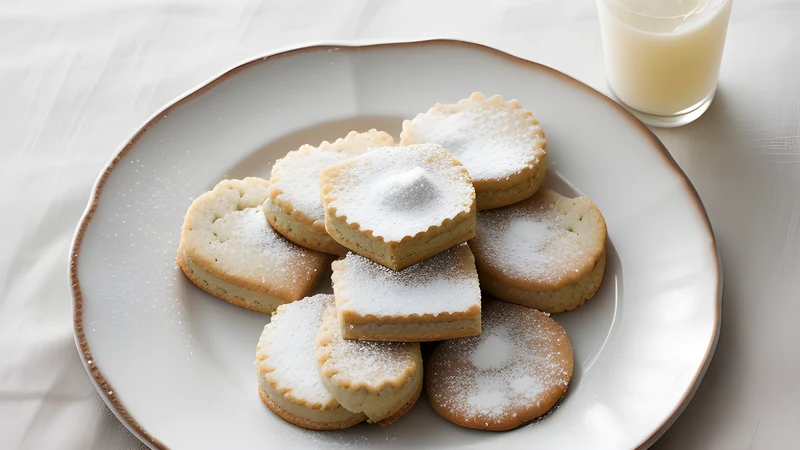
↓ Jump to recipeThere is a moment, about ninety seconds after you bite into a good kourabie, when you realise you have made a tactical error with your clothing. The icing sugar goes everywhere. It is on your jumper, it is on the table, and if anyone in the room is laughing you have inhaled some. Greek bakers know this. They pile the sugar on anyway, several centimetres deep, because a kourabie under a modest dusting is a biscuit that has given up.
These are the almond shortbreads of Greek Christmas and Greek weddings and Greek christenings, and they are one of the few biscuits where the sugar is genuinely part of the structure rather than decoration. The biscuit itself is barely sweet — 80 g of icing sugar across 380 g of flour, which is austere by any standard. The sweetness arrives from outside, in a drift you break through.
Kourabiedes: Greece's Snowdrift of Almond Shortbread
Ingredients
- 250 g unsalted butter, at cool room temperature
- 80 g icing sugar, plus 300 g more for dusting
- 1 egg yolk
- 2 tbsp brandy or Metaxa
- 1 tsp vanilla extract
- 120 g blanched almonds
- 380 g plain flour
- 1/2 tsp baking powder
- 1/4 tsp fine salt
- 3 tbsp rosewater, for misting
- 30 whole cloves (optional)
Method
- Melt 100 g of the butter in a small pan over medium heat and cook for 5-6 minutes until the milk solids turn hazelnut brown and it smells of toffee. Pour into a bowl and chill for 45 minutes until it sets to a soft paste.
- Toast the almonds at 180C for 8 minutes until pale gold and fragrant. Cool completely, then chop to the size of lentils. Do not grind them to dust.
- Beat the remaining 150 g butter with the browned butter and 80 g icing sugar for 6-8 minutes until pale and aerated. Beat in the yolk, brandy and vanilla.
- Sift the flour, baking powder and salt over the top, add the almonds, and fold with a spatula until a soft dough just comes together. Stop the moment there is no dry flour.
- Roll 30 g pieces into balls, flatten slightly into domes, and press a clove into the centre of each if using. Space them 3 cm apart on lined trays.
- Bake at 170C fan for 20-22 minutes. The tops stay pale; the bases should be light gold.
- Rest the biscuits on the tray for 5 minutes. Mist the warm tops with rosewater, then sift a thick layer of icing sugar over them.
- Once cool, bury them completely in the remaining icing sugar in a deep container. Leave at least 4 hours before eating.
Where the biscuit comes from
The name traces back to the Persian qurabiya, a butter-and-flour sweet that spread across the Ottoman world and left a relative in nearly every country it touched: Turkish kurabiye, Azerbaijani qurabiya, Armenian ghurabia. Greece took the form and did two specific things with it. It swapped in almonds, which grow across the Peloponnese and Thessaly in enormous quantity, and it turned the sugar dusting into an event.
Regional variation is real. In Kastoria, in the north, the biscuits are shaped into crescents. On the islands they are more often domes. Some bakers use ouzo instead of brandy, which reads as aniseed on the finish. And then there is the clove — one pressed into each biscuit, traditionally, and the subject of more argument than anything else in the recipe. The story goes that the clove stands in for the gifts of the Magi. The practical story is that it was a marker: cloves were expensive, and a clove in a biscuit meant the household had money for spice. My honest view is that it perfumes the biscuit around it beautifully and is also a genuine hazard for anyone who bites down without thinking. I press them in. I also warn people.
The other thing worth knowing: kourabiedes are almost always made with proper butter, and in Greece that often means goat or sheep butter, which is tangier and whiter than cow butter.
The butter question, answered properly
Everything in a kourabie is butter. There are five ingredients doing real work and one of them is 250 g of fat, so the choice is worth more than a passing sentence.
Greek households making these at Christmas overwhelmingly use voutyro galaktos — often sheep or goat butter, sometimes clarified. Sheep’s milk butter has a different fatty-acid profile from cow’s: markedly higher in short-chain fatty acids like caproic and caprylic, which is exactly why it tastes tangy and slightly barnyard where cow butter tastes creamy and sweet. It is also whiter, because sheep and goats convert beta-carotene to vitamin A more completely than cows do, so none of the yellow pigment reaches the milk. A kourabie made with sheep butter is paler and sharper, and the sharpness is what keeps 300 g of icing sugar from becoming unbearable.
You can buy sheep butter at Greek, Turkish and Middle Eastern grocers, usually in a tin. Use half of it and half regular unsalted cow butter — all of it is genuinely too much for most palates, and the fat behaves slightly differently under creaming. If you cannot get it, the closest approximation is to use a good cultured European butter, which has been fermented with lactic bacteria and carries some of the same tang.
What will not work: baking spread, margarine, or anything described as a “baking block”. These are emulsions with different water contents and melting curves, and they produce a kourabie that spreads flat and tastes of nothing.
The twist: brown half the butter
Here is the change I make, and it is the only one. I brown 100 g of the 250 g of butter before it goes into the dough.
Classic kourabiedes rely entirely on the quality of the butter for flavour, which means a biscuit made with supermarket block butter tastes of very little. Browning drives off water and toasts the milk solids into nutty, caramelised compounds. Cooled back to a paste and creamed with the remaining raw butter, it gives the biscuit a background hum of toffee and hazelnut that sits underneath the almonds and makes them taste more almondy.
The reason I brown only 40 per cent of it: browned butter has lost its water, and water is what turns into steam and lifts a shortbread. Brown all of it and the biscuits come out dense and greasy. Brown some of it and you get the flavour without the structural cost.
Chill the browned butter until it is the consistency of soft cream cheese before you cream it. Warm browned butter will not hold air, and these biscuits need the air.
Method notes that actually matter
Toast the almonds, then chop them coarsely. Raw almonds taste of almost nothing. Eight minutes at 180C changes them completely. Chop by hand to lentil size — a food processor will produce a mix of dust and boulders, and the dust absorbs butter and makes the dough tight.
Cream for longer than feels sensible. Six to eight minutes with an electric whisk. You are looking for a mixture that has gone from yellow to ivory and roughly doubled in volume. This is the only leavening these biscuits get beyond half a teaspoon of baking powder, and undercreamed dough gives you a hard, flat biscuit.
Fold the flour in by hand. The mixer will develop gluten and you will get chew where you want shatter. A spatula, a light hand, and stop as soon as the flour disappears.
Bake pale. Kourabiedes are meant to stay the colour of parchment on top. If they are browning, your oven is running hot — drop it 10 degrees. Judge them by the base, which should be a light gold, and by the smell, which arrives at about eighteen minutes.
Mist with rosewater while warm. This is the trick that makes the sugar cling. A dry biscuit sheds icing sugar; a faintly damp one grabs it and forms a thin, almost meringue-like crust as it cools. A cheap plant mister kept for kitchen duty is ideal. If you do not have one, flick it on with your fingers.
Buy rosewater from a Middle Eastern grocer rather than a supermarket baking aisle. The supermarket version is usually a dilute flavouring with glycerol in it; the grocer’s is distilled and costs about the same for four times the volume. Check the label: it should say rose water and water, and that is all.
The double dusting is deliberate. The first sift goes on while the biscuits are warm and damp, and it partially dissolves into a thin glaze. The second happens hours later, when they are cold, and it stays powdery. That two-layer structure — a set shell with loose snow on top — is what a good kourabie has and a once-dusted one does not.
Weigh the dough. Thirty grams a piece. Kourabiedes bake unevenly if they vary in size, and because you are judging doneness by smell and base colour rather than by top colour, a tray of mixed sizes gives you some raw and some sandy.
What goes wrong
The biscuits spread. Your butter was too warm, or the kitchen is. Chill the shaped domes for 20 minutes before they go in.
They are hard. Overworked dough, or too much flour. Weigh the flour; do not scoop.
They crumble to nothing when you lift them. They need the full five minutes on the tray. Straight out of the oven they have no strength at all. After five minutes they are liftable, after twenty they are sturdy.
They taste of raw flour. Underbaked. Kourabiedes stay pale on top even when fully cooked, which makes them easy to pull early. Twenty minutes is the minimum at 170C fan and the base must be gold.
The sugar goes grey and damp after two days. The biscuits are giving off moisture into the sugar. Sift a fresh layer over the top. This is normal and expected — Greek households top them up all through Christmas week.
Storage and variations
Kept in a sealed tin, buried in their sugar, they hold for three weeks and genuinely improve for the first four or five days as the brandy and rosewater diffuse through the crumb. They freeze well undusted; dust after thawing.
For variations: swap the brandy for ouzo and the rosewater for orange blossom water, and you have a distinctly different biscuit with an aniseed-and-citrus edge. Replace 60 g of the almonds with pistachios for colour and a greener flavour — the same logic behind orange blossom shortbread with pistachios. Add the finely grated zest of one lemon to the creaming stage if you find the plain version too rich.
A version I make in summer: fold the finely grated zest of two oranges and 40 g of chopped candied peel into the dough, swap the brandy for Cointreau, and mist with orange blossom water. It stops being a Christmas biscuit entirely.
If you want a comparison point on what shortbread can be when the sugar is baked in rather than heaped on, petticoat tails make the argument for the other approach. And if you are building a Greek table around these, pistachio baklava is the syrup-soaked counterweight, while avgolemono is what you serve before anyone gets near the sweets.
On the quantity of sugar
I want to defend the 300 g, because every time I make these for people who have not met them, someone asks whether it is a misprint.
It is not. A kourabie’s sweetness is engineered to arrive in two distinct phases. The powder hits first and dissolves almost immediately — icing sugar has an enormous surface area and the crystals are gone within a second or two on the tongue, so you get a fast, clean sweetness that vanishes. Then the biscuit itself arrives, and it is barely sweet at all: buttery, nutty, faintly boozy, with the clove and the rosewater underneath. The sugar is a prologue.
Bake a kourabie with the sugar in the dough instead and you get a fundamentally different and worse biscuit. The sweetness sits there the whole time, the butter and almond have to fight through it, and the texture goes short and sandy rather than shattering, because sugar in shortbread interferes with gluten and tenderises past the point you want here.
So: bury them. A deep container, the biscuits in a single layer, and enough sifted icing sugar that you cannot see them at all. Four hours minimum before anyone eats one, so the shell has time to set.
Make them on a day when you are not wearing black.
Related Content