Kouign-amann: The Butter Cake of Douarnenez
Bread dough laminated with salted butter and sugar, with cardamom in the last turn
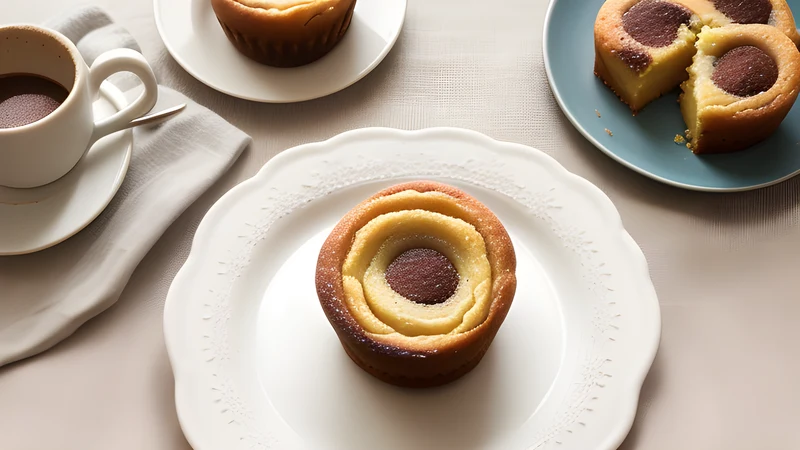
Contents
↓ Jump to recipeThe name is Breton and it’s a shopping list: kouign is cake, amann is butter. Douarnenez, a sardine port on the Bay of Biscay, claims the invention around 1860, and the story is that a baker called Yves-René Scordia was short of flour, long on butter, and folded what he had into what he didn’t. The story is almost certainly tidied up after the fact — Brittany had been folding butter into bread dough for a very long time — but Douarnenez has the plaque and I’m not going to argue with a town that produces this.
What matters is the ratio. 400 g of flour, 300 g of butter, 290 g of sugar. That is a proportion no pastry chef would sign off on and it is precisely the point.
Kouign-amann: The Butter Cake of Douarnenez
Ingredients
- 400 g strong white bread flour
- 250 ml water, at 20C
- 6 g fast-action dried yeast
- 8 g fine salt, for the dough
- 30 g unsalted butter, softened, for the dough
- 300 g salted Breton butter, at 14C, ideally a beurre de baratte with crystals
- 250 g caster sugar, for laminating
- 1.5 tsp green cardamom pods, about 20 pods
- 40 g caster sugar, for the tin
- 20 g salted butter, softened, for the tin
- 0.5 tsp flaky sea salt, to finish
Method
- Mix the flour, water, yeast, 8 g salt and the 30 g softened butter to a shaggy dough. Knead 8 minutes until smooth and slightly slack. Cover and prove 1 hour at room temperature, then refrigerate 1 hour.
- Split the cardamom pods, discard the husks and grind the black seeds to a fine powder in a mortar. Sift the powder into the 250 g of caster sugar and mix well. Set aside.
- Beat the 300 g salted butter between two sheets of baking parchment into a 16 x 16 cm square, 1 cm thick. It must be pliable and cold — 14C, bending without cracking or smearing.
- Roll the chilled dough to a 32 x 16 cm rectangle. Sit the butter square on one half and fold the other half over it. Pinch the three open edges closed.
- Roll the parcel out to 45 x 20 cm, keeping the corners square. Scatter 60 g of the cardamom sugar over the surface. Fold in three like a letter. Wrap and chill 40 minutes.
- Repeat the roll, sugar and letter fold twice more, using 60 g of cardamom sugar each time and chilling 40 minutes between turns. Three turns in total.
- Butter a 12-hole muffin tin heavily and coat each hole with the 40 g of plain caster sugar, tapping out the excess.
- Roll the dough to a 40 x 30 cm rectangle, 8 mm thick. Scatter over the remaining cardamom sugar and press it in with the rolling pin. Cut into twelve 10 cm squares.
- Fold the four corners of each square into the centre and press down firmly. Turn each one over and drop it into a muffin hole, folded side down.
- Prove uncovered for 40 minutes at room temperature — no warmer than 22C, or the butter will run out.
- Bake at 200C fan for 20 minutes, then reduce to 180C fan for 12 to 15 minutes, until the tops are deep brown and the caramel at the edges is bubbling hard and nearly black.
- Sprinkle with flaky salt. Wait 3 minutes, then turn each cake out onto a rack immediately. Leaving them any longer welds them to the tin. Cool 15 minutes before eating.
What it actually is
This confuses people, so: kouign-amann is a laminated bread dough, and every part of that phrase does work.
It’s laminated, like a croissant — butter folded into dough in layers so steam separates them in the oven. But croissant dough is enriched with milk, egg and sugar and behaves like pastry. Kouign-amann dough is bread: flour, water, yeast, salt, and 30 g of butter for suppleness. Nothing else.
That lean, strong, well-developed dough is what makes the thing work. It has enough gluten to be rolled thin around a great deal of butter without tearing, and enough chew that the finished cake has structure under the caramel. A pastry dough at this butter ratio collapses into greasy shards.
Then the sugar. Sugar goes in between the layers, dry, at every turn — it never touches the dough before lamination. In the oven, the layers of butter melt and the sugar dissolves into that butter, and butter and sugar together at 200C is a caramel. The layers fry in it. The base sitting in the tin gets the most of it and turns to a sheet of amber glass.
The cardamom
The twist, and it took me four attempts to place it correctly.
Traditional kouign-amann is butter, sugar and salt, and the flavour is entirely caramel. Caramel at this concentration has a problem: it saturates. The first mouthful is extraordinary, the third is sweet, the fifth is a job.
Cardamom is the fix, and Brittany would object, and Brittany also spent four centuries as a maritime trading region with ships going to and from the spice routes, so I’ll take my chances. Cardamom’s dominant aromatics are eucalyptol and terpinyl acetate, both volatile and both fat-soluble. They dissolve into the melting butter, ride it through the layers, and lift off the warm cake as aroma. What you get is caramel that keeps declaring itself instead of settling into one flat sweet note.
Grind it fresh from pods. Pre-ground cardamom has lost most of its volatiles to the jar and tastes of soap and dust. Twenty green pods, split, husks discarded, seeds crushed to powder in a mortar — 90 seconds of work.
Sift it into the laminating sugar. This is the placement that took the attempts. Worked into the dough, it dilutes into nothing and partly bakes out. In the laminating sugar, it sits in the butter layers where the fat carries it, and it’s exactly where the caramel forms.
Butter: the one ingredient you cannot compromise
Salted Breton butter, ideally beurre de baratte — churned, cultured, with visible salt crystals. It has 82 per cent fat minimum against the 80 per cent of standard British butter, and that 2 per cent is 2 per cent less water going into your layers as steam and dilution.
The salt crystals matter too. They don’t fully dissolve, so you get occasional bright sparks of salt against the caramel. Lescure, Bordier and Le Gall are all sold in British supermarkets now. If you can only find unsalted, use it and add 6 g of fine salt to the laminating sugar.
14C. This is the number the whole recipe turns on. Butter at 14C bends without cracking and holds its shape under a rolling pin. Colder and it shatters into shards that punch through the dough. Warmer and it smears into the flour, the layers merge, and you have brioche.
Take it from the fridge 20 minutes before you beat it out, then beat it between parchment with a rolling pin — beating aligns the fat crystals and makes it pliable in a way that just letting it warm up does not.
Three turns, and no more
Croissants get three turns and produce 27 layers. Kouign-amann gets three turns too, and it should not get more.
The arithmetic is against you. Each letter fold triples the layers: three turns gives 27, four gives 81. At 81 layers with 300 g of butter across 400 g of flour, each butter layer is thinner than a sheet of paper, and it simply merges into the dough during the final roll. You lose the separation entirely.
Fewer, fatter layers is the goal here, which is the opposite of croissant logic. You want visible strata in the finished cake and a chew between them.
Chill 40 minutes between every turn. No exceptions and no shortcuts. Rolling generates friction and friction is heat, and the butter comes off each turn at around 18C. Put it back in the fridge until it’s at 14C again. A warm turn is how the butter escapes, and butter that escapes ends up on the oven floor rather than in the layers.
The folding, and the final prove
The corners-to-centre fold is the traditional shape and it has a purpose beyond looking like a parcel. Folding four corners into the middle stacks the layers vertically at the centre and leaves them exposed at the edges, so the cake rises as a tower and the cut edges bloom open in the heat. Turned over into the tin, the folded side sits on the base and the sealed side faces up, which stops the whole thing unwinding as the butter melts.
Press hard when you fold. A loose fold springs open in the prove and you get a flat disc.
Prove uncovered, 40 minutes, at 22C or below. Every part of that matters. Uncovered lets the surface dry slightly, which helps the top crisp. Forty minutes is enough for the yeast to inflate the layers and not enough for the structure to relax. And 22C is a hard ceiling: butter starts softening meaningfully at 26C, and a dough proved in a warm kitchen leaks its butter into the tin before it ever reaches the oven, where it fries the outside and leaves a dense, greasy middle.
If your kitchen is hot, prove them in the fridge for 90 minutes instead and bake from cold, adding 4 minutes. It’s slower and it’s reliable.
The bake, in two stages
200C for 20 minutes, then 180C for 12 to 15.
The first stage is about steam. The water in the dough and in the butter flashes to vapour and forces the layers apart, and that has to happen fast, before the butter has finished melting and run out. A cool start gives you a leaking, dense cake.
The second stage is about caramel. Sugar needs time above about 160C to caramelise properly, and at 200C the tops would be black before the base had got there. Drop the heat and let the bases work.
Push the colour further than feels sensible. The edges should be bubbling hard and verging on black, and the tops should be deep mahogany. A pale kouign-amann is a failure — the caramel is what you came for, and caramel that stops at golden tastes of sugar rather than of caramel. Trust the smell: when the kitchen smells of toffee rather than of baking, you’re two minutes away.
The tin, and the caramel problem
Butter the muffin tin heavily and coat it in plain sugar. That sugar is what becomes the glass base.
Then get them out. Three minutes after the tin leaves the oven, and then out onto a rack, every one of them. Caramel at 180C is liquid, caramel at 60C is a structural adhesive, and caramel at 20C is a permanent bond between your cake and your tin. If you turn your back for ten minutes you will be chipping them out with a chisel.
Set the tin on a tray. They leak — everything leaks — and burning sugar smokes.
A silicone muffin tray works and gives a slightly paler base. Non-stick metal gives the best colour. Individual paper cases do not work; the caramel dissolves them.
Timing, storage and a warning
Eat them the day they’re made, ideally within two hours, warm. The caramel goes soft and slightly chewy overnight and the layers lose their crispness by morning. Refreshing them at 180C for 4 minutes helps a little and doesn’t restore them.
They freeze well unbaked: shape them in the tin, freeze solid, bag them, and bake from frozen with 6 extra minutes. That’s how to have one on a Sunday without a three-hour Sunday.
The warning is genuine. Molten caramel sticks to skin and keeps burning. Do not touch these for the first three minutes and use a spoon, not fingers, to turn them out. Let them cool 15 minutes before eating — the inside holds heat far longer than the outside suggests.
If lamination is new to you, start with rough puff, which teaches the same butter-temperature discipline with rather less at stake, and forgives a warm turn.
Related Content