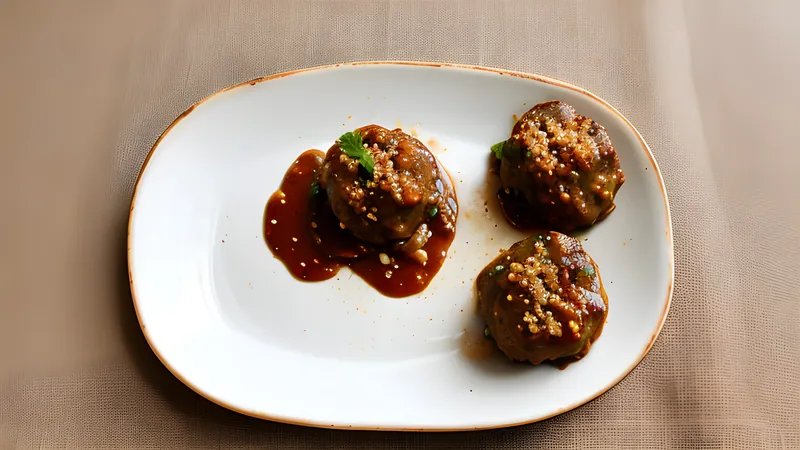
Köttbullar: Swedish Meatballs With Cream Sauce
Small, soft, and browned in butter until the pan is worth deglazing
Contents
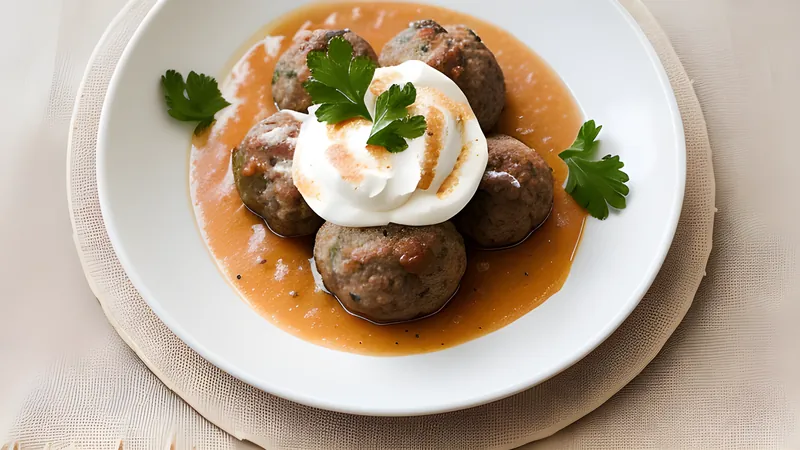
↓ Jump to recipeThere is a version of köttbullar that exists mainly to be eaten from a flat-pack shopping trolley with a wooden fork, and it is fine. It is genuinely fine. What it is not is what a Swedish home cook makes, which is smaller, softer, more heavily spiced and served in a gravy built from the pan the meatballs browned in rather than from a tub.
The twist in mine is browned butter. Sweden cooks these in butter as standard; taking that butter a stage further — foaming, quietening, then turning the colour of a conker and smelling of hazelnuts — gives you a browning fat that puts toasted milk-solid flavour on the outside of every ball, and leaves the pan with a fond so dark that the gravy needs almost nothing else.
Köttbullar: Swedish Meatballs With Cream Sauce
Ingredients
- 70 g white bread, crusts removed, torn into small pieces
- 120 ml whole milk
- 1 medium onion (about 130 g), very finely chopped
- 40 g butter, plus 30 g for frying
- 300 g minced beef (15% fat)
- 200 g minced pork
- 1 egg
- 1 tsp fine salt
- 0.5 tsp ground white pepper
- 0.25 tsp ground allspice
- 0.25 tsp ground nutmeg
- 1 tbsp neutral oil
- 30 g plain flour
- 400 ml beef stock, hot
- 150 ml double cream
- 2 tsp dark soy sauce
- 1 tsp Dijon mustard
- 1 tsp red wine vinegar
Method
- Tear the bread into a bowl, pour over the milk and leave for 10 minutes until it collapses into a paste. Mash it smooth with a fork.
- Melt 40 g butter in a frying pan over medium-low heat. Cook the onion for 10–12 minutes until completely soft and translucent with no colour. Tip onto a plate and cool to room temperature.
- Combine the beef, pork, milk-soaked bread, cooled onion, egg, salt, white pepper, allspice and nutmeg in a bowl. Mix with your hand for 60–90 seconds until the mixture turns slightly sticky and holds together.
- Fry a teaspoon of the mixture in a small pan and taste it. Adjust the salt and spice now.
- Chill the mixture for 30 minutes. With wet hands, roll into balls of about 20 g each — roughly a walnut, or 32 from this quantity.
- Heat 30 g butter and the oil in a wide frying pan over medium heat until the butter foams and the foam subsides. Add the meatballs in two batches, leaving space between them.
- Fry for 8–10 minutes per batch, shaking the pan every couple of minutes so they turn and colour on all sides. They are done at 70°C in the centre. Transfer to a warm plate.
- Pour off all but about 2 tbsp of fat, leaving the browned residue in the pan. Sprinkle in the flour and cook, stirring, for 2 minutes over medium heat until it smells nutty.
- Add the hot stock a ladle at a time, whisking each addition smooth before the next. Scrape the base of the pan as you go.
- Stir in the cream, soy sauce and mustard. Simmer for 5–6 minutes until the sauce coats the back of a spoon.
- Add the vinegar, taste, and adjust the salt. Return the meatballs to the pan and warm through for 3 minutes.
- Serve with mashed potato, lingonberry jam and quick-pickled cucumber.
A dish that came home in a suitcase
The story most Swedes will tell you is that Karl XII brought meatballs back from the Ottoman Empire, and unusually for a national food origin story it is broadly defensible. Karl XII spent five years in exile at Bender, in what is now Moldova, after losing catastrophically at Poltava in 1709. He returned in 1714 with debts, an entourage and a set of Turkish habits, and Swedish culinary historians credit that period with introducing stuffed cabbage, coffee and the small spiced meatball to the Swedish table. The Turkish antecedent is köfte — minced meat, onion, bread, spice, rolled small.
What Sweden did with it was subtract. The chilli went. The parsley and mint went. What stayed was allspice, a spice that arrived in Europe from the Caribbean in the sixteenth century and which Swedish cooking adopted with unusual enthusiasm; it turns up in kalops and in pickled herring with the same insistence. Then came the northern additions: milk-soaked bread, cream, and eventually a gravy owing more to French technique than Ottoman.
The meatball settled into Swedish domestic life properly in the nineteenth century, when Cajsa Warg’s enormously influential cookbook and its successors put it in front of a literate middle class. By the twentieth it was the default Thursday dinner and a fixture on every julbord. The flat-pack version dates from 1985 and has done more for Swedish soft power than any government campaign, which is a slightly uncomfortable thing for Swedish chefs to acknowledge and which they acknowledge anyway.
Finland makes its own, lihapullat, in a browner, less creamy sauce. Norway’s kjøttkaker are flattened patties the size of a digestive biscuit. Denmark’s frikadeller are ovals, pork-led, and fried in a pan with no gravy at all. They are cousins with strong opinions about each other.
The panade, and why the bread is doing the real work
Mince plus egg gives you a firm, bouncy meatball. Mince plus milk-soaked bread gives you a tender one, and the difference is not subtle.
The mechanism is starch. As the bread’s starch granules sit in warm milk and then hit the heat of the pan, they swell and gel, trapping moisture in a structure that does not contract. Meat proteins, meanwhile, do contract — that is what squeezes juice out of an overcooked burger. The gelled starch physically gets in the way of the protein strands linking up tightly, so they cannot squeeze as hard. You end up with a meatball that has lost less water at 70°C than a bread-free one would have lost at 60°C.
Use stale white bread, crusts off, and let it sit in the milk for a full ten minutes. It should collapse when you press it. Breadcrumbs work in a pinch, though they need less milk and give a slightly denser result. Do not use fresh sourdough — the crumb is too open and the sourness reads as a mistake.
The onion has to be cooked and cooled. Raw onion in the mix releases water in the pan, steams the meatball from the inside and leaves crunchy shards. Cooked and warm is worse: it starts denaturing the meat proteins before you have shaped anything, and the mixture goes slack.
The meat, and the case for two of them
Beef and pork in a 3:2 ratio is the Swedish default, and the ratio is doing something specific. Beef brings the iron-and-blood savouriness and the darker browning; pork brings fat that renders at a lower temperature and stays soft when cold, which is why a leftover köttbullar eaten straight from the fridge is pleasant and a leftover all-beef meatball is a pebble.
Fat content is the number that matters more than the split. Aim for something around 18 per cent across the combined mixture: 15% beef and standard shoulder pork gets you there. Supermarket “lean” mince at 5% will produce a meatball that is dry no matter how good your panade is, because there is nothing to melt.
If you have a mincer or a grinder attachment, chuck steak and pork shoulder ground once through a 5 mm plate is a noticeable upgrade — the texture is coarser and each ball has visible structure rather than paste. Pre-minced supermarket meat is ground finer and worked harder, which means you need to mix it less to reach the tacky stage. Watch for it rather than counting seconds.
Browning the butter
Do this in the pan you will fry in, before the meatballs go anywhere near it. Melt 30 g of butter over medium heat. It will foam noisily as its water boils off, then go quiet — that silence is the signal that the water has gone and the milk solids have started to toast. Swirl the pan and watch the flecks at the bottom. They pass from pale gold to hazelnut in about forty-five seconds and to acrid black in another twenty.
Add the oil at the hazelnut stage. It raises the smoke point and stops the toasted solids burning while the meatballs cook, which is the whole trick: you get browned-butter flavour available for ten minutes of frying rather than for ten seconds.
Those toasted milk solids end up in the fond, and from the fond they end up in the gravy. It is one extra minute of attention and it is the difference between a sauce that tastes of cream and a sauce that tastes of the pan.
Rolling and browning
Mix with your hand, not a spoon, and keep going for a minute or so past the point where it looks combined. You are looking for a change in the mixture — it stops being crumbly and starts being tacky, clinging to your palm. That is myosin, the salt-soluble protein that gives a meatball its structure. Ten seconds of mixing gives you meatballs that crumble; ninety gives you meatballs that hold. Three minutes gives you a sausage, which is a real risk with a stand mixer.
Chill for thirty minutes before rolling. Cold fat holds a shape and warm fat smears.
Wet hands, 20 g per ball. Weigh the first three, then trust your eye. Small matters here: a 20 g ball cooks through in the time it takes to brown properly, so browning and doneness arrive at the same moment. A 40 g ball is brown long before its centre is safe, and you spend the last three minutes overcooking the crust.
Two batches, always. A crowded pan drops below the temperature where the Maillard reaction runs at any useful speed, the meatballs release water, and you get grey spheres poaching in their own juice. Space between them, medium heat, and shake the pan rather than turning them individually — you want an uneven, patchy brown across a curved surface, which is what shaking produces and tongs do not.
The sauce
Everything good in the gravy is stuck to the pan. Pour off the excess fat and keep the fond.
The flour goes in dry, into the retained fat, and cooks for a full two minutes — long enough to lose the raw flour taste and start smelling like biscuits. Then the stock, hot, a ladle at a time, whisked smooth before the next goes in. Cold stock into a hot roux is the classic route to lumps, because the flour gelatinises in clumps before you can disperse it.
Soy sauce is the ingredient people query. It is standard in Swedish home kitchens and has been for decades, and it does two things: colour, and a glutamate savouriness that beef stock from a cube badly wants. Use dark soy, two teaspoons, and nobody will identify it. Mustard sharpens. The teaspoon of vinegar at the end is the one that makes the sauce taste finished rather than merely rich — cream flattens the palate, and acid lifts it back.
Where it goes wrong
They fall apart in the pan. Under-mixed, or the panade was too wet. Chill harder and mix longer.
They are dense and rubbery. Over-mixed, over-egged, or the mince was too lean. 15% fat beef is the floor.
The gravy is grainy. The cream boiled hard. Simmer only.
The gravy is bland. Not enough fond, usually because the meatballs were crowded and never browned. There is no way to add that flavour back later.
The full plate
Mashed potato, loose and buttery. Lingonberry jam, which needs to be the raw-stirred kind — see lingonsylt — because cooked jam is too sweet against the cream. Quick-pickled cucumber: slice a cucumber wafer-thin, toss with 100 ml white vinegar, 50 g sugar, 50 ml water and a good pinch of salt, and leave for an hour.
Some Swedish households serve boiled potatoes instead of mash, and a few insist on both. On a full smörgåsbord alongside gravlax, the meatballs go out at room temperature and taste better for it.
Storage and make-ahead
The rolled raw meatballs keep 24 hours in the fridge and freeze beautifully — open-freeze on a tray, bag them, and fry from frozen with an extra 4 minutes and a lid for the last 3.
Cooked meatballs in gravy reheat well for 3 days, gently, with a splash of milk to loosen. The gravy thickens overnight as the starch retrogrades; this is normal and reverses with heat.
Cold leftover meatballs on buttered rye with a smear of mustard is a legitimate Swedish lunch, and possibly the best thing you will do with them.
Related Content