Königsberger Klopse: Veal Dumplings in Caper Cream
A dish from a city that no longer exists, still on the table every week
Contents
↓ Jump to recipeThere is an anchovy in this dish and nobody in Germany talks about it. Ask a German who grew up eating Königsberger Klopse what makes them taste the way they do and you will hear about the capers, which is fair, and the lemon, which is fair. The anchovies mashed into the veal are the reason the meat itself has a savoury depth that plain minced veal could never manage, and they are so thoroughly cooked into the background that most people eating them have no idea they are there.
That is what an anchovy is for. Four fillets in 600 g of meat will not taste of fish. They will taste of more.
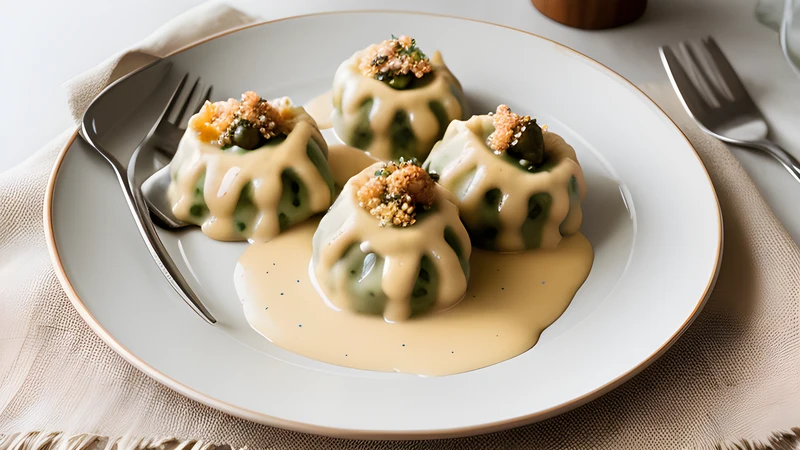
Königsberger Klopse: Veal Dumplings in Caper Cream
Ingredients
- 2 stale white bread rolls (about 120 g)
- 150 ml whole milk, warm
- 1 tbsp butter, for the onion
- 1 onion (about 150 g), very finely chopped
- 500 g minced veal
- 100 g minced pork (about 20% fat)
- 4 anchovy fillets in oil, mashed to a paste
- 1 egg
- 1 tsp fine salt, for the klopse
- 1/2 tsp ground white pepper
- 1/4 tsp freshly grated nutmeg
- 1 litre light veal or chicken stock
- 2 bay leaves
- 6 allspice berries
- 1 tsp black peppercorns
- 1 small onion, halved, for the poaching stock
- 40 g butter, for the sauce
- 40 g plain flour
- 100 ml double cream
- 2 egg yolks
- 60 g capers in brine, drained, plus 2 tbsp of the brine
- 2 tbsp lemon juice
- 1/2 tsp caster sugar
- 2 tbsp chopped flat-leaf parsley, to finish
Method
- Tear the rolls into a bowl, pour over the warm milk and leave 10 minutes. Squeeze out the excess milk, keeping the bread.
- Melt 1 tbsp butter in a small pan and cook the chopped onion over medium-low heat for 8 minutes until soft and still pale. Cool completely.
- Combine the soaked bread, cooled onion, minced veal, minced pork, anchovy paste, egg, 1 tsp salt, white pepper and nutmeg in a bowl. Mix hard with your hand for 2 minutes until sticky and homogeneous. Chill 20 minutes.
- Bring the stock, bay, allspice, peppercorns and halved onion to a simmer in a wide pan and hold at 85C (trembling, not bubbling).
- Fry a teaspoon of the mixture and taste it. Adjust salt now.
- With wet hands, roll the mixture into 16 balls about 45 g each. Lower them into the stock in two batches and poach 12-14 minutes, until they float and are firm to a gentle press. Lift out with a slotted spoon.
- Strain the poaching stock and measure out 600 ml.
- Melt 40 g butter in a clean pan over medium heat, whisk in the flour and cook 2 minutes without letting it colour. Whisk in the 600 ml hot stock a ladle at a time, keeping it smooth. Simmer 8 minutes, whisking, until it thickly coats a spoon.
- Whisk the cream and egg yolks together in a small bowl. Whisk in a ladle of the hot sauce, then pour the mixture back into the pan off the heat, whisking constantly. Do not let it boil again.
- Stir in the capers, the caper brine, the lemon juice and the sugar. Taste: it should be sharp and salty with the cream behind it. Adjust.
- Return the klopse to the sauce and warm through over low heat for 4 minutes. Scatter with parsley and serve.
A recipe with no home
Königsberg was the capital of East Prussia, the city of Immanuel Kant, who is buried there and who never in his life travelled more than a hundred miles from it. It was destroyed by bombing in 1944 and ground warfare in 1945, its German population expelled or dead, and in 1946 it was renamed Kaliningrad and repopulated with Soviet citizens. The city that gave this dish its name has not existed for eighty years.
The dish went west with the refugees. Something like twelve million Germans were displaced from the eastern territories between 1944 and 1950, and they arrived in a wrecked country carrying almost nothing — and their recipes. Königsberger Klopse became a staple of West German home cooking in the 1950s and 60s, and then, in a further twist, an icon of East German canteen food, where it was rebranded Kochklopse because the GDR was uncomfortable with the name of a city it had ceded.
So a dish named for a vanished Prussian capital ended up on both sides of the Iron Curtain, under two names, cooked by people whose grandparents had walked out of the place. It is on German restaurant menus today more reliably than almost any other regional dish, and hardly anyone who orders it could point to Königsberg on a map.
The same displacement runs through Rindsrouladen, whose Silesian version travelled the same roads at the same time. A surprising amount of what reads as generically German cooking is eastern cooking that moved.
What the name actually means
Klops is a Baltic word, and it is one of the few pieces of evidence about the dish’s age that does not depend on somebody’s grandmother. It appears in Low German, in Swedish as kalops, in Latvian and Lithuanian, and it seems to descend from a Germanic root meaning to beat or pound — the same family as English “clap”. A klops is a beaten thing, which is exactly what a meat mixture worked hard by hand is.
That word travelled the Baltic on the same ships as the capers. Swedish kalops is now a beef stew with allspice in it rather than a dumpling, and the two dishes have drifted a long way apart, but the name is the same name and the allspice in the poaching stock here is the same allspice. Hanseatic trade routes left vocabulary and spice cupboards behind wherever they touched, and the Baltic still cooks like a single region if you squint.
The first printed Königsberger Klopse recipes appear in the nineteenth century, in the German cookbooks aimed at bourgeois households that were codifying regional cooking for the first time. By then the dish was already old enough to be described without explanation, which is usually the sign that a recipe has been around for a century or more.
Why capers, in Prussia
This is the question that should bother you. Königsberg is on the Baltic. Capers grow on rocky Mediterranean hillsides. What are they doing in an East Prussian dumpling?
Trade, and money. Königsberg was a Hanseatic port and one of the busiest on the Baltic — grain, timber and amber went out, and everything else came in. Preserved Mediterranean goods travelled well and arrived cheaply enough by the eighteenth century that a bourgeois Königsberg kitchen could treat capers and anchovies as pantry items rather than luxuries. The same trade explains the lemon.
The dish is a merchant city’s dish, in other words: local veal, local dairy, and a sharp Mediterranean note that only exists because ships came in. Compare it to the interior of Germany, where the sour note in a braise comes from vinegar or a jar of pickles because that is what was there, and the geography reads straight off the plate.
Veal, pork, and why both
Pure veal makes a pale, delicate, slightly dry dumpling. Veal is very lean, and 600 g of it poached for twelve minutes with nothing to help gives you something with the texture of a rubber. The 100 g of fatty pork is insurance: it renders into the dumpling and keeps it succulent, and at that ratio it does not read as pork.
If veal is a problem — and it is a legitimate one for many people, depending on how it was raised — the standard German substitution is minced turkey with the same 100 g of pork, which is genuinely close, or a 50/50 veal and pork mix, which is what a lot of German butchers sell as Hackfleisch gemischt and what most home cooks actually use.
The soaked bread is a panade, and people who mistake it for filler reduce it and wreck the texture: the starch and the milk proteins get between the meat proteins and physically stop them contracting into a tight, bouncy mass when heated. Take the bread out and your klopse will be springy and tough. Meatballs across Europe use this and the ones that skip it are worse for it, whether they are Danish frikadeller or Swedish köttbullar.
Chill the mixture for twenty minutes before rolling. Cold fat rolls cleanly and holds its shape in the poaching liquid; warm fat smears and the balls slump.
The poach, and the sauce
Eighty-five degrees. Trembling water, no bubbles breaking the surface. This is the whole difference between a good klops and a bad one. A rolling boil will batter them apart and drive the fat out, and the sauce will be greasy and the dumplings will be dry — both failures from the same cause.
Poach in stock, never in water. The stock flavours the klopse, and more importantly the klopse flavour the stock, and that stock is what the sauce is made of. This is a closed loop: everything the dumplings give up during poaching comes back to them in the sauce. Poaching in water and making the sauce from a cube produces a competent dish with a hole in the middle of it.
The sauce is a velouté — a blond roux let down with stock — finished with a liaison of egg yolk and cream. Two rules:
Cook the roux for a full two minutes without colouring it. Uncooked flour tastes raw and pasty, and no amount of simmering later removes it.
Never boil the sauce after the yolks go in. Egg yolk proteins set around 65-70C. Temper them first with a ladle of hot sauce, add them off the heat, and hold the pan below a simmer. Boil it and you will have a pan of white sauce with scrambled egg in it, and the only fix is a sieve and a lowered expectation.
The seasoning is the dish
Königsberger Klopse should be aggressively sharp. This is a dish about acid and salt sitting on top of cream, and the commonest failure — in restaurants as much as at home — is a timid, floury white sauce with a few capers rattling around in it.
Sixty grams of capers for four people looks like a lot. It is correct. Use the brine too, two tablespoons of it, because that is concentrated caper flavour in a liquid you can dose. Then lemon on top of that, and the half-teaspoon of sugar to keep the acid from becoming shrill.
Taste at the end and be brave. If it makes you blink slightly, it is right. The potatoes will absorb a great deal of that sharpness and the plate will balance.
What goes wrong
The klopse fall apart in the stock. The mixture was underworked. Two full minutes of hard mixing with your hand develops the myosin in the meat into a sticky matrix that holds everything together; a gentle fold with a spoon does not. If the mixture does not tack to your palm when you press it, keep going.
They are bouncy and tough. Too much mixing, no bread, or the water boiled. All three drive the same failure from different directions.
The sauce is lumpy. The stock went in cold, or too fast. Hot stock into a hot roux, a ladle at a time, whisking between each — the first ladle should look like a thick paste before the second goes in.
The sauce tastes of flour. The roux was not cooked. Two minutes, medium heat, and it should smell faintly of biscuits before any liquid touches it.
The sauce is grey and dull. The roux browned. Königsberger Klopse should be white — this is one of the few sauces in German cooking where colour is a fault. Keep the heat moderate and stop the moment the roux stops smelling raw.
It tastes bland despite the capers. The stock was weak. There is nothing else in this dish to carry it.
Serving, storage and variations
Boiled potatoes, always — plain, floury, split with a fork so they drink the sauce. Beetroot is the traditional East Prussian partner and the earthy sweetness against the caper sharpness is very good indeed; roasted beetroot with horseradish crème fraîche pushes the same idea further than tradition would. Some households serve rice, which the GDR canteens standardised and which is a step down.
Klopse keep 3 days in their sauce. Reheat gently and never boil, for the same egg-yolk reason. They freeze poorly once sauced — the liaison breaks on defrosting — so freeze the poached dumplings and their strained stock separately, for 3 months, and make the sauce fresh.
For a more assertive version, add a tablespoon of Dijon with the capers. For the older, plainer variant, skip the egg yolks entirely and finish with cream alone; it is more robust and less silky. And if you want to know what the anchovies do, make half the batch without them and taste both. That comparison is worth the trouble once.
Related Content