Knäckebröd: Rye Crispbread From Scratch
A hole in the middle, a rolling pin with spikes, and a bread that keeps for a year
Contents
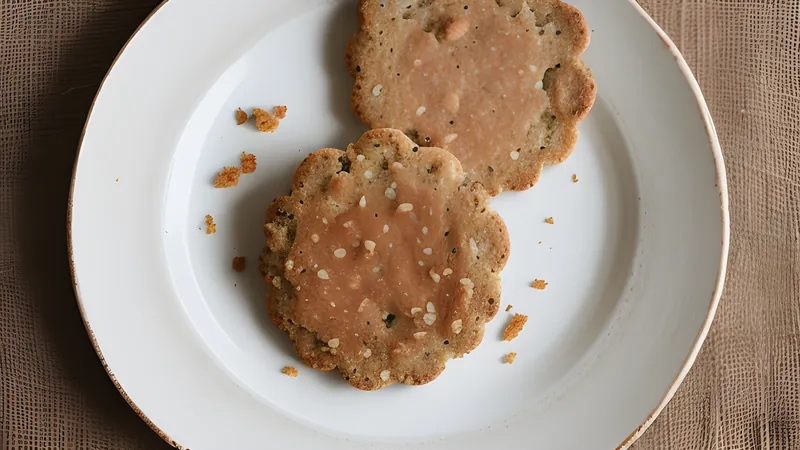
↓ Jump to recipeKnäckebröd is the oldest thing in Swedish cooking still eaten daily. Archaeological and documentary evidence puts flat, dried rye bread in Sweden by around 500 CE, and it was baked more or less unchanged for the next thousand years: a household would fire up the oven twice a year, bake several hundred rounds in two exhausting days, thread them onto a pole through the hole in the middle, and hang the pole in the rafters above the stove. The bread kept until the next baking. That is the whole design, and every feature of it — the thinness, the hole, the docking, the rye — exists to serve it.
Sweden still eats it in volume. It is on every breakfast table, in every canteen, and beside every bowl of soup. Wasa alone produces something in the region of a quarter of a million tonnes of the stuff a year. What almost nobody does is make it, which is a shame, because a fresh knäckebröd is a different food from the packet — nutty, faintly sweet, with a snap that shatters rather than crumbles.
Knäckebröd: Rye Crispbread From Scratch
Ingredients
- 250 g wholegrain rye flour, plus more for rolling
- 150 g strong white bread flour
- 1 tsp fine sea salt
- 1 tbsp caraway seeds, lightly crushed
- 7 g instant dried yeast
- 1 tsp runny honey
- 280 ml water, warmed to 37°C
- 2 tbsp cold-pressed rapeseed oil
- 1 tsp flaky sea salt, for finishing
Method
- Whisk the rye flour, white flour, fine salt, caraway and yeast together in a large bowl.
- Stir the honey into the warm water until dissolved. Pour into the flour with the oil and mix to a soft, slightly tacky dough.
- Knead on a lightly floured surface for 6 minutes. Rye develops little gluten, so the dough will stay dense and slightly claggy rather than becoming springy. Stop when it is uniform.
- Cover and prove at room temperature for 45 minutes. It will rise only modestly — about a third.
- Heat the oven to 240°C with a baking stone or heavy upturned tray on the middle shelf.
- Divide the dough into 8 pieces of about 85 g. Keep the ones you are not using covered.
- Dust the surface generously with rye flour. Roll one piece to a 20 cm round, as thin as you can manage — 2 mm, thin enough to see the counter through in places.
- Dock the round all over with a knäckebröd rolling pin, a fork, or a docking roller, at roughly 1 cm intervals. Cut a 3 cm hole in the centre with a small glass or apple corer.
- Sprinkle lightly with flaky salt and press it in with the rolling pin.
- Slide onto the hot stone using a floured peel or the back of a tray. Bake for 5–6 minutes until the round is dry, blistered and lightly browned at the edges.
- Transfer to a wire rack. It will crisp fully as it cools, within 3 minutes. Repeat with the remaining pieces.
- If any round is still flexible once cool, return all of them to a 120°C oven for 10 minutes to dry out completely.
- Cool completely before storing in an airtight tin.
The hole is structural
The hole in the middle of a knäckebröd is the most misunderstood detail in Nordic baking. It has always been a piece of engineering.
Before airtight storage, dried bread had one enemy: humidity. A stack of crispbread in a Swedish farmhouse in November would draw moisture out of the air, go leathery, and then go mouldy. The solution was to keep the rounds separated and off any surface, hanging on a pole — brödstång — slung between the roof beams above the fireplace, in the warmest and driest air in the house, with room around every round for air to move. The hole is the hanging point.
That gives you the rest of the logic. The bread had to be thin, because thin dries completely and thick retains a moist core that spoils. It had to be rye, because rye was what grew reliably in Swedish soil at Swedish latitudes and because rye’s pentosans hold the dough together without gluten. And it had to be baked twice a year, because firing a masonry oven was a major undertaking involving a day of wood and a day of heat, so you did it rarely and made it count.
The two baking days were traditionally after the autumn harvest and around Lady Day in spring, and they were communal — a village oven, a queue of households, a great deal of work in a very hot room. The result kept for six months on a pole and was still perfectly good. Bread that lasts a year is a considerable technology.
Why rye, and how it behaves
Rye flour is a genuinely different material from wheat and it will not behave like wheat, no matter what you do to it.
Rye contains gliadin and glutenin, the two proteins that form gluten, but it also contains a high proportion of pentosans — branched arabinoxylan chains that absorb up to ten times their weight in water and that physically obstruct the proteins from linking into a network. So a rye dough never becomes elastic. You cannot windowpane it, you will not get oven spring from it, and kneading it for twenty minutes achieves nothing except tired arms.
This is a problem for a loaf and an advantage for a crispbread. What you want here is a dough that rolls thin without springing back, holds its shape, and dries into a rigid plate. The absence of gluten gives you all three. The 150 g of white bread flour in this recipe is a small concession — it makes the dough manageable enough to roll and lift without tearing, and it does not make it springy. Go to 100% rye and the rounds are more authentic, more fragile and considerably harder to get onto a stone in one piece.
The pentosans also explain the sticky, claggy feel of rye dough. That clagginess is water bound up in a gel, and it will stay that way however long you work it. Flour the surface generously and stop worrying about it.
Wholegrain rye is essential. Light rye has had the bran and germ sieved out, and with them most of the flavour and all of the character. The nutty, faintly bitter, mineral note of a real knäckebröd comes from the bran, which is also why the same flour drives Danish rugbrød and Finnish sour rye rounds.
Docking, and the physics of a blister
Those hundreds of small holes across the surface are doing a job.
When a thin sheet of wet dough hits a 240°C stone, the water in it flashes to steam almost instantly. In an undocked round, that steam has nowhere to go, so it collects under the setting surface and inflates the sheet into a balloon — the same mechanism that puffs a pitta, which is desirable there and a disaster here. A puffed knäckebröd has a hollow interior with two thin walls, it bakes unevenly, and it collapses into fragments the moment it cools.
Docking punctures the sheet at close intervals so steam vents continuously instead of accumulating. The result is a flat, evenly dried plate with a fine blistered surface — small local puffs between the dock marks, which is exactly the texture you want.
The traditional tool is a kruskavel, a rolling pin with a spiked wooden or metal surface, and if you find one in a Swedish flea market buy it. A fork works completely well; dock at roughly 1 cm intervals, going right through to the surface below. A pastry docker from a baking shop is faster. Whatever you use, be thorough — one unpunctured patch will balloon and take the round with it.
Thin, hot, fast
Two millimetres, 240°C, five to six minutes. All three numbers are load-bearing.
Thinness is the whole dish. Roll until the round is translucent in patches when you lift it toward the light. A knäckebröd at 4 mm will be a hard biscuit; at 2 mm it shatters cleanly under a thumb. Rye’s lack of elasticity is your ally here — it rolls out and stays put.
The heat is what dries the sheet before it browns. A cooler oven takes longer, which gives the surface sugars time to caramelise while the interior is still setting, and you get a round that is dark and slightly bitter and still bendy in the middle. A hot stone drives the water out fast. Preheat it for a full 30 minutes; a stone that has been in for ten is not up to temperature no matter what the oven says.
The crisping happens off the heat. A round comes out of the oven flexible and firms up on the rack within three minutes as the residual moisture flashes off and the starch sets. Judge doneness by dryness and blister rather than by feel in the oven. If a cooled round still bends, the whole batch needs ten minutes at 120°C to finish.
Caraway, and other seeds
A tablespoon of lightly crushed caraway is the standard Swedish seasoning and I would not omit it. Caraway’s carvone is a strong, slightly medicinal aromatic that most people meet in rye bread and nowhere else, and the association runs deep enough that a rye crispbread without it tastes incomplete.
Crush the seeds lightly — a few pulses in a mortar, enough to fracture them. Whole seeds keep their oils locked in and you taste them only when you bite one directly.
Fennel seed is the common alternative and gives a sweeter, aniseed-leaning bread. A mix of the two is traditional in parts of Norrland. Sesame, poppy or sunflower seeds pressed into the surface before baking are all good and all modern. For a plainer bread built on the same principles, seeded rye crackers go further in that direction.
Where it goes wrong
It ballooned. Under-docked. Prick more thoroughly and closer together, and make sure the fork goes all the way through — a dimple in the surface is not a hole. A round that has already puffed can be pressed flat with a palette knife in the oven and will usually still bake out.
It bent instead of snapping. Residual moisture. Ten minutes at 120°C, all eight rounds together, then cool on a rack with air underneath. This is fixable at any point, even weeks later.
It is dark and bitter. Too long at too low a heat. The bran in wholegrain rye carries compounds that turn acrid well before the round is dry, so the oven has to be hot enough to finish the job before that happens.
It tore during rolling. Too dry. Rye’s pentosans keep absorbing water for the first twenty minutes, so a dough that felt right at mixing can be stiff by the time you roll. Work in a tablespoon of water and give it five minutes.
It stuck to the peel. Not enough rye flour underneath. Be generous — the excess burns off on the stone and adds a pleasant toasted note.
Storage, and what to put on it
Cool completely — genuinely completely, an hour on a rack — before the tin goes on. Any residual warmth means residual moisture, and a sealed tin will redistribute it through the whole batch overnight and give you eight soft rounds.
Stored properly, knäckebröd keeps for months. It has almost no free water and almost no fat, which leaves nothing for microbes to work with and nothing to go rancid. If it softens, ten minutes at 120°C resets it entirely, and you can do that indefinitely.
The classic load is cold butter, sliced hard cheese and a grind of pepper. Beyond that: pickled herring with soured cream and red onion, a slab of gravlax with mustard sauce, or simply butter and a hard-boiled egg. It goes beside pea soup on a Thursday as a matter of national routine.
The case against
This is an eight-round bake that occupies an oven at 240°C for the better part of an hour, one round at a time, and the product is available in every supermarket in Europe for two pounds. The economics are terrible and I am not going to pretend otherwise.
It is also fiddly in a specific way: rolling a 20 cm round to 2 mm and then transferring it to a hot stone without folding it over on itself takes practice, and the first two will probably be casualties. Rolling directly onto a square of baking parchment and sliding the whole thing onto the stone removes the problem entirely, at the cost of a slightly less blistered underside. Do that for the first batch and graduate to the peel when you are confident.
What you get for the trouble is a bread that tastes of rye rather than of packaging, with a snap the industrial version has never quite matched, and a stack that will still be good in March.
Related Content