Kibinai: The Karaim Pastry of Trakai
Crimped half-moon pastries of a tiny community that has fed a Lithuanian lakeside town for six centuries
Contents
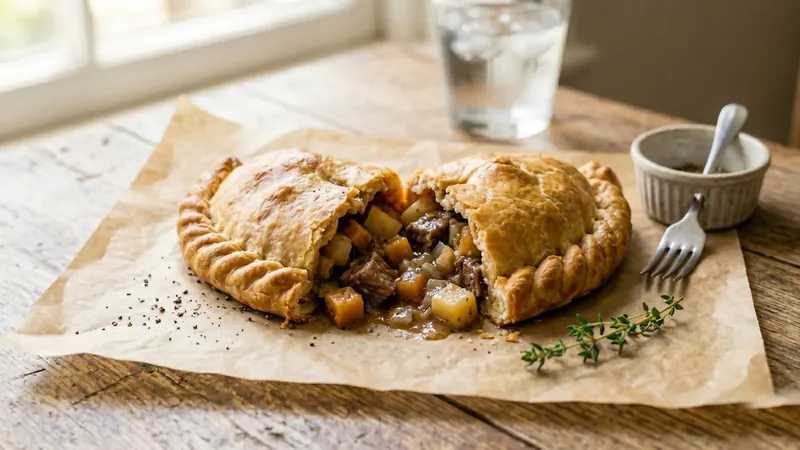
↓ Jump to recipeIn the Lithuanian lakeside town of Trakai, half an hour west of Vilnius, there is a street that smells permanently of baking lamb and onion. The pastries responsible are kibinai — plump, crimped half-moons with a tender soured-cream crust and a filling so juicy it steams when you bite in. They belong to one of Europe’s smallest and most remarkable communities, and they are one of my favourite things to make when I want a hand pie with real history behind it.
One point of housekeeping before we start: the singular is kibinas and the plural kibinai, so you order one kibinas and eat five kibinai. Nobody in Trakai stops at one.
Kibinai: The Karaim Pastry of Trakai
Ingredients
- 400g plain flour, plus extra for dusting
- 120g cold unsalted butter, diced
- 150g soured cream
- 1 egg yolk (save the white for sealing), plus 1 whole egg for glazing
- ½ tsp fine salt for the dough
- 1 tsp caster sugar
- 350g lamb shoulder, hand-chopped or coarsely minced (about 15% fat)
- 2 medium onions, very finely diced
- 1 tsp fine salt for the filling
- ¾ tsp ground black pepper
- 1 tbsp cold water or lamb stock, to keep the filling juicy
- 1 tbsp chopped fresh dill or parsley (optional)
Method
- Rub the cold diced butter into the flour, salt and sugar with your fingertips until it resembles coarse breadcrumbs.
- Mix in the soured cream and egg yolk to form a soft dough. Bring it together without kneading, wrap and chill for at least 30 minutes.
- For the filling, combine the chopped lamb, very finely diced onion, salt, pepper and cold water. The onion should roughly equal the meat by volume — it melts down and keeps the filling moist. Chill until needed.
- Preheat the oven to 200°C (fan 180°C). Line two baking trays with baking paper.
- Roll the chilled dough 3mm thick on a floured surface and cut out 12–14cm rounds using a saucer as a guide. Re-roll trimmings once.
- Place a heaped tablespoon of filling on one half of each round, brush the edge with egg white, fold into a half-moon and press the edges together firmly.
- Crimp the sealed edge into a rope pattern by folding small overlapping pleats along the rim, the classic kibinai finish that also locks in the juices.
- Arrange on the trays, brush all over with beaten whole egg, and pierce a small steam hole in the top of each.
- Bake for 28–32 minutes until deep golden and the juices bubble at the seam. Rest for 10 minutes before eating, as the filling is molten hot.
Who the Karaim are, and how their pastry got to Lithuania
Kibinai are Karaim food. The Karaim — also spelled Karaite — are a Turkic-speaking people who follow Karaite Judaism, a tradition that recognises the Hebrew Bible but not the later rabbinic Talmud. Their ancestors came from the Crimean peninsula, and in the late fourteenth century Grand Duke Vytautas of Lithuania brought several hundred Karaim families north to Trakai, most likely as a trusted guard for his castle on the lake. They settled, kept their language and faith, and stayed for more than six centuries.
That is an astonishing act of cultural survival. The Karaim community in Lithuania today numbers only in the low hundreds, and their language is one of the most endangered in Europe. Yet their food has outgrown the community entirely: kibinai are now sold up and down the Trakai lakefront, eaten by every Lithuanian schoolchild on a day trip to the castle, and recognised nationally as a Lithuanian speciality with a protected geographical link to the town.
The town itself does much of the marketing. Trakai’s red-brick island castle, restored in the twentieth century, pulls in coachloads of visitors who walk the causeway, tour the keep, and file out hungry along Karaimų Street, the old Karaim quarter of low wooden houses with their distinctive three windows facing the road — one for God, one for Grand Duke Vytautas, one for the family, so the saying goes. The kibinai bakeries are strung along exactly this street, and buying a hot one to eat by the water is now as much a part of the visit as the castle.
The Karaim also kept a food language of their own. In their dialect the dish is kybyn, and older recipes call for mutton rather than young lamb — an animal that had lived a while, with more flavour and more fat to keep the filling succulent through a long bake. If you can find hogget or mutton, use it and trim it to roughly the same 15% fat; the deeper, slightly gamey note is closer to the pastry the community actually ate. Lamb shoulder is the easy modern stand-in and makes a lovely kibinas, but it is worth knowing the older animal is the authentic one.
You can taste the Turkic origins in the shape and the filling. A meat-and-onion pastry, hand-crimped and baked, is a cousin of the Central Asian baked pies that spread with the Turkic peoples — the same idea that gives us the tandoor-baked Uzbek samsa and the Anatolian börek. What the Karaim did was adapt that inheritance to a northern larder: butter and soured cream instead of tail fat, a wetter oven-friendly dough, and lamb or mutton from the local flocks.
The dough: soured cream is the secret
The kibinai crust is not a rough Central Asian pastry; six centuries in a dairy-rich land turned it into something tender, almost short. The dough is enriched with soured cream and an egg yolk, which do two lovely things. The fat and acid in the soured cream keep the gluten relaxed, so the pastry stays tender rather than tough, and they give the baked crust a faint tang that plays beautifully against the rich lamb.
Treat it like a shortcrust. Rub cold butter into the flour, bring it together with the soured cream and yolk without kneading, then chill it. Over-working develops gluten and gives you a chewy, shrinking crust; a light hand gives you flakiness. The half-hour rest is not optional — it relaxes the dough so it rolls without springing back, and firms the butter so the pastry holds its shape in the oven.
Some Trakai bakeries use a yeasted dough for a softer, bready kibinas, and others go the other way to a properly laminated, flaky version. The soured-cream shortcrust here is the reliable home middle ground: forgiving to roll, sturdy enough to hold a wet filling, and quick because there is no proving to wait for. If your kitchen is warm and the dough turns sticky, chill it again for fifteen minutes rather than flouring it heavily, which would toughen the crust.
The filling, and the point of all that onion
The classic kibinai filling is lamb or mutton and a great deal of onion. The proportion surprises people: you want roughly as much onion, by volume, as meat. This is deliberate. As the pastry bakes, the onion breaks down and releases its liquid, keeping the filling moist and creating that famous juicy interior. Skimp on the onion and the filling bakes dry.
Traditionally the meat is hand-chopped rather than machine-minced, which gives a better texture — small nuggets of lamb rather than a smooth paste. If you have the patience, dice lamb shoulder finely with a sharp knife. If not, coarse mince works; just avoid the very fine stuff. A little cold water or lamb stock stirred through the raw filling gives up extra steam and juice inside the sealed pastry. Season it honestly with salt and plenty of black pepper — this is a simple filling and it needs to be well seasoned to sing.
Keep the filling cold and raw when you assemble; it cooks entirely inside the pastry. Do not pre-cook the lamb or you lose the juices that make the dish. One trick from the bakeries: dice the onion, salt it lightly and leave it ten minutes, then mix it straight into the meat without draining. That short salting starts to soften the onion so it renders more evenly, while the released liquid stays in the filling where you want it.
Shaping and the crimp
Roll the dough about 3mm thick and cut rounds using a saucer as a template. Pile a heaped spoon of filling on one half, brush the rim with egg white to glue it, fold into a half-moon and press firmly to seal. Then comes the part that makes a kibinas look like a kibinas: the crimped rope edge. Fold small overlapping pleats along the sealed rim, each one tucking over the last, to build a twisted rope that runs the length of the curve. It is the same motion as an empanada repulgue or a Cornish pasty crimp, and it does a real job — a well-crimped seam will not leak the precious juices, where a fork-pressed edge often splits.
Do not overfill. A heaped tablespoon feels stingy in the hand, but filling that reaches the rim will push out as it heats and break the seal. Leave a clear centimetre of dough around the edge to fold and crimp cleanly. Glaze the whole pastry with beaten egg for colour and shine, and cut one small steam hole in the top. Without it, steam builds up and blows a seam open.
Baking, and the discipline of waiting
Bake at 200°C until deep golden and you can see juices bubbling at the seam, around half an hour. Then wait. The single most common kibinai mistake is biting in straight from the oven, because the filling is molten and the onion-lamb juice will scald your mouth. Ten minutes of resting lets it settle from lava to lusciously hot, and lets the pastry firm up so it does not collapse when you pick it up.
If the tops are browning faster than the seams are bubbling, drop the oven by 10°C and give them the full time rather than pulling them early — an underbaked kibinas has raw dough where it meets the wet filling. A gentle sheet of steam escaping the vent hole is your signal that the inside has come up to temperature.
Portioning, scaling and dough thickness
The bakeries along Karaimų Street mix dough in the morning, keep the filling cold, and assemble in long batches so a fresh tray leaves the oven every twenty minutes and nothing sits long enough to lose its steam. Borrow that rhythm for a party: make dough and filling ahead, chill both, and bake in two waves so the second tray goes in as the first is eaten. The quantities here make ten pastries, feeding four as a main with a bowl of broth or six as a snack, and the recipe scales cleanly if you keep the filling roughly equal parts onion and meat by volume. One number matters most: dough thickness. Roll to a true 3mm and the pastry bakes through in the same half hour the filling needs; roll it thicker and the base under the wet meat stays pale and doughy while the top browns.
Tips, troubleshooting and variations
The pastry leaked. Either the seal was not firm, the crimp was loose, or you forgot the steam hole. Seal with egg white, crimp properly, and always vent.
The filling came out dry. Not enough onion, or the meat was too lean. Aim for equal onion to meat and around 15% fat in the lamb.
Tough crust. You over-worked the dough or skipped the chill. Handle it as little as possible and keep everything cold.
Fillings beyond lamb. Beef, or a mix of beef and lamb, is common. Chicken versions exist, and there are cheese-and-vegetable and mushroom kibinai for a lighter bite. The Trakai standard, though, is lamb and onion.
Make-ahead. You can assemble the pastries and chill them for a couple of hours before baking, or freeze them raw on a tray then bake from frozen with an extra 5–8 minutes. Baked kibinai reheat well in a moderate oven for ten minutes; avoid the microwave, which softens the crust to a sad flop.
What to drink and serve alongside
Kibinai are usually eaten warm in the hand, often with a bowl of clear meat broth alongside for dipping — the same instinct that pairs a rich parcel with hot soup all across the region, as it does with the lemony Georgian chicken soup chikhirtma. In Trakai the traditional accompaniment is a cup of gira, the lightly fermented Baltic kvass made from rye bread, whose gentle sourness cuts the richness of the lamb. Failing that, a pot of strong black tea does the same honest work.
For a fuller table, set them next to something sharp and vegetable-forward to balance the pastry: a plate of pickles, or a bright grated salad. They also belong in the wider family of Baltic potato-and-dairy comfort cooking, so if you are building a Lithuanian spread they sit happily beside Belarusian potato pancakes with soured cream, which share the same larder of onion, dill and smetana.
Make a batch, carry them out to a table by whatever water you have, and eat food that a few hundred people kept alive for six hundred years.
Related Content