Khao Man Gai: Poached Chicken and Ginger Rice
Thailand's answer to Hainanese chicken, built on its own fermented soybean dipping sauce
Contents
↓ Jump to recipeKhao Man Gai: Poached Chicken and Ginger Rice
Ingredients
- 1 whole chicken, about 1.6kg
- 8 slices fresh ginger, plus 2 tbsp grated for the sauce
- 6 spring onions, whites bruised, greens reserved
- 1 head garlic, halved crosswise, plus 4 cloves minced for the sauce
- 2.5 litres water
- 2 tsp salt
- 400g jasmine rice, rinsed
- 2 tbsp chicken fat, skimmed from the poaching liquid
- 3 tbsp fermented yellow soybean paste (taucheo)
- 2 tbsp light soy sauce
- 3 tbsp white vinegar
- 2 tbsp sugar
- 3 red chillies, finely chopped
- cucumber slices, to serve
- coriander leaves, to serve
- sliced tomato, to serve
Method
- Rub the chicken all over with 1 tsp of the salt. Bring the water to a boil in a large pot with the ginger slices, bruised spring onion whites and halved garlic head.
- Lower the chicken into the pot, breast down. Bring back to a bare simmer, cover, and poach gently for 40 minutes — the water should barely move, never boil.
- Turn off the heat and let the chicken sit in the hot liquid, covered, for 15 minutes to finish cooking through gently.
- Lift the chicken out and plunge briefly into iced water to firm the skin, then pat dry. Reserve the poaching liquid.
- Skim 2 tbsp of the golden fat from the surface of the poaching liquid. Fry the rice in this fat with the minced garlic for the sauce reserved separately, for 2 minutes, until each grain is coated and glossy.
- Cook the rice with 500ml of the strained poaching liquid in a rice cooker or covered pot until tender, about 18 minutes.
- For the dipping sauce, whisk together the taucheo, grated ginger, light soy, vinegar, sugar and chopped chillies. Loosen with a spoonful of the poaching liquid if too thick.
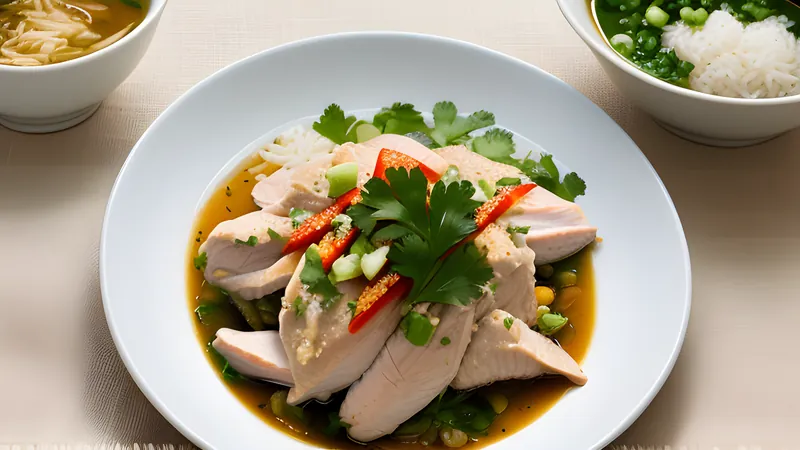
- Carve the chicken into pieces. Serve over the rice with cucumber, coriander and tomato, with the dipping sauce and a cup of the reserved hot broth alongside.
Same idea, different island
Anyone who has made Hainanese chicken rice will recognise the bones of khao man gai immediately — a whole chicken poached gently in aromatics, rice cooked in the chicken’s own fat, a sharp dipping sauce, a cup of the poaching broth on the side. That’s not a coincidence. Both dishes descend from the same Hainanese immigrant cooking that spread across Southeast Asia in the nineteenth and twentieth centuries, adapting to local tastes wherever it landed — Singapore and Malaysia kept closer to the Cantonese-inflected ginger-scallion-and-chilli sauces, while Thailand developed its own direction entirely, built around fermented yellow soybean paste rather than fresh ginger oil as the backbone of the dipping sauce.
Khao man gai translates plainly and functionally: khao (rice), man (fat/oil), gai (chicken) — rice cooked in chicken fat, which tells you exactly what matters about the dish and in what order. It’s ubiquitous street food in Bangkok, sold from carts and shophouse stalls with a chicken hanging in the window, and it’s judged almost entirely on two things: whether the chicken is silky rather than dry, and whether the sauce has the right sour-salty-funky balance to cut through the richness of the rice.
The gentle poach is non-negotiable
A rolling boil is the single fastest way to ruin this dish. Chicken cooked at a hard boil seizes up, turning the breast meat dry and stringy while the skin toughens rather than staying supple — exactly the opposite of the tender, almost custardy texture the dish is built around. The poaching liquid should never do more than tremble, with the occasional lazy bubble rising to the surface, for the full forty minutes. Turning the heat off entirely for the final fifteen minutes and letting residual heat finish the job — the same technique used for Hainanese chicken rice — carries the breast meat gently across the finish line without ever risking overcooking it in the last stretch, when it’s most vulnerable to going dry.
The ice bath immediately after poaching does real work too: it stops the cooking instantly and firms the skin against the flesh, giving you that faintly gelatinous layer just under the skin that separates good poached chicken from chicken that’s merely “cooked through.” Skip the ice bath and the skin stays slightly flabby, without the taut, glossy finish a proper plate demands.
Rice cooked in chicken fat, not chicken stock
The fat skimmed from the surface of the poaching liquid, rather than the broth itself, is what the rice actually fries in before it goes into the cooker — this is the step people skip most often, substituting oil or margarine, and it’s the single biggest reason a home version can taste noticeably flatter than a good Bangkok stall’s. That thin golden layer floating on the poaching pot carries concentrated chicken flavour that plain stock, however good, doesn’t replicate; frying the rinsed rice in it for a couple of minutes with garlic before switching to the poaching liquid to actually cook it means every grain picks up that flavour twice over, once from the fat and again from the cooking liquid.
Garlic fried into the rice at this stage should turn golden, not brown — burnt garlic introduces a bitterness that no amount of good chicken fat will disguise, so keep the heat moderate and pull the pan off if the garlic starts colouring too fast.
The sauce is where the dish lives or dies
Where Hainanese chicken rice serves three separate sauces — ginger-scallion oil, chilli, and a dark soy — khao man gai typically arrives with one unified sauce built around taucheo, fermented yellow soybean paste, whisked with grated ginger, vinegar, sugar, light soy and fresh chilli. The result is funky, sour, sweet and hot all at once, thick enough to cling to a slice of chicken rather than running off it. Taucheo varies significantly in saltiness between brands, so taste the paste on its own before building the full sauce, and adjust the sugar and vinegar accordingly rather than following quantities blindly.
Some Bangkok stalls make a thinner, more vinegar-forward version; others lean sweeter and thicker, closer to a paste than a pourable sauce. Both are legitimate — the only real requirement is that the sauce brings enough acidity and funk to cut cleanly through the richness of fat-cooked rice and poached chicken skin, which otherwise sits fairly heavy on the palate without something sharp alongside it.
Serving it the street-stall way
A proper plate keeps the components distinct rather than mixed together: rice mounded to one side, chicken sliced and fanned over or beside it, a few slices of cucumber and tomato for a cool, watery contrast, a scattering of coriander, and the sauce either drizzled over the chicken or served in its own small dish for dipping slice by slice. A cup of the reserved poaching broth, seasoned lightly and sometimes with a little extra ginger and a few chopped spring onion greens floating in it, comes alongside as a palate-cleansing soup rather than as an ingredient in the main plate itself.
Choosing your chicken
A slightly older, more flavourful bird — anything labelled free-range or corn-fed rather than the fastest-growing supermarket option — makes a genuinely noticeable difference here, since the whole dish depends on the fat and skin carrying real chicken flavour into both the rice and the broth. A very young, bland bird will still produce a technically correct plate, but the rice in particular will taste thinner without a well-flavoured fat to fry it in.
Make-ahead and storage
The chicken keeps well, whole or sliced, refrigerated for up to three days — keep it in a little of the poaching liquid to stop the meat drying out in the fridge. The rice reheats best with a splash of extra poaching liquid or water stirred through before microwaving, since it dries out otherwise. The sauce actually improves after a day, as the ginger and chilli mellow slightly into the paste; make it a day ahead if you’re organising the meal in advance. Freeze the poaching broth on its own in an airtight container for up to two months — it’s a genuinely useful base for future rice or soup, well beyond just this one dish.
For more of this same Hainanese-derived family of poached chicken and fat-cooked rice, hainanese chicken rice is the closest relative, built on the same technique but with a completely different sauce logic. If you want to round out a Thai meal around this dish, tom yum goong or khao soi both make good companions on the same table.
Why Bangkok’s version leans on soybean paste rather than ginger oil
The shift from a ginger-forward sauce to a fermented soybean base says something about how Thai cooking absorbs outside influence generally — rather than reproducing the Hainanese original closely, Thai cooks pulled the dish toward flavours already central to their own pantry. Taucheo shows up across central Thai cooking in stir-fries and braises, and folding it into the khao man gai sauce meant the dish could sit comfortably next to other Thai dishes on a street-food cart without tasting like an import. Ginger hasn’t disappeared from the dish entirely — it’s still in the poaching liquid and grated fresh into the sauce — but it’s no longer the dominant note the way it is in the Singaporean and Malaysian ginger-scallion oil, demoted to a supporting flavour behind the funkier, more fermented taucheo.
This kind of quiet substitution, swapping one region’s defining condiment for another while keeping the overall dish structure intact, is common wherever Hainanese chicken rice travelled. It’s worth tasting a few versions side by side if you get the chance — the Singaporean, Malaysian and Thai sauces are different enough that comparing them directly makes clear how much a single sauce can redirect an entire dish’s character while the chicken and rice stay almost identical.
A note on the broth
The reserved poaching broth deserves more attention than most recipes give it, since it’s easy to treat as an afterthought rather than a proper component of the meal. Strain it well after removing the chicken and aromatics, season it lightly with salt and a touch of white pepper, and taste before serving — a broth that tastes watery usually just needs a longer initial simmer with the bones and aromatics rather than more seasoning added at the last minute. Some stalls finish the broth with a few slivers of daikon radish simmered in during the last twenty minutes of the chicken’s poaching time, which adds a mild sweetness and a bit of substance to what’s otherwise a very clean, simple soup.
Common mistakes worth avoiding
Overcooking the chicken by boiling rather than poaching is the single biggest failure point, covered above, but a close second is rinsing the rice too aggressively before frying it in the chicken fat. A light rinse to remove surface starch dust is fine, but rice rinsed until the water runs completely clear has lost some of the surface starch that helps it turn glossy and slightly sticky once cooked in fat and broth — jasmine rice doesn’t need the same thorough rinsing that other varieties sometimes call for. A third common issue is a sauce that tastes purely salty rather than balanced, usually because the taucheo used was a particularly salty brand and the recipe’s sugar and vinegar quantities weren’t adjusted to match — always taste the raw paste first and scale the other seasonings to it rather than trusting fixed quantities across different brands.
Scaling for a larger table
Doubling the chicken and rice quantities works cleanly, but the poaching liquid needs proportionally less increase than you’d expect — two chickens poached together displace more water than one, so start with roughly 3.5 litres rather than a straight doubling to 5, and top up if the birds aren’t fully submerged once they’re in the pot. The sauce, by contrast, scales exactly linearly and is worth making in a slightly larger batch regardless, since good khao man gai sauce keeps well and disappears fast once people realise how good it is spooned over plain rice on its own, days after the chicken itself is gone.
Related Content